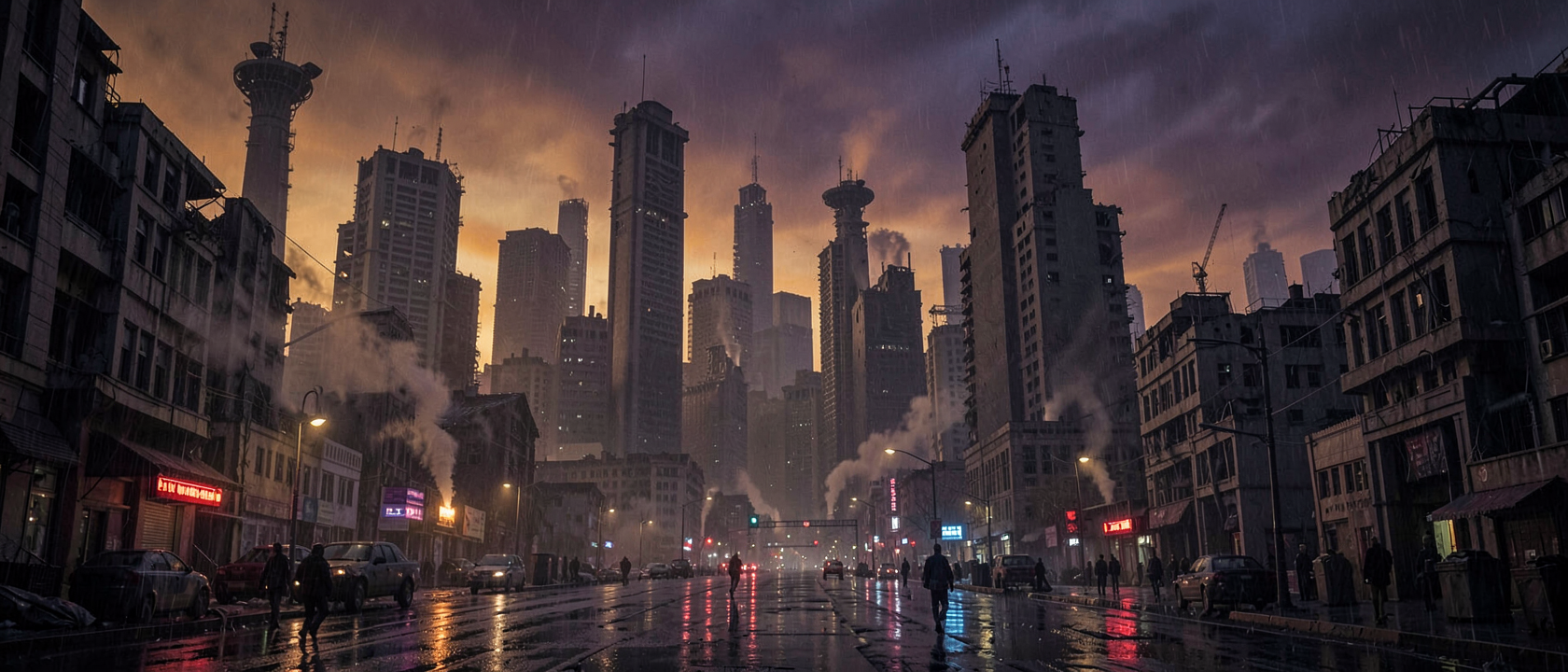
A Crowd Picks Its Nightmare
On September 28, 2007, a Neatorama writer named Alex wrote up a ranking making the rounds online: the fifty greatest dystopian movies ever made, compiled by a blog called Snarkerati. The method was simple: take a film’s Rotten Tomatoes score and its IMDB rating, and average the two into a single number out of 10.
The film on top was Metropolis, the 1927 silent classic, with a combined score of 8.6 out of 10 (97% Rotten Tomatoes, 8.3 average on IMDB). A Clockwork Orange (1971) took second. Third went to Terry Gilliam’s Brazil (1985), a film about paperwork, heating ducts, and a man arrested over a bureaucratic mix-up while trying to fix a simple repair. The Matrix and Blade Runner both placed lower on the same list.
Yet when Neatorama wrote up the list, the image chosen to represent all fifty films wasn’t the winner, it was Brazil, sitting at number three. Alex even admitted the film’s theme song gets stuck in their head whenever the movie comes up. An 80-year-old silent film technically topped the chart, yet a 1980s satire about red tape became the one people remember.
What Even Makes a Movie “Dystopian”?
Say “dystopian” out loud and a dozen different movies come to mind: zombie outbreaks, alien invasions, robot uprisings, hackers in trench coats. The word works as shorthand for “dark future,” loose enough to cover almost anything grim. But a bureaucratic satire about heating repairs and a zombie outbreak don’t obviously belong in the same box.
Most people have never needed a stricter definition. The gap only becomes a problem once a list like Snarkerati’s forces the question: fifty films, different decades, different tones, all filed under one label. Something specific has to hold them together.
Dystopia Is Utopia Turned Inside Out
The connecting idea is more precise than “bleak.” A dystopia is defined as the inverse of a utopia: an idealized society with no hunger, no conflict, no inequality, where politics and technology maximize individual freedom. A dystopia runs that blueprint backward, poverty replaces abundance, domination by a narrow few replaces shared power.
The ingredients stay the same; only the direction changes. A utopia promises technology that frees people from labor, scarcity, and danger. A dystopia shows that same promise used to monitor people instead, to sort them, or to replace them.
Same Nightmare, Different Costume
That inversion explains why such different films land on one list. The genre’s definition names three recurring engines: dehumanizing technology, man-made disaster, and class systems rigid enough to spark revolt. In Brazil, the oppressive technology isn’t a robot or a weapon, it’s paperwork: a labyrinth of forms and ducts and departments so tangled that one heating error gets an innocent man mistaken for an enemy of the state. That’s bureaucracy weaponized into control, the same inversion a surveillance thriller runs with cameras instead of forms.
Look at the range the same ranking covers: Metropolis (1927) sits beside The Matrix (1999), a 72-year gap, alongside A Clockwork Orange (1971) and Blade Runner (1982), four decades, four films that don’t look related at a glance. Under the definition, they are: each takes something a utopia would promise, order, safety, progress, and shows it turned against the people living inside it.
A Ranking Is a Mirror, Not a Formula
The Snarkerati list was two rating platforms, averaged, at one moment in 2007, no panel of film scholars built it, no peer-reviewed survey backs it up, just Rotten Tomatoes and IMDB numbers combined into a sortable score. That’s a reasonable way to build a list, not an objective verdict on which films best capture dystopia; more a snapshot of what two popular audiences rated highly at that moment.
People noticed the seams fast. A discussion thread on October 8, 2007, picked the list apart, with commenters questioning whether entries like Minority Report, Ghost in the Shell, and Gattaca truly counted as dystopian at all. That disagreement is the point: a ranking built from audience ratings shows what resonated with raters in a given year, not where the genre’s borders objectively sit.
Why We Keep Returning to Broken Paradises
Nearly two decades after that list went up, dystopian fiction still pulls at audiences. Every fresh round of anxiety about surveillance, automation, or concentrated power sends people back toward stories where exactly those things already went wrong on screen. The appeal isn’t despair for its own sake, it’s recognition.
Once the inversion clicks, it’s hard to unsee. Every dystopian film is quietly in conversation with a utopia it never shows. The next time a movie opens on a gleaming skyline or a technology that promises to fix everything, the real question is which promise it’s about to break, and what that broken promise says about the fear the writer started with.