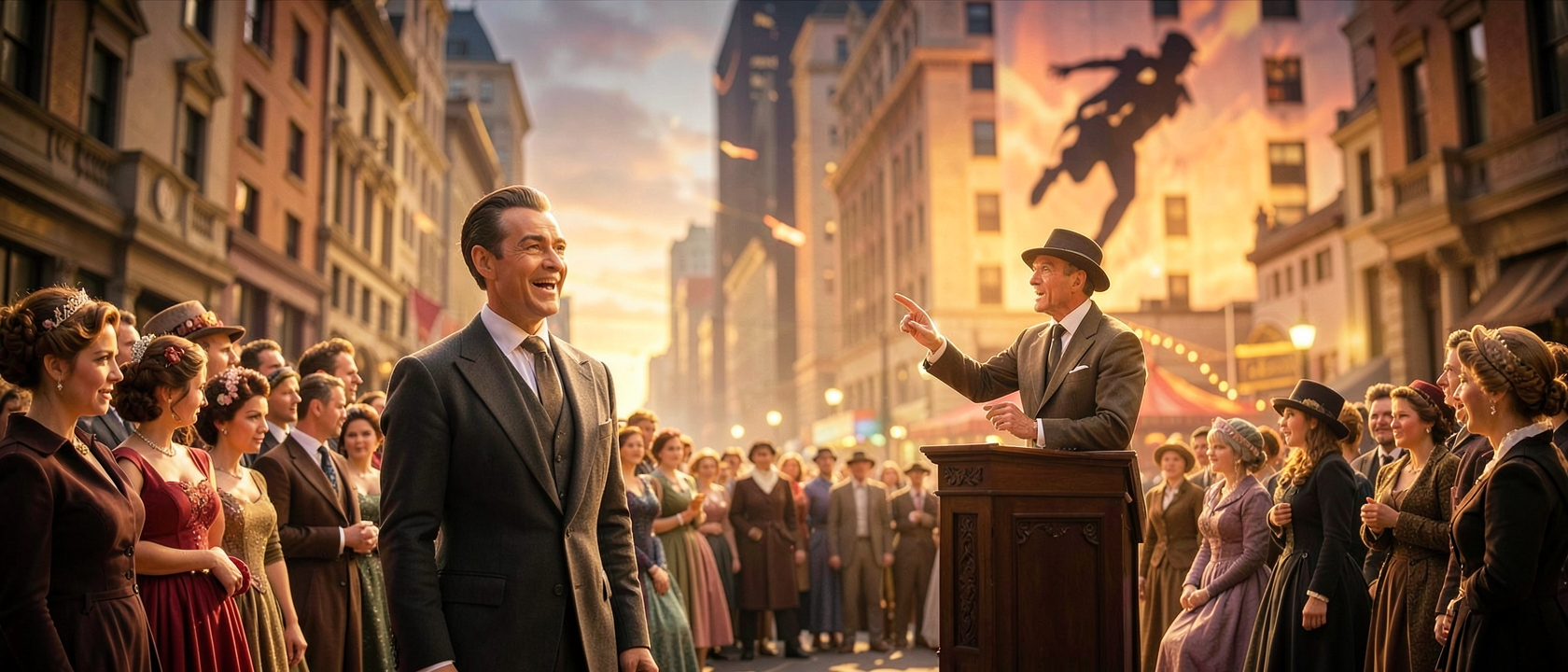
Franklin Kills a Man Who Isn’t Dead
On October 17, 1733, Benjamin Franklin predicted that his rival, almanac publisher Titan Leeds, would die that day. Franklin had launched Poor Richard’s Almanack in 1732 and needed an edge over competitors like Leeds. The date passed. Leeds was alive, furious, and said so in print.
Franklin doubled down, running Leeds’s obituary anyway and insisting the real Leeds was dead while an impostor used his name. The feud ran in both almanacs for years. When Leeds actually died in 1738, Franklin publicly thanked the “impostors” for finally ending the charade.
Why Does Fighting Sell Better Than Flattery?
Franklin could have simply claimed his almanac was better written. Instead he picked a public fight with a man who wasn’t in on the joke. Fame rarely goes to the most talented person or the best pitch, it goes to whoever gets talked about. Approval doesn’t spread on its own; attention does. A strange cast of characters across three centuries figured that out, each on their own.
The Mechanism Behind the Madness
A plain pitch gets ignored, but a charged, slightly absurd story gets repeated. Nobody forwards “buy my almanac.” People forward “this man insists his dead rival is secretly alive and lying.” One is an ad; the other is gossip, and gossip spreads itself for free.
Franklin borrowed the trick from a prank Jonathan Swift played on an astrologer in 1708. Decades later, Edward Bernays dressed up a product launch as a social cause. The Dalís relied on spectacle. Marilyn Monroe’s camp turned scandal into sympathy. Richard Branson risked his own body. Five different costumes, one engine underneath.
Smoking on Fifth Avenue: Bernays Invents the Modern PR Stunt
On Easter Sunday, March 31, 1929, a group of young women, accounts range from ten to thirty, lit cigarettes and walked down Fifth Avenue in a staged protest against the taboo on women smoking in public. The New York Times ran the headline “Group of Girls Puff at Cigarettes as a Gesture of ‘Freedom'” the next morning.
Unknown to readers, the American Tobacco Company had hired the march’s organizer, Edward Bernays, nephew of Sigmund Freud, to normalize female smoking. A psychoanalyst he consulted suggested framing cigarettes as “torches of freedom.” Women’s share of cigarettes consumed rose from 5% in 1923 to 12% by 1929, though later researchers found press coverage was less uniformly celebratory than the legend suggests.
12,000 Shoes and a Startled Toad: The Dalís Arrive in America
By 1941, Salvador and Gala Dalí were well known in Europe and barely known in America. Their introduction wasn’t a gallery show, it was a party. At the Hotel Del Monte near Pebble Beach, California, they staged “A Night in a Surrealist Forest,” officially a fundraiser for artists displaced by the war, though bills reportedly ran so high nothing was left over. By one widely repeated account, decor included 12,000 shoes, 2,000 pine trees, two dozen animal heads, and a wrecked car. Bob Hope, dressed like the other guests, had a toad leap from his covered dish mid-dinner.
Monroe’s Nude Calendar: Turning Scandal Into Sympathy
By 1952, Marilyn Monroe had made 15 films, yet most of the country still couldn’t place her name. Wire service reporter Aline Mosby traced a set of nude calendar photos back to her. Her studio, 20th Century Fox, told her to deny it. She didn’t.
In March 1952, Monroe confirmed the photos were hers, saying she had posed because she needed rent money. The honesty made her sympathetic instead of disgraced. A month later she was on the cover of Life magazine, and her film Clash by Night became a hit. Biographers now suspect the leak itself may have been arranged, possibly by producer Jerry Wald, possibly by Monroe herself, neither theory confirmed.
The Billionaire in a Wedding Dress
Richard Branson launched the Virgin brand in 1972 and has spent decades proving a billionaire in costume beats a press release. To promote Virgin Brides, he wore a $10,000 wedding dress with blue eye shadow, red lipstick, and pearl earrings. For Virgin’s first flights to South Africa, he dressed as a Zulu warrior.
At 57, in 2007, launching Virgin America’s San Francisco to Las Vegas route, he bungee jumped 407 feet off the Palms Casino Resort, slammed into the building, tore his pants, and cut his arm and leg. Journalists don’t cover a memo. They cover a man falling off a casino.
Why This Still Works on You
Line it up: a fake death notice in 1733, a staged protest in 1929, a surrealist party in 1941, a confirmed scandal in 1952, a billionaire off a casino ledge in 2007. Different costumes, same move: make people feel something strong enough that they can’t help repeating it.
Once you see the pattern, you notice it everywhere, in the celebrity feud timed suspiciously well to an album drop, in the brand that turns “controversial” right before a launch. None of it is new. It’s Franklin’s almanac with better lighting. You now know what Titan Leeds never figured out: you weren’t supposed to argue with the hoax. You were supposed to talk about it.