The Invisible Highway
On the night of September 7, 1940, German bombers found London with a precision that defied explanation. The city was blacked out, every window covered, every street lamp off, the Thames itself a dark ribbon below. Yet the bombs fell on specific targets, not scattered across the countryside. That accuracy was no accident.
A Puzzle Written in Radio Waves
Mid-century aerial navigation was essentially dead reckoning: estimate your position from compass heading, airspeed, and elapsed time, then correct by spotting landmarks below. The North Sea offers none of those. Flying from occupied Europe to England at night, a few degrees of drift could mean missing a target by miles. The precision of those early Blitz raids presented British intelligence with a genuine problem. The Luftwaffe was not guessing its way to London.
Crooked Leg
The answer was a system called Knickebein, German for “crooked leg,” referring to the bent shape of the transmitting antenna. The technology came from a perfectly ordinary piece of civilian aviation equipment.
In 1932, Dr. Ernst Kramar of C. Lorenz AG developed the Lorenz Blind Landing System, first installed at Berlin-Tempelhof airport and adopted by Lufthansa in 1934. Two overlapping radio beams aimed along a runway’s centerline transmitted Morse dots on one side and dashes on the other. In the narrow overlap zone, the signals merged into a single continuous tone, a pilot tracking that steady tone was perfectly aligned with the runway.
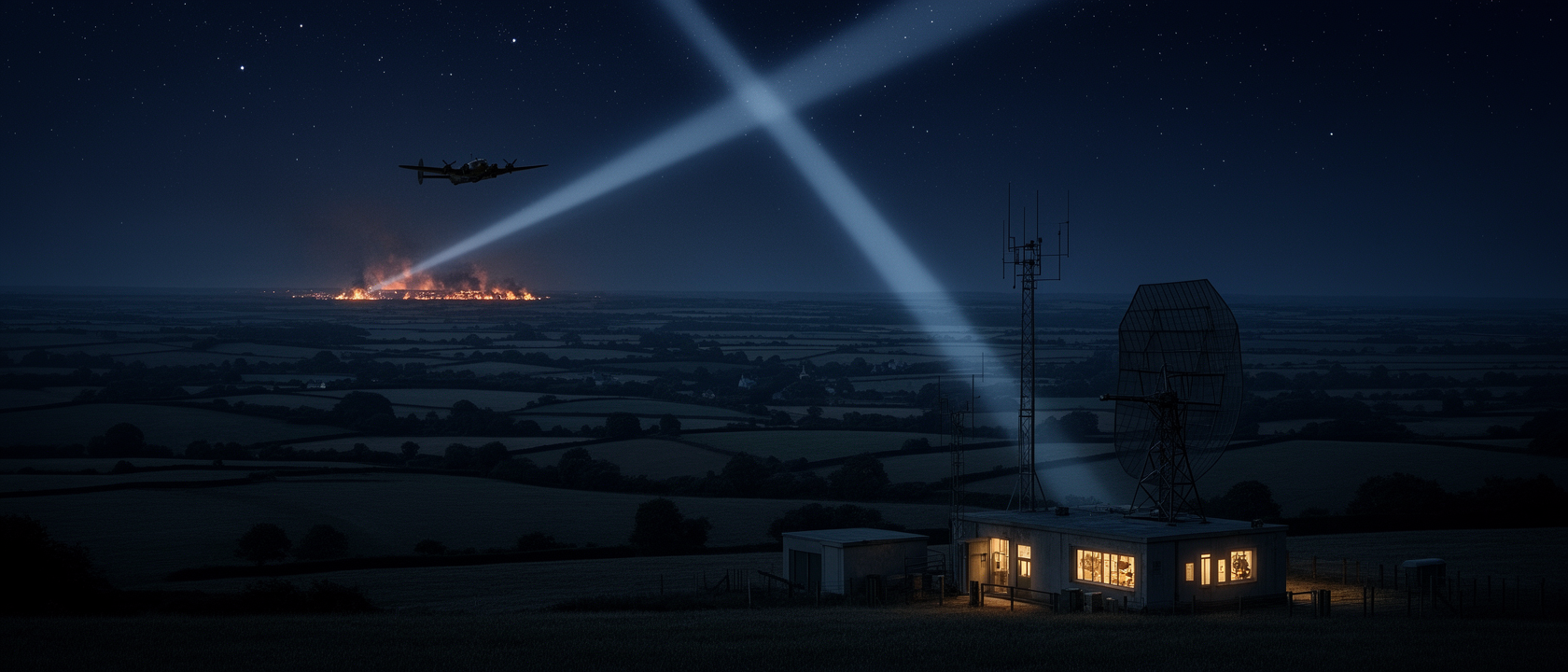
Physicist Johannes Plendl scaled this civilian aid into Knickebein. A ground transmitter in Kleve, Germany, sent a modified Lorenz-type beam across the North Sea at roughly 30 MHz. A bomber following that equisignal was locked onto a precise track hundreds of miles long, narrowing to about one mile wide over London. A second beam on a different frequency crossed the first at the intended target; when the navigator’s receiver caught that crossing, the bombs were released. The crew never needed to see the ground.
Three Clues, One System
British intelligence assembled their picture of Knickebein from three fragments. The first arrived on November 4, 1939: an anonymous package at the British Embassy in Oslo, sent by Hans Ferdinand Mayer, a physicist at Siemens. His seven-page document, typed at the Hotel Bristol on November 1 and 2, 1939, and later called the Oslo Report, catalogued secret German weapons programs, including a radio guidance system for bombers. British intelligence was initially skeptical; the report seemed too comprehensive to be credible.
The second piece came in March 1940, when investigators examined radio equipment from crashed Heinkel He-111 bombers of Luftwaffe unit KG26. Among standard gear was a Lorenz Blind Landing Set (the EBL2) far more sensitive than any approach aid required, someone had modified it for long-range use.
The third piece arrived on June 5, 1940, when a decrypted intercept read: “Knickebein, Kleve is established at a point 53°24′ North and 1° West.” The coordinates placed the beam squarely over central England.
The Physicist Who Bent the Beams
R.V. Jones, a physicist who had studied at Oxford under Frederick Lindemann, Churchill’s personal scientific advisor, pulled these threads together at the Air Ministry. On June 21, 1940, Churchill ordered an RAF aircraft to search for the signal. The crew found it exactly where Jones had predicted.
That confirmation was the key, because the countermeasure depended entirely on knowing the frequency. British engineers built transmitters that interfered with the Knickebein signal, bending the beam sideways without German crews realizing it. A bomber following its steady tone would believe it was on course; its bombs fell over open countryside. Conversations recorded via hidden microphones at the Cockfosters Cage, a bugged prisoner interrogation centre in North London, filled in further operational details.
The campaign ran from mid-1940 until May 1941, when the Luftwaffe shifted forces east for the invasion of the Soviet Union. During those months, what had been a precision weapon became a liability. Mayer, who first alerted the British to the beam system, was arrested by the Gestapo in 1943 for listening to British broadcasts and criticising Nazi rule. He survived Dachau and other camps. The Gestapo never learned he had written the Oslo Report; Jones kept Mayer’s identity secret until 1989, nine years after Mayer’s death.