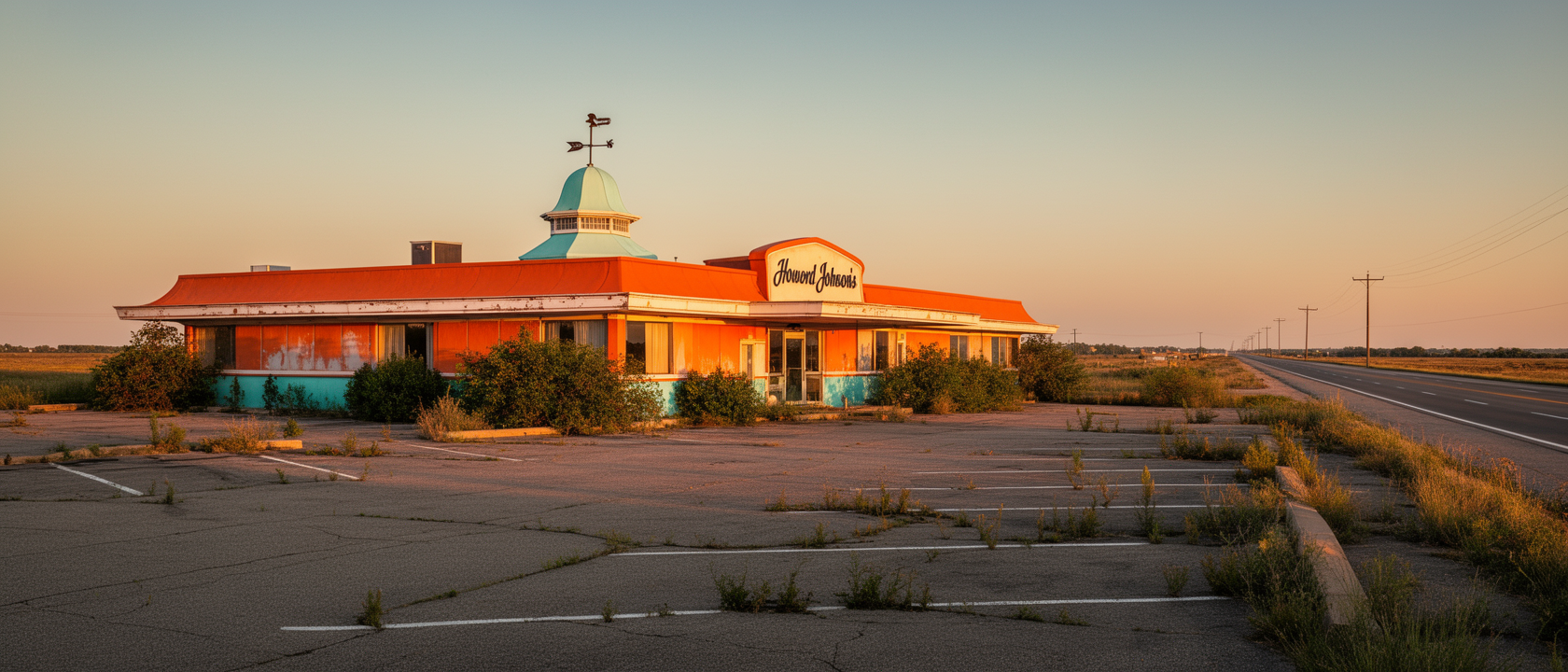
The Chain That Fed America
By 1965, one restaurant chain was outselling McDonald’s, Burger King, and Kentucky Fried Chicken combined, not outperforming each one separately, but all three added together. Ask anyone born after 1990 to name it, and the answer is usually a blank stare.
The chain was Howard Johnson’s. At its peak it operated over 1,000 restaurants and more than 500 motor lodges across the United States. Measured by meals served to civilians, it ranked second in the entire country, behind only the U.S. military. That is not loose rhetoric; it is one of the stranger facts in American commercial history to have quietly slipped from public memory.
A $2,000 Start
Howard Deering Johnson was born in Boston on February 2, 1897, and grew up in Wollaston, Quincy, Massachusetts. He left school around eighth grade to work in his father’s cigar business. When his father died and the debts landed on him, he came up short.
In 1925, he scraped together $2,000, $500 borrowed from his mother, the rest from a doctor friend, and bought a small drugstore, newsstand, and soda fountain on Beale Street in Wollaston. The ice cream changed things. Johnson developed his own recipe with roughly double the butterfat of standard ice cream, producing something noticeably richer. Where the original recipe came from is disputed: one account credits a German pushcart vendor he paid $300; others point to his own experiments or his mother’s kitchen. He started with three flavors and by 1928 had expanded to 28, the number that became the brand’s calling card.
How You Clone a Restaurant
A second Wollaston store opened in 1927, beach stands followed along the Massachusetts coastline, and a full-service restaurant arrived in Quincy in 1929. Johnson’s solution to reliable replication was architecture, documentation, and centralized food production.
Every Howard Johnson’s wore the same bright orange roof and blue cupola with a weathervane, the design was readable by a driver before they could make out any lettering. Every recipe, uniform, and table setting was governed by a comprehensive operations manual his staff called the Howard Johnson’s Bible. Central commissaries prepared food to precise recipes, froze it, and distributed it weekly. A cook at any outpost didn’t need to make the clam chowder from scratch, only reheat it correctly. Consistency was engineered in.
The Depression as an Accelerant
The stock market crashed in October 1929, taking Johnson’s ability to self-finance with it. So he let other people build. In what most accounts date to 1932, though some place it as 1935, he struck a deal with Reginald Sprague, whose family owned land in Orleans, Massachusetts: Sprague funded construction; Johnson supplied the brand, recipes, and supply chain. That first summer, the Orleans location reportedly served around 700 meals a day.
The model spread fast. By 1936 the network had 41 locations; by 1939, 107 restaurants along the East Coast generating $10.5 million in annual revenue. Financial crisis had pushed Johnson into the exact structure that let him scale far faster than self-financing ever would have.
Dior Uniforms and a Chef Who Said No
Johnson wanted the chain to feel elevated. Uniforms were designed by Christian Dior. In 1961, he hired Pierre Franey, a New York Times food columnist who had come to Johnson’s from Le Pavillon, and Jacques Pépin, who had just turned down an offer to serve as chef to President John F. Kennedy in order to become Howard Johnson’s director of research and development. Pépin stayed roughly ten years.
One Thing Johnson Did Not Invent
Johnson was pivotal in bringing franchising to the restaurant industry, later operators, including Dunkin’ Donuts founder William Rosenberg, acknowledged learning from his example, but he did not invent the practice. Ben Franklin operated a franchise printing arrangement as early as 1731, and Martha Harper built a franchised salon network starting in 1891.
What Johnson demonstrated was that the model could work for food: that you could ship a consistent product to hundreds of kitchens, hold them all to a single standard, and have customers trust the result wherever they stopped. That application, at that scale, was his contribution, substantial enough that the last Howard Johnson’s restaurant, in Lake George, New York, did not close until 2022, nearly a century after a man with $2,000 and a newsstand first decided to sell ice cream.