The Face Behind the Finger
If you’ve seen the “I WANT YOU” poster, you already have a face memorized: that stern, white-haired man with the direct stare and the extended finger. What almost no one knows is whose face it actually is.
It belongs to the illustrator himself. James Montgomery Flagg created the image for the July 6, 1916 cover of Leslie’s Weekly, and when he needed a model for Uncle Sam, he used a mirror. A neighbor named Walter Botts posed for the shoulders and pointing finger, but the face is a self-portrait. More than 4 million copies were printed between 1917 and 1918 alone, making Flagg’s own likeness one of the most reproduced images in American history. For the composition, Flagg borrowed from a 1914 British recruitment poster by Alfred Leete, featuring Lord Kitchener in a nearly identical pose.
The Story Everyone Believes
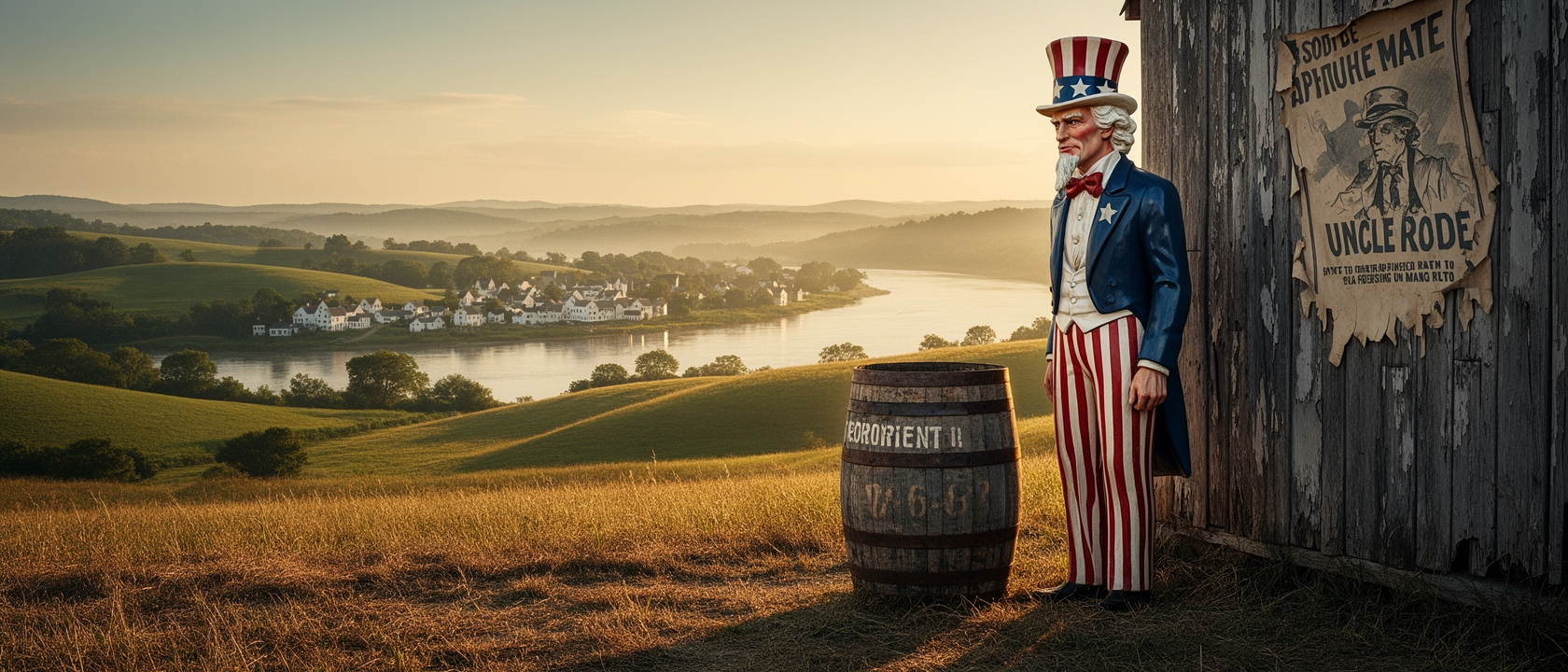
Ask someone who Uncle Sam was based on and you’ll likely hear about Samuel Wilson: a meat packer from Troy, New York, born September 13, 1766. During the War of 1812, Wilson’s company supplied the U.S. Army with barrels stamped “E.A. U.S.” A worker, so the story goes, joked that “U.S.” must stand for “Uncle Sam,” Wilson’s local nickname. Soldiers picked it up, and an accidental pun became a national identity.
The Date That Breaks the Legend
The Wilson barrel incident allegedly took place in October 1812, but the timeline doesn’t hold up. Researchers at the USS Constitution Museum in Charlestown, Massachusetts found a diary entry by Navy midshipman Isaac Mayo dated March 24, 1810, using “Uncle Sam” to mean the United States government. That is more than two years before Wilson’s contract existed. The barrel story didn’t appear in print until 1830, roughly 18 years after it supposedly happened. Wilson lived until 1854 and left no known written confirmation of the tale. The evidence suggests he may have helped the nickname circulate in Army circles, but he did not coin it.
Who Came Before
Uncle Sam didn’t step into a vacuum. The earliest American allegorical figure was an “Indian Queen,” eventually replaced by Columbia, a classically dressed woman in a toga and Phrygian cap who served as a primary national symbol for roughly a century. Her role eroded after 1924, when her image became attached to the Columbia Pictures logo.
Before Uncle Sam claimed the male role, there was Brother Jonathan: a lean New England Yankee in striped pants and a top hat. By the mid-19th century he had acquired political baggage, becoming associated with the nativist Know-Nothing Party and an unmistakably Northern identity, a serious problem after 1865.
After the War
When the Civil War ended, the federal government faced a real image problem: how to project a unified national identity to a country that had just spent four years at war with itself. Brother Jonathan was a Northern figure, and putting him forward as the face of reunion would have been a daily reminder of the divide. A more neutral “uncle” figure, with no clear regional roots, served the political moment in a way Brother Jonathan couldn’t.
The Look Takes Shape
Early depictions gave Uncle Sam a stocky, colonial look, far removed from the lean figure that emerged in the 1860s. During that decade the character grew leaner and acquired a beard. Cartoonist Thomas Nast, often mistakenly credited with creating the character, he popularized a figure that already existed, helped cement the look during his years at Harper’s Weekly. The hollow-cheeked, bearded patriarch readers recognize was shaped heavily by the image of Abraham Lincoln.
Congress Makes It Official
On September 15, 1961, the 87th U.S. Congress passed a resolution formally recognizing Samuel Wilson of Troy, New York as the progenitor of the Uncle Sam symbol. In 1989, Congress designated September 13 as “Uncle Sam Day” in his honor. Neither act engaged with the 1810 diary entry, or with the fact that the barrel story didn’t surface in print until nearly two decades after the event it describes.
Wilson may well have helped spread the nickname through Army camps. But the face on the poster is James Montgomery Flagg, one of the most recognized faces in America, belonging to a man most viewers never learned to name.