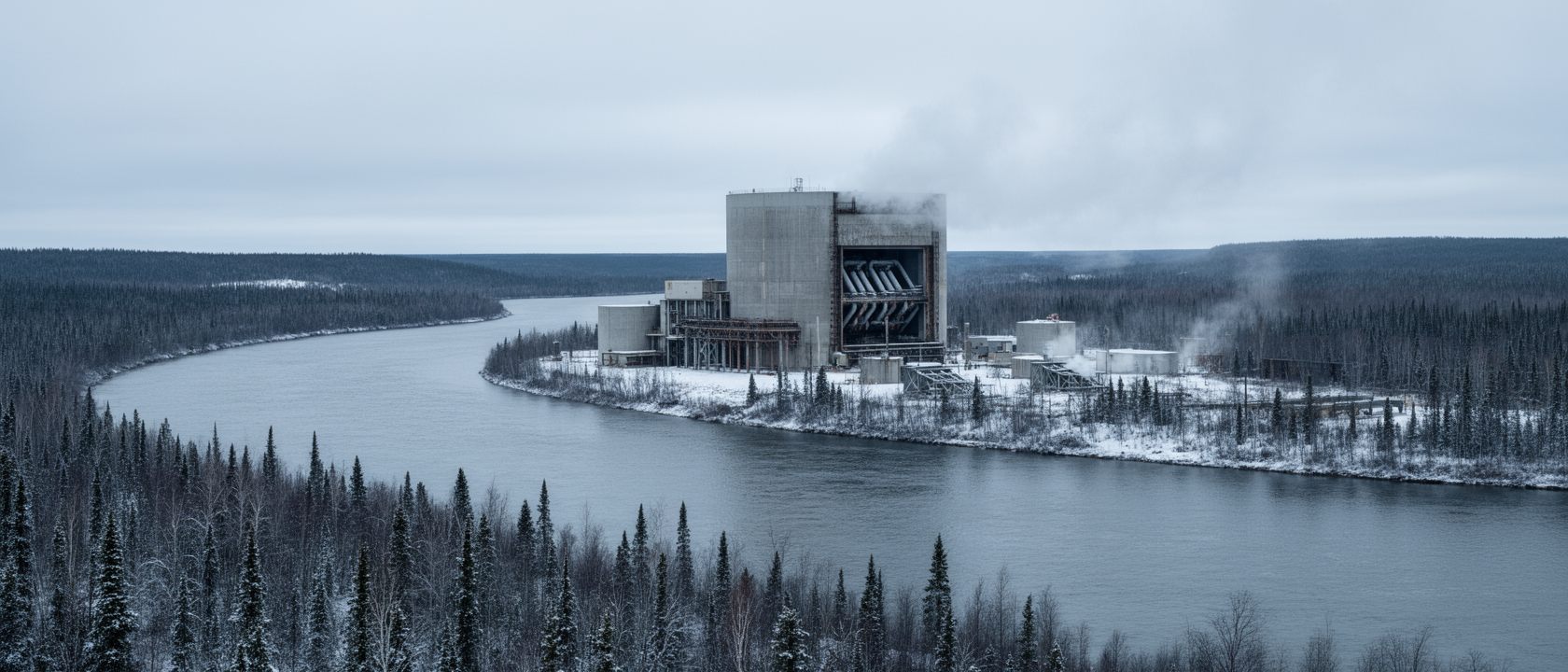
Built on What Canada Didn’t Have
Most engineering breakthroughs come from having more: more money, more resources, more industrial muscle. The CANDU reactor came from having less. Canada in the late 1940s lacked two things every other nuclear program took for granted, and the engineers at Atomic Energy of Canada Limited (AECL) arrived at something genuinely different by working around them both.
Two Dead Ends
The first problem was uranium. Every major reactor design of the era ran on enriched uranium, requiring enormous, expensive industrial facilities Canada didn’t have. The second problem was steel. American and Soviet designs used a single massive pressure vessel strong enough to hold water under extreme heat and pressure, fabricating it demands specialized foundries Canada also lacked. These weren’t minor inconveniences. They were walls. So AECL’s engineers went around them.
The Key Was in the Water
To run a reactor on natural, unenriched uranium, you need a moderator that barely interacts with neutrons. Ordinary water absorbs too many to sustain a chain reaction without enriched fuel. The solution was heavy water (deuterium oxide, D₂O), chemically almost identical to the kind you drink, but with an extra neutron in each hydrogen nucleus. That subtle difference makes it far less “grabby” with neutrons, so the chain reaction sustains itself without enrichment. Heavy water also served as the coolant, one fluid doing two jobs.
The Calandria: Geometry Over Brute Force
Instead of one colossal pressure vessel, AECL designed the calandria: a large horizontal cylindrical tank, left unpressurized, filled with cool heavy-water moderator. Running through it were hundreds of individual Zircaloy pressure tubes, a zirconium alloy nearly transparent to neutrons, carrying fuel and high-pressure coolant. Carbon dioxide gas in the gap between each pressure tube and its outer calandria tube prevented heat from bleeding into the moderator. No giant vessel, no specialized foundry: a carefully arranged geometry of smaller, manufacturable parts.
A Reactor That Never Needs to Stop
The tube-based layout had a decisive bonus. Because each fuel bundle sat in its own pressure tube, a robotic fueling machine could push a fresh bundle in one end and a spent one out the other while the reactor ran at full power. Every other major design of the era required a full shutdown for refueling. The CANDU refueled continuously, an operational advantage that traced directly back to the “limitation” that forced the tube design in the first place.
The Road Through Chalk River
The CANDU didn’t arrive fully formed. Canada’s first reactor, ZEEP, reached criticality on September 5, 1945, at Chalk River Laboratories in Ontario, the first reactor to run outside the United States. The NRX reactor followed in 1947, heavy-water moderated and fueled with natural uranium, a direct ancestor of CANDU. On December 12, 1952, NRX suffered a partial meltdown; among those brought in for cleanup was U.S. Navy Lieutenant James Earl Carter, later the 39th President. The hard lessons fed directly into the final design’s safety protocols. AECL was formally established that same year, and the NPD prototype near Rolphton, Ontario, reached first criticality on April 11, 1962.
Why It Stayed a Niche
As of 2026, 26 CANDU reactors operate worldwide: 17 in Canada, 3 in South Korea, 2 in Romania, 2 in China, 1 in India, and 1 in Argentina. India built 17 additional reactors derived from the concept. But the enriched-fuel industry had decades of industrial and political momentum, and heavy water production costs raised the barrier for new buyers.
None of that changes the engineering record. CANDU reactors have generated electricity since the 1960s without enriched fuel and without refueling shutdowns. As a side effect of their geometry, they also produce most of the world’s cobalt-60, the isotope used in cancer radiation therapy and industrial sterilization. That last part wasn’t the goal. It just came along with the design.