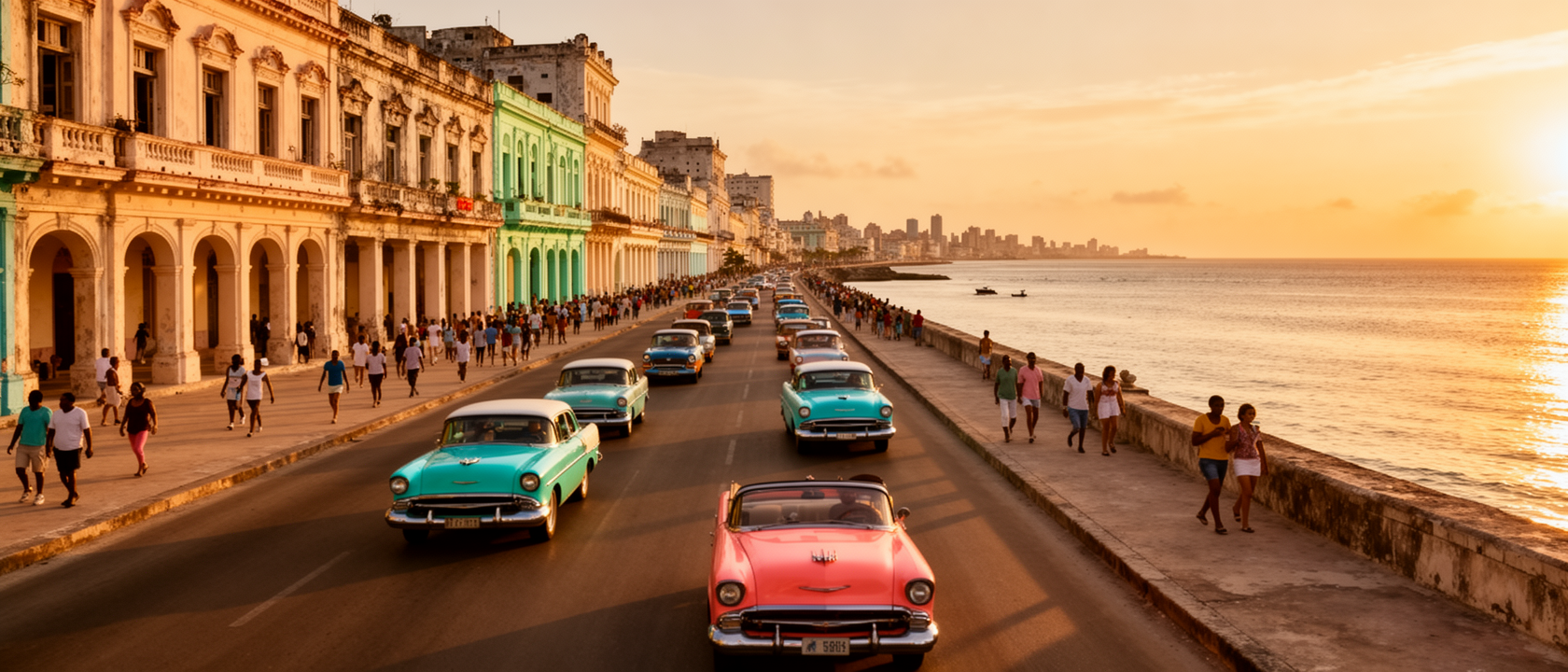
The Musician Earning More Than the Doctor
A Cuban hospital doctor finishing a twelve-hour shift takes home a state salary in Cuban pesos, enough for rent and staples from the state store, and not much beyond that. A few blocks away, a guitarist wraps up a set at a tourist bar, pockets $200 in tips, and heads home with roughly ten times what the doctor made in a month. This was not some quirk of the black market. For several decades it was a structural feature of Cuban life, built deliberately by the same government that once banned tourism to protect ordinary Cubans from exactly this kind of inequality.
The Country That Outlawed Its Own Tourism Industry
Before Fidel Castro’s forces took power on January 1, 1959, Havana and Las Vegas were direct rivals for the gambling capital title. More than 15 luxury casinos operated in Havana, and over 350,000 visitors arrived in 1957 alone. Castro shut it all down. In his framing, mass tourism was wealthy foreigners using a poor country as a playground. By 1961, American tourist arrivals had collapsed from hundreds of thousands to around 4,000.
The ideology held for three decades, sustained by Soviet subsidies averaging roughly $4.3 billion per year. Then the Soviet Union dissolved in 1991. Cuba had derived about 80% of its foreign trade from that relationship, and GDP shrank somewhere between 33 and 40 percent between 1990 and 1993. Cubans called the crisis the Special Period in Time of Peace.
Spending $3.5 Billion to Rebuild What You Demolished
Faced with collapse, the Cuban government made a reversal that would have been politically unthinkable a decade earlier. Between 1990 and 1999, the state invested more than $3.5 billion rebuilding the tourism infrastructure it had dismantled. Hotel rooms available to international tourists grew from roughly 12,000 to over 35,000, sixty new hotels in less than ten years, giving Cuba the second-largest hotel capacity in the Caribbean. By 1995, tourism had overtaken sugar as the island’s largest source of revenue, with about 2 million visitors a year arriving on an island that had spent a generation insisting tourism was exploitation.
Two Economies on One Island
The government solved the ideological problem with a physical and financial partition. Tourist zones were off-limits to ordinary Cubans except as staff. Researchers have called this arrangement “tourist apartheid,” though at least one peer-reviewed study questions whether that label is fully precise.
The financial partition was a dual currency system, formalized in 1994. Ordinary Cubans used the Cuban Peso (CUP) for state salaries and basic goods. Tourists used the Cuban Convertible Peso (CUC), pegged one-to-one with the US dollar, worth 25 Cuban pesos. The same island ran two economic realities at once.
That division explains the guitarist’s situation entirely. State salaries, paid to doctors, engineers, and teachers, came in CUP. Tips from tourists arrived in CUC or hard currency. A service worker taking in $200 in monthly tips was pulling in the equivalent of what many government employees earned across most of a year. Walking away from medicine for hotel work was rational: the numbers made no argument for staying.
Small Cracks in the Framework
When Raúl Castro formally assumed the presidency in February 2008, modest changes followed. Cubans gained the legal right to purchase cell phones, stay in hotels previously reserved for foreigners, and the state began leasing unused land directly to farmers and issuing licenses for small private businesses, eventually reaching hundreds of thousands of enterprises. None of this dismantled the underlying structure, but it introduced spaces where private enterprise could operate.
Money From Across the Water
On April 13, 2009, President Obama lifted all restrictions on Cuban-Americans visiting relatives in Cuba and sending money home. In January 2011, the administration went further, allowing any American, not just those with family ties, to send remittances to individuals in Cuba, and expanding categories of authorized educational travel. An estimated 20,000 to 60,000 Americans also visited each year by traveling via Canada or Mexico, though those figures are unverified estimates.
On January 1, 2021, Cuba formally abolished the dual currency system. But for roughly three decades, the country that dismantled Havana’s casinos to end capitalist exploitation had run a two-tier economy, one in which a musician with a tip jar could out-earn a doctor several times over, not because of talent or luck, but because of which currency landed in their pocket at the end of the night.