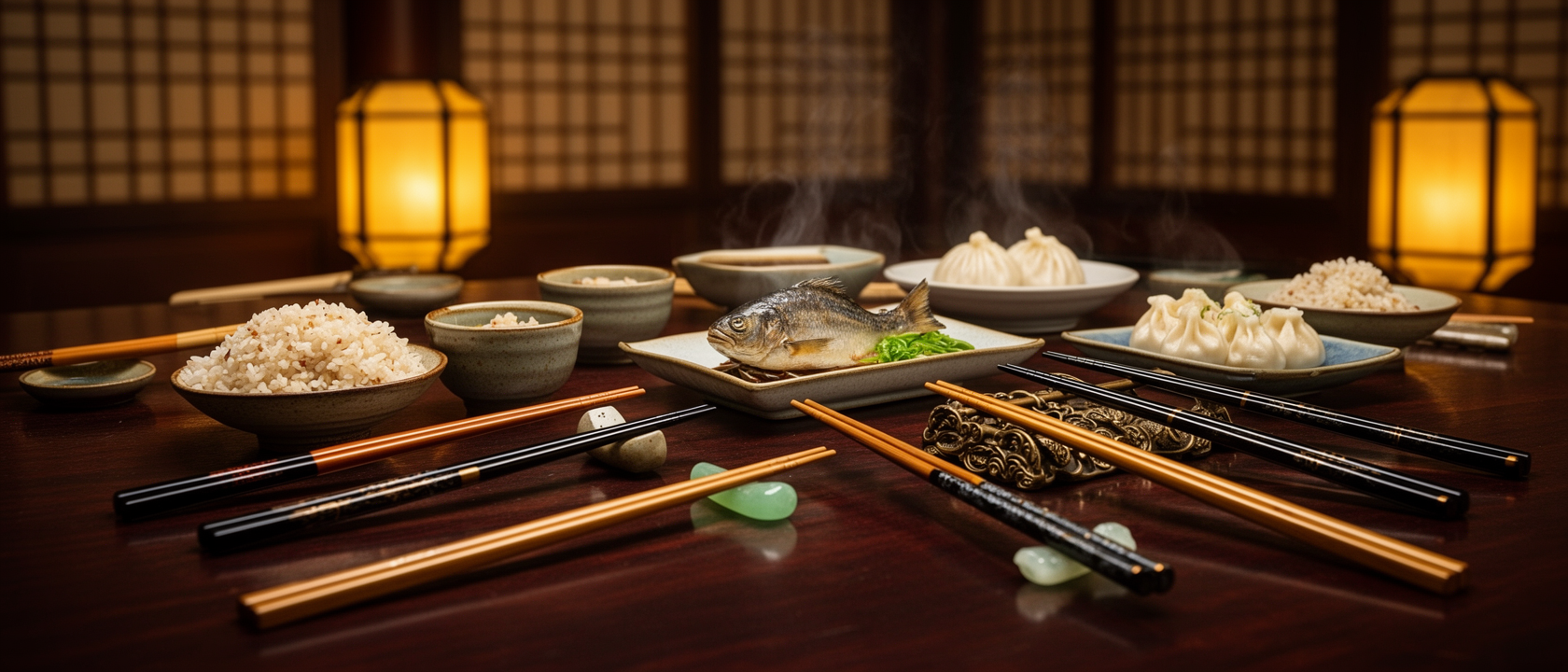
From Hearth to Table
The first chopsticks were never meant to touch your lips. About 5,000 years ago in China, according to the California Academy of Sciences’ Rietz Collection of Food Technology, people were using sticks for a single purpose: fishing food out of boiling pots. Not carved, not refined, just twigs, held like tongs over a fire.
Bronze eventually replaced wood. The oldest physical evidence is a set of six bronze implements, each roughly 10.2 inches (26 centimeters) long, unearthed from the Yin Ruins near Anyang in Henan province, dating to around 1200 BCE during the Shang dynasty. Their length puts them firmly in cooking territory: long enough to reach into a pot without burning your hand, not quite right for eating. Most historians read them as stirring and retrieving tools, not dining utensils. Chopsticks didn’t reach the table for roughly another thousand-plus years, by around 400 to 500 AD, something had to change to make that happen.
The Knife That Disappeared
Most culinary traditions kept a cutting implement at the table. The fork and knife remain a matched pair across Europe and the Americas. Yet across a wide stretch of Asia, a different solution took hold. Why move away from the knife at mealtime? The answer splits into two parts: a resource crisis and a philosopher with strong opinions about violence.
A Population Boom and a Philosopher’s Distaste
Around 400 to 500 AD, China’s population grew faster than its resources. Cooking fuel became scarce. The fix was straightforward: cut everything into small pieces before it goes into the pot. Smaller pieces cook faster, burning less firewood. Once food arrives at the table already bite-sized, a knife has no job left to do.
Philosophical reinforcement came from Confucius (551–479 BCE), whose ideas shaped the region’s social codes for centuries. He considered knives instruments of slaughter that clashed with the peace a shared dinner should carry. A precept associated with his teachings held that food should arrive pre-cut, so that only chopsticks would be needed. Whether the specific wording is authentically his is disputed, modern scholars point to it as a later addition, but the underlying philosophy gave the trend lasting cultural authority, and left a physical mark: Chinese chopsticks kept a blunt, rounded tip, since no cutting function was needed.
Why the Rice Matters
Short grain rice, common in Japan and Korea, has high starch content that makes cooked grains cling together. Pick up a small clump with two sticks and it holds its shape long enough to reach your mouth. Long grain rice cooks up light and separate; try to pinch a pile with chopsticks and the grains roll away. The food that drove chopstick adoption happened to be exactly the type chopsticks can handle.
Silver, Poison, and a Bad Chemical Assumption
As materials evolved from bamboo through bronze to precious metals, silver chopsticks acquired a reputation in the Chinese imperial court: the belief that silver would darken on contact with arsenic, giving a visible warning before it was too late. It doesn’t work that way. Silver reacts with hydrogen sulfide, the compound in rotten eggs, garlic, and onions, producing dark silver sulfide tarnish. Arsenic trioxide causes no such reaction. The belief probably persisted because medieval arsenic preparations contained sulfur impurities. As refining improved during the Tang dynasty (618–907 AD), those impurities disappeared, and so did any visible reaction. Silver chopsticks would reliably detect garlic, and reliably miss actual poison.
One Tool, Five Traditions
By 500 AD, chopsticks had reached Japan, Vietnam, and Korea, and each culture adapted them. Early Japanese chopsticks were a single bent piece of bamboo, closer to tweezers, used in religious ceremonies. The design eventually split into two pieces, got lacquered, and tapered to a point, useful for separating fish bones. Japanese chopsticks are also sized by gender. Korean chopsticks are frequently metal and used mainly for side dishes, while a spoon handles rice.
The etiquette is as regionalized as the tools. In Japan, pressing chopsticks vertically into a bowl of rice is associated with funeral rites, considered deeply inauspicious at any ordinary meal. In China, tapping a bowl’s rim with chopstick ends carries associations with begging. In Korea, picking up utensils before elders have begun eating is considered rude. A single change in angle, and the same gesture shifts from eating to mourning.