The Night London Brought a Coffin to the Theater
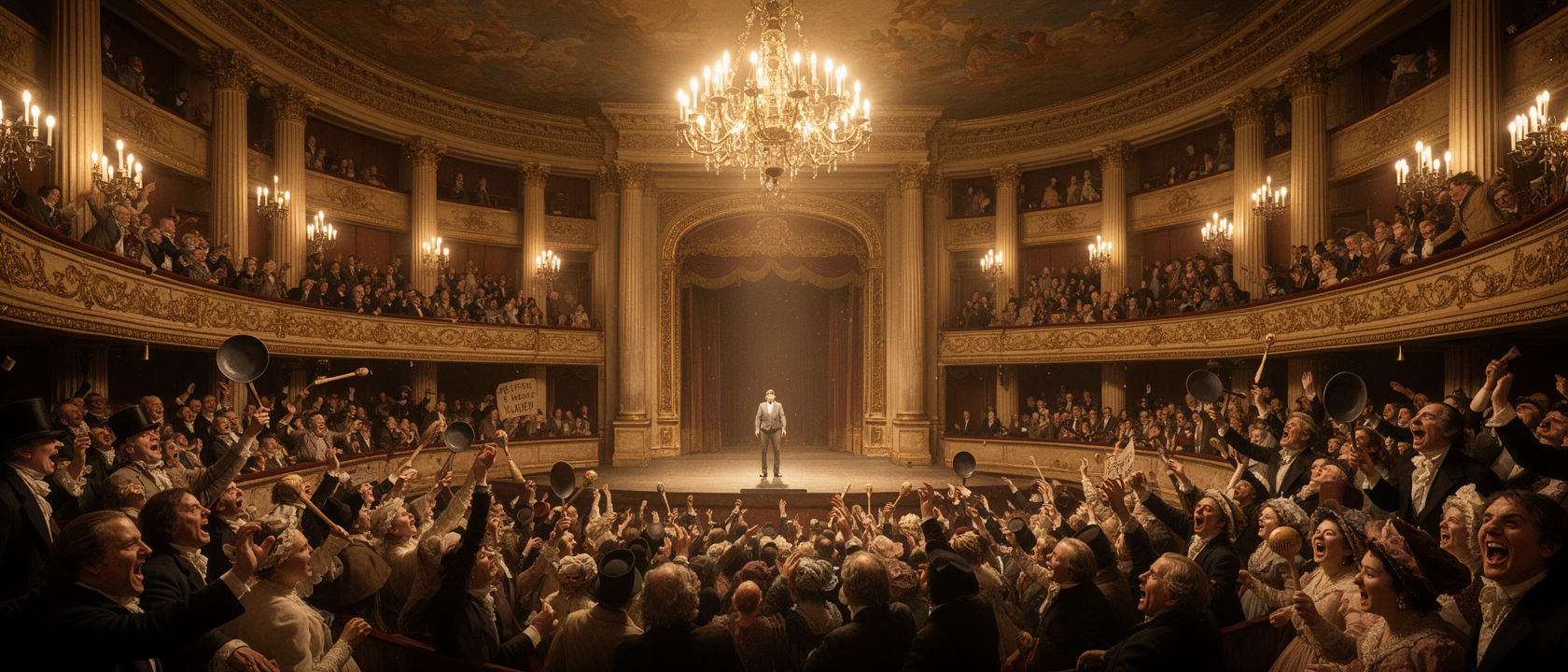
Picture a man in a dress, stomping on a theater bench, while the person beside him beats a frying pan. A pigeon wheels past the chandeliers. Somewhere in the gallery, a coffin is propped against the rail. On the stage below, actors are attempting Macbeth. Nobody can hear a word.
This happened in London. Repeatedly, across 67 nights. All because ticket prices went up by roughly 15%.
The Spectacle Before the Explanation
The protesters called themselves OPs, for Original Prices. From opening night, September 18, 1809, they packed Theatre Royal, Covent Garden and made it impossible to watch anything. Not through vandalism, but through sustained, inventive noise. Rattles, drums, and frying pans clanged in rhythm while the crowd stomped on the benches in unison. Historians call it the OP dance.
The coffin arrived with a label already attached: “Here lies the body of the new price, which died of the whooping cough on 23 September 1809, aged 6 days.” Farm animals were smuggled in. Pigeons were released inside the house. The actors kept going. The audience kept drowning them out.
Two Fires and a Legal Monopoly
Fire destroyed the original Covent Garden on September 20, 1808, in roughly three hours. The cause was never established. Gone with it were costumes, manuscripts, and the organ Handel had once used there.
Under the Licensing Act of 1737, only two London theaters, Covent Garden and Drury Lane, could legally stage full spoken plays. That monopoly made Covent Garden one of only two places in the city where a playwright’s words could be heard as written. Rebuilding cost around £150,000 against an insurance payout of £50,000. The Duke of Northumberland contributed £10,000 as a loan, then returned the repayment bond suggesting manager John Philip Kemble toss it into a fire. The rest came from subscription shares. The Prince of Wales laid the foundation stone on December 31, 1808; architect Sir Robert Smirke modeled the facade on a Greek temple.
In February 1809, Drury Lane also burned. For a stretch, Covent Garden was the only venue in London with a legal right to perform spoken drama, and it had not yet reopened.
Frying Pans and a Former Champion
When the rebuilt theater opened, Kemble raised prices. Boxes went from 6 shillings to 7; the pit from 3 shillings 6 pence to 4 shillings. The gallery price held, but the gallery had been so poorly redesigned that patrons there could only see the performers’ legs. The entire third tier had been converted into private boxes rented annually by the wealthy at £300 a year.
Kemble commissioned a committee to investigate whether the new prices were justified. It found they were, unsurprisingly, since it consisted of the theater’s own shareholders. He then hired professional boxers to remove protesters, among them Daniel Mendoza, English bare-knuckle champion of the early-to-mid 1790s. The sight of a famous prizefighter hauling paying customers through the corridors amplified everything.
The Real Message Was in the Brickwork
The price hike was the visible edge of something larger. The redesigned building had physically shrunk the gallery where ordinary Londoners had always sat, while privatizing the prime sections for wealthier patrons. London audiences of that period treated the theater as a shared civic space where they had standing to be heard. The OP coalition was unusually broad, drawing in laborers and businessmen alike. British authorities grew nervous: an audience capable of this level of sustained organization might, under the right conditions, turn its attention to bread prices or the war with France.
The Accounting of Surrender
On December 14, 1809, Kemble met with the protest leadership at the Crown and Anchor pub and agreed to terms. The following evening he apologized from the stage, restored the old pit prices, reduced the number of private boxes, and dropped all charges against arrested protesters.
The theater did not suffer for it. Between 1809 and 1821, annual ticket receipts averaged £80,000, roughly double the £40,000 annual operating costs. In the 1810–11 season alone, receipts reached £100,000. The coffin with its six-day epitaph had, it turned out, been right on schedule.