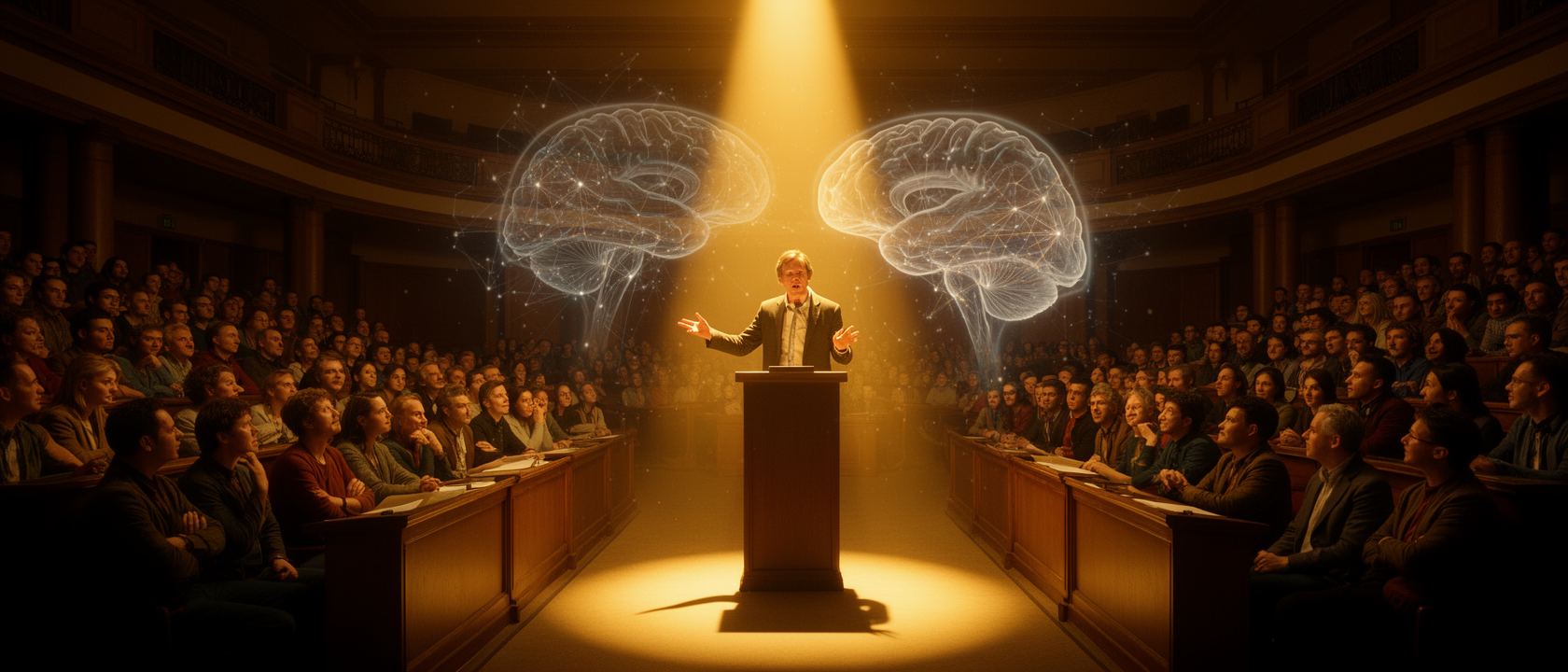
The Neurological Bypass
Most of us treat charisma as a gift. The German sociologist Max Weber, writing in the early twentieth century, described it as a quality that sets certain people “apart from ordinary men,” treated by followers as if it were of almost divine origin. Science has a different answer: charisma is a set of learnable behaviors that exploit a specific vulnerability in how the human brain handles information. When those behaviors work, they don’t just make a speaker likeable. They can switch off the listener’s capacity for critical thought.
The Memory Paradox
People who listen to charismatic speakers feel more persuaded and leave feeling energized. But in findings reported from laboratory studies, when tested on actual content, they remember fewer factual details than participants who heard the same material from a non-charismatic speaker. The people who felt most convinced had the least to show for it. That gap points directly at what charisma is actually doing inside the brain.
Two Networks, One Seesaw
The brain’s Default Mode Network, or DMN, activates during daydreaming, social reflection, and emotional engagement. Opposing it is the network tied to reasoning, planning, and critical analysis. Research by Anthony Jack and Richard Boyatzis at Case Western Reserve University, published in 2012 and 2013, established that these two networks are reciprocally inhibitory. An emotionally charged, charismatic speaker activates the DMN, and while that surges, the analytical network drops in signal strength at exactly the moment a persuasive speaker most benefits from it doing so.
The Awestruck Effect
Jochen Menges, an organizational behavior researcher at Cambridge Judge Business School, identified a mechanism that compounds this. When a listener senses awe toward a speaker, the instinct is to suppress the outward sign of it. But suppressing an emotion doesn’t dissolve it, the internal response intensifies, and that intensification carries a real cognitive cost: mental resources get diverted, leaving less capacity for clear evaluation. Menges’s research, published in The Leadership Quarterly in 2015, found this effect specific to charismatic speakers, not to leaders who simply showed warmth. The effort to stay composed leaves the listener more susceptible, not less.
One Second Is Enough
Before any of this takes hold, a faster process is already running. Princeton psychologist Alexander Todorov’s 2005 study in Science found that people form judgments of competence and likability from a face alone within one second of exposure, linked to amygdala activity. Those first-impression ratings predicted U.S. congressional election outcomes approximately 70% of the time; Senate races in 2004 came in at 68.8%. A judgment faster than most people can finish a sentence was doing real predictive work on who would hold office.
A Learnable Toolkit
John Antonakis, professor of organizational behavior at the University of Lausanne, identified 12 Charismatic Leadership Tactics, or CLTs: nine verbal and three nonverbal. The verbal ones include metaphors, storytelling, rhetorical questions, and moral conviction. The nonverbal ones involve animated voice, gestures, and facial expressiveness. Research published in the Harvard Business Review in June 2012 by Antonakis, Marika Fenley, and Sue Liechti showed that training people in these tactics produced measurably higher charisma ratings afterward.
The Extreme Case
The furthest point on this spectrum looks, neurologically, close to hypnosis. In 2011, Uffe Schjødt and colleagues at Aarhus University published an fMRI study in Social Cognitive and Affective Neuroscience, scanning devout young Christians who believed certain people possess genuine healing powers. When participants thought they were listening to a healer, their frontal executive network, handling reasoning, planning, and executive control, showed significant deactivation. Secular participants showed no such effect. The finding was strictly conditional on belief: those who shared the framework largely switched their analytical circuits off. A speaker the listener has already decided carries special authority can, under the right conditions, effectively borrow a portion of that listener’s brain.