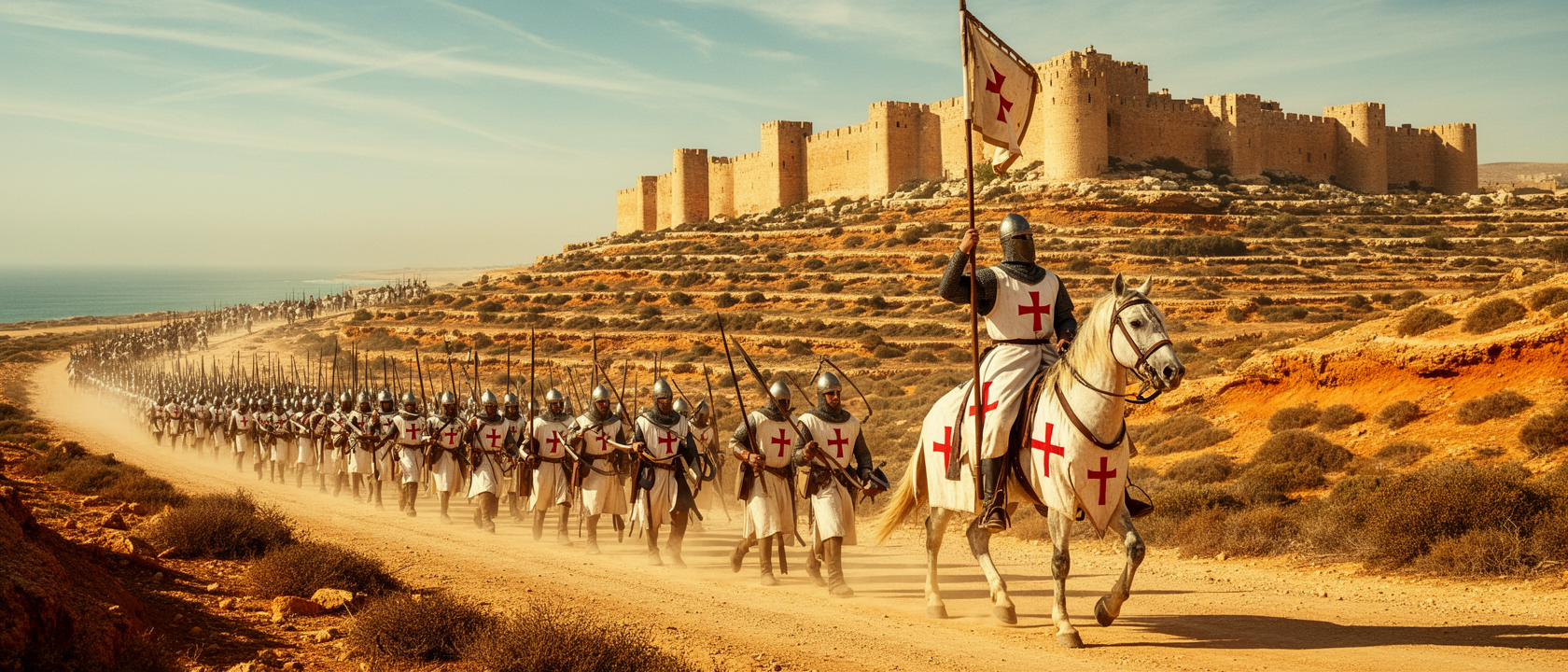
The Knightly Mirage
Picture the medieval knight: gleaming armor, a code of honor, riding out to protect the innocent. That image has held up for centuries, and it is almost entirely wrong.
The warriors who answered Pope Urban II’s call at the Council of Clermont in 1095 were not, for the most part, disciplined idealists. They were a class of armed men with too much time, real weapons, and not enough to do. Their “tournaments” bore no resemblance to the pageantry of later legend. These were organized brawls fought with real weapons, in which prisoners were ransomed and the surrounding peasant farms routinely got caught in the damage. For the Church and the lords of Europe, this was not a romantic problem. It was a security problem.
Moving the Mayhem
The more interesting question is not why men went on Crusade, but how the Church convinced an entire class of violent, independent-minded warriors to travel thousands of miles from their lands, their income, and their families, with a reasonable chance of dying from dysentery before they ever saw a battle.
The answer involves something closer to a structured recruitment contract than a spontaneous surge of faith. And the terms of that contract were specific.
The Incentive Package
The legal backbone of Crusade recruitment was the papal bull, a formal document from the Pope spelling out who was going, why, and what they would receive. Pope Eugene III issued the first formal crusading bull, Quantum praedecessores, on December 1, 1145. It included three concrete offers: a plenary indulgence, protection for the crusader’s family and property while he was away, and a freeze on any interest accumulating on his debts.
A plenary indulgence is not a get-out-of-sin-free card in the way it is sometimes described. The Catholic Church defines it as remission of the temporal punishment still owed for sins that have already been confessed and forgiven. For a knight who had spent years doing the things knights did, erasing that outstanding penalty was worth something real.
Each subsequent bull refined the package. Pope Gregory VIII’s Audita tremendi, issued on October 29, 1187, restated and formalized these protections in explicit terms: no lawsuit could be brought against a crusader’s possessions while he was on campaign, and no interest would accumulate on his debts. These were not new ideas so much as a sharper, more binding restatement of what the 1145 bull had already established, which tells you something about how often the original terms were apparently ignored. Pope Innocent III sweetened it further in 1209 with two additions for the Albigensian Crusade: crusaders could keep whatever they plundered, and serving just 40 days was enough to earn the full indulgence. Forty days is less time than some modern job contracts require before benefits kick in.
Recruitment fell to traveling preachers from the Benedictine and Dominican orders, who used graphic descriptions of sacred sites being desecrated to frame inaction as personal shame. Each knight also came packaged with his retinue, typically three to twelve additional soldiers. Recruiting one man meant mobilizing a small tactical unit.
A Repeatable Template
Once the mechanism existed, it proved reusable. The Iberian Crusades ran from 1095 to 1492, directing military energy against the Muslim taifa states of the Iberian Peninsula. The Albigensian Crusade, launched in 1209 against the Cathar community in the Languedoc region of southern France, ran for 20 years and ended with the Treaty of Paris in 1229, which folded Languedoc into the French kingdom. The target there was not a foreign power. These were Christian communities in France. Whatever else the Albigensian Crusade was, it was not a rescue mission to the Levant.
The template was identical each time: identify a problem, issue a bull, offer the package, dispatch the preachers.
A Word That Did Not Exist Yet
One detail tends to catch people off guard. The people who went on these campaigns did not call themselves “Crusaders,” and the campaigns were not called “Crusades.” Participants were known as crucesignati, Latin for “those marked by the cross.” The campaigns were referred to as “expeditions” or “the business of the cross.” The word first appeared in English in 1562, in a translation by a writer named J. Shute, and the modern spelling settled around 1760. These events were centuries over before anyone called them that.
And perhaps the most candid document in the whole system: in 1237, Pope Gregory IX issued an indulgence for James I of Aragon’s campaign against the Muslim Kingdom of Valencia, extended specifically to cover arsonists, provided they joined the effort. People who had committed arson could earn full remission by signing up. The Church knew exactly what kind of men it was working with, and it had a use for them.