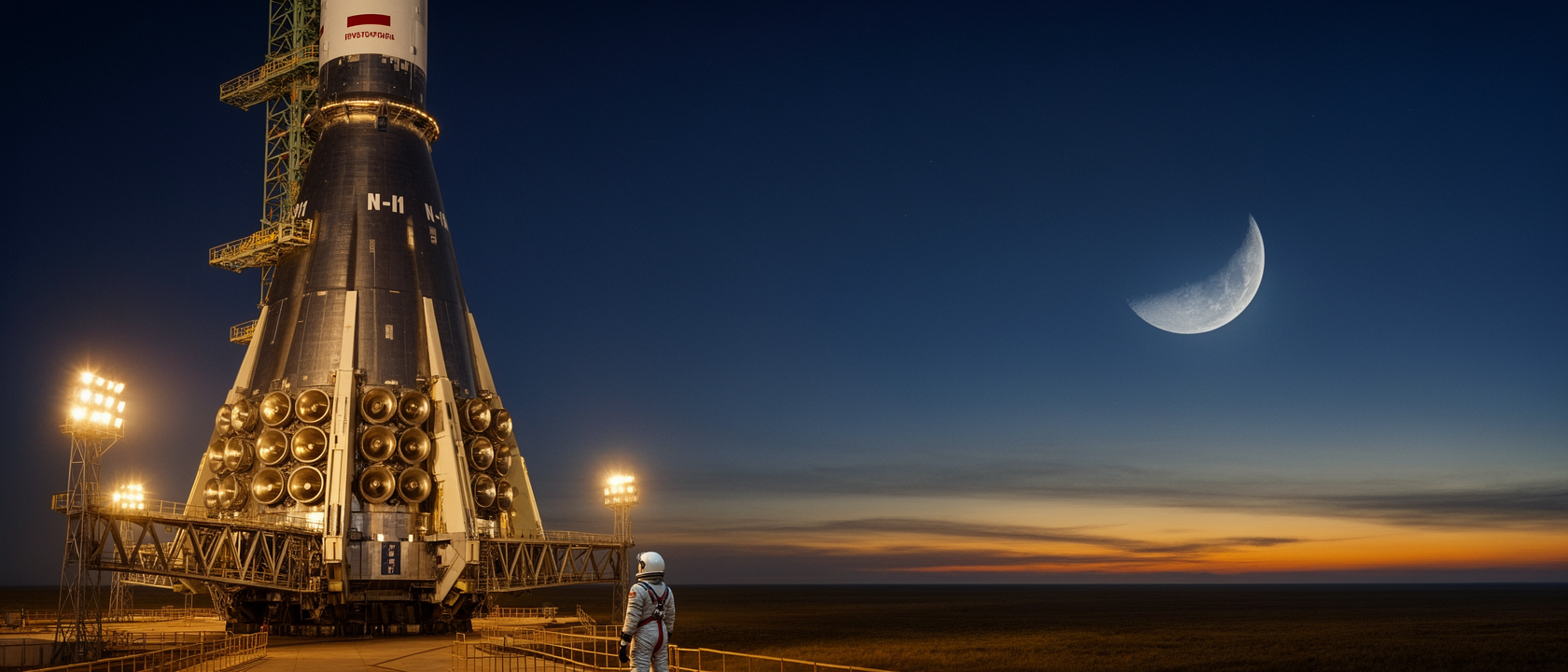
The Rocket That Could Have Beaten Apollo
The Soviet N-1 rocket had more raw thrust than the Saturn V. The machine that lost the Space Race was physically more powerful than the one that won it. Its first stage generated roughly 45,400 kilonewtons of force, making it the most powerful single rocket stage ever flown until SpaceX’s Super Heavy booster lifted off on April 20, 2023. The Soviets had the muscle. So what went wrong?
Power Without Efficiency
Raw thrust and mission success are not the same thing. The Saturn V could haul about 119 tonnes to low Earth orbit; the N-1 could manage roughly 95 tonnes. The American rocket outperformed it on payload because its upper stages burned liquid hydrogen and liquid oxygen, extracting far more thrust per kilogram of fuel than kerosene does. The N-1 burned kerosene all the way up, and its spherical fuel tanks were less structurally efficient than the Saturn V’s cylindrical ones. More thrust at the bottom, less efficiency through the whole stack.
But the efficiency gap alone doesn’t explain four consecutive launch failures. For that, you have to go back to 1938 and a labor camp in Siberia.
A Grudge That Outlasted the Gulag
Sergei Korolev was the Soviet Union’s Chief Designer, the mind behind Sputnik and Gagarin’s flight. Valentin Glushko was the country’s foremost rocket engine designer. In any functional program, the two would have been natural collaborators.
On June 27, 1938, Korolev was arrested by the NKVD during Stalin’s Great Purge, tortured, and sent to a labor camp in Kolyma, Siberia. He later learned that Glushko had denounced him to Soviet authorities. Korolev survived, came back, and became indispensable to the Soviet state, but he never forgot.
When the crewed lunar program was authorized by government decree on August 3, 1964, the two men were still working in the same industry and still unable to speak without the conversation turning poisonous. They disagreed on fuel: Glushko favored hypergolic propellants, fuels that ignite spontaneously on contact with each other, while Korolev insisted on kerosene and liquid oxygen. Neither would yield. Glushko walked off the N-1 project entirely.
Thirty Engines and a Fatal Gamble
With Glushko gone, Korolev turned to Nikolai Kuznetsov, a jet engine designer with no history building large rocket engines. Kuznetsov’s solution was to cluster 30 smaller NK-15 engines together in two concentric rings at the base of the rocket. This introduced combustion instability: uneven pressure waves that amplify into violent vibrations. Managing this across 30 engines feeding a shared propellant system, each capable of disturbing the others, was fiendishly complex.
The program never conducted a full static fire test of the integrated first stage before flight. Every flaw was discovered during an actual launch attempt. There were four, between February 21, 1969, and November 1972. All four failed.
The second launch, on July 3, 1969, was catastrophic. The rocket rose about 200 meters, stalled, and fell back onto the pad. Nearly 2,300 tonnes of propellant ignited in an explosion estimated at around 7-kiloton TNT equivalent, one of the largest non-nuclear explosions ever recorded. It destroyed the launch infrastructure and set the program back roughly 18 months. Seventeen days later, Apollo 11 landed on the Moon.
One More Thing That Didn’t Help
A political coup in October 1964 removed Khrushchev and installed Brezhnev, disrupting funding and management at exactly the moment the program needed stability. Korolev himself died on January 14, 1966, before the N-1 ever flew. His successor, Vasily Mishin, lacked the authority to hold the competing factions together.
When the program was suspended in 1974 and canceled in 1976, the man appointed to oversee what remained of Soviet launch capability was Valentin Glushko, the engineer Korolev had refused to work with for three decades, now inheriting the program Korolev had built.