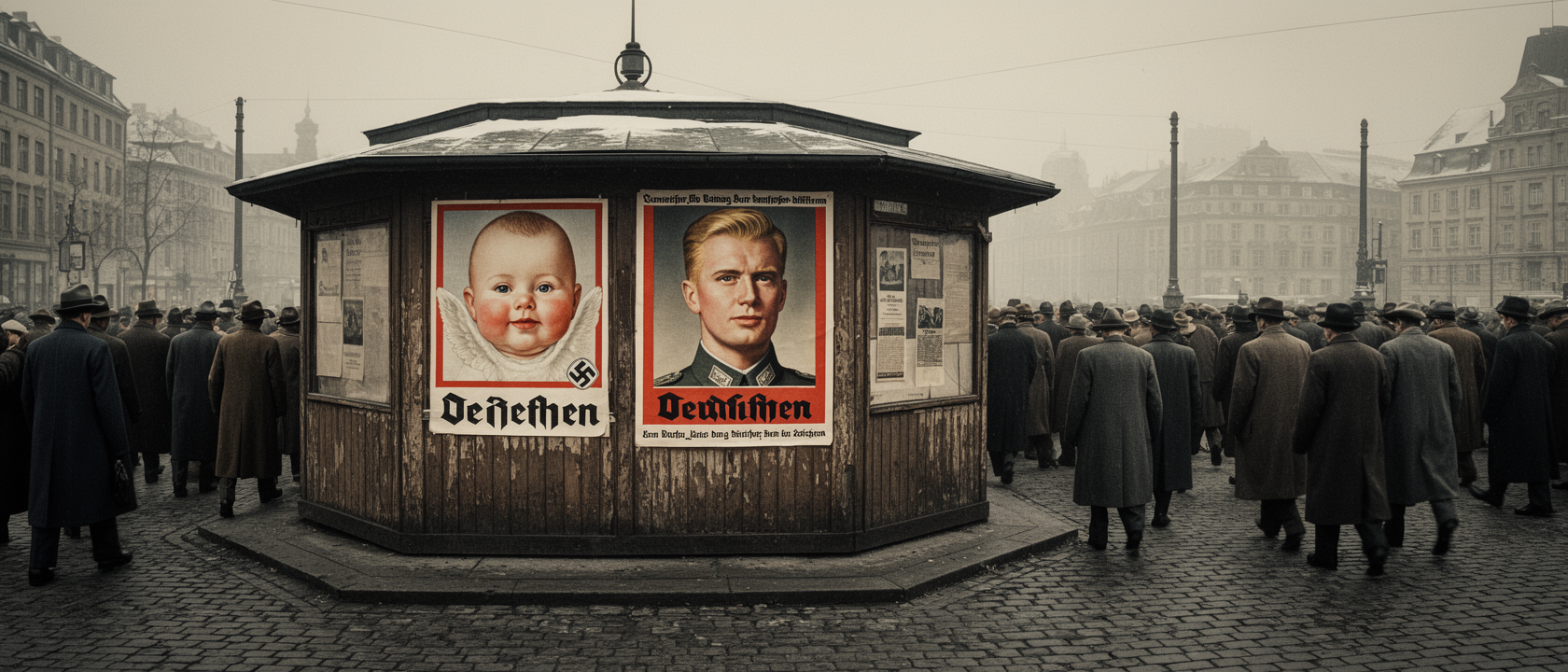
The Face of a Paradox
Picture a magazine cover from January 24, 1935: a round-cheeked, blue-eyed baby, selected by Nazi Propaganda Minister Joseph Goebbels as the living image of Aryan perfection. Picture also a soldier whose photograph ran in the Berliner Tageblatt in 1939 under the caption “The Ideal German Soldier,” his blond hair and blue eyes making him the visual centerpiece of the Third Reich’s racial recruiting effort. Both images were used, widely and proudly, by the Nazi propaganda machine.
Both subjects were Jewish.
A Regime That Prided Itself on Precision
This is not a minor embarrassment tucked away in an archive. On September 15, 1935, the Reichstag passed the Nuremberg Laws, stripping Jews of citizenship and banning marriage between Jews and those classified as ethnically German. The laws even created a taxonomy for partial ancestry: a Mischling ersten Grades had two Jewish grandparents; a Mischling zweiten Grades had one. The regime built an entire bureaucratic architecture around ancestral precision. Goebbels’ propaganda office was, in theory, operating within that same framework when it ran a contest to put a baby on a magazine cover.
In practice, the visual test took over.
The Blind Spot
Blonde hair and blue eyes are not the genetic property of any single ethnic group. The Nazis knew this at some level, which is why the Nuremberg Laws were built on ancestry rather than appearance. But when propagandists went looking for a face, they looked at faces. The ideology demanded genealogy; the instinct reached for a photograph. That gap is where both of these stories live.
The Baby on the Cover
Hessy Levinsons was born May 17, 1934, in Berlin. Her parents, Jacob and Pauline Lewinsohn, were Ashkenazi Jews from Latvia who had moved to Berlin in 1928 as opera singers. When the regime’s family magazine Sonne ins Haus organized a contest to find the most beautiful Aryan baby, photographer Hans Ballin made a deliberate choice: he entered Hessy’s portrait. He later told her mother he had wanted “to allow myself the pleasure of this joke.” Goebbels selected her as the winner. Her face appeared on the cover on January 24, 1935, then spread onto postcards, shop windows, and product advertisements. Her family kept her indoors, afraid of what would happen if someone connected the famous baby to the Jewish family in the apartment.
The Soldier in the Newspaper
Werner Goldberg was born October 3, 1919, in Berlin. His father had grown up Jewish but converted to Lutheranism before marrying a Christian woman; under the Nuremberg Laws, that made Werner a Mischling ersten Grades. He was drafted on December 1, 1938, and participated in the invasion of Poland in September 1939. An army photographer sold his portrait to the Berliner Tageblatt, which ran it as “The Ideal German Soldier”; the image later appeared on Wehrmacht recruitment posters. There was no subversive joke, his appearance simply matched what propaganda required, and nobody looked further. On April 8, 1940, Hitler ordered all first-degree Mischlinge discharged, and Goldberg was expelled.
A Prank and a Coincidence
The two cases differ in one important way. Ballin knew exactly what he was doing. Goldberg’s case had no such intention; his image entered the public record purely because he fit an aesthetic the editors recognized on sight. One was a deliberate provocation, the other an accidental one. Both revealed the same structural crack running through the entire project: you cannot sort human beings by bloodline and then select their faces by eye and expect the results to be consistent.
What Came After
Hessy’s family fled Germany, eventually reaching Cuba around 1941 or 1942 after traveling through Latvia, Paris, Nice, and Lisbon. They settled in New York City in 1949. Most of her extended family in Latvia was murdered by the Nazis. Hessy earned a chemistry degree from Barnard College in 1955, pursued graduate work at Columbia, and built a career spanning Rutgers University, more than thirty years at Educational Testing Service, and a position at St. John’s University in Queens, from which she retired in 2016.
The cover photo story did not reach the public until 1987, when it appeared in Gertrude Schneider’s book Muted Voices: Jewish Survivors of Latvia Remember. In June 2014, Hessy donated the original Sonne ins Haus cover to Yad Vashem in Jerusalem, telling the newspaper Bild: “I can laugh about it now, but if the Nazis had known who I really was, I wouldn’t be alive.”
Hessy Levinsons Taft died January 1, 2026, in San Francisco, at the age of 91.