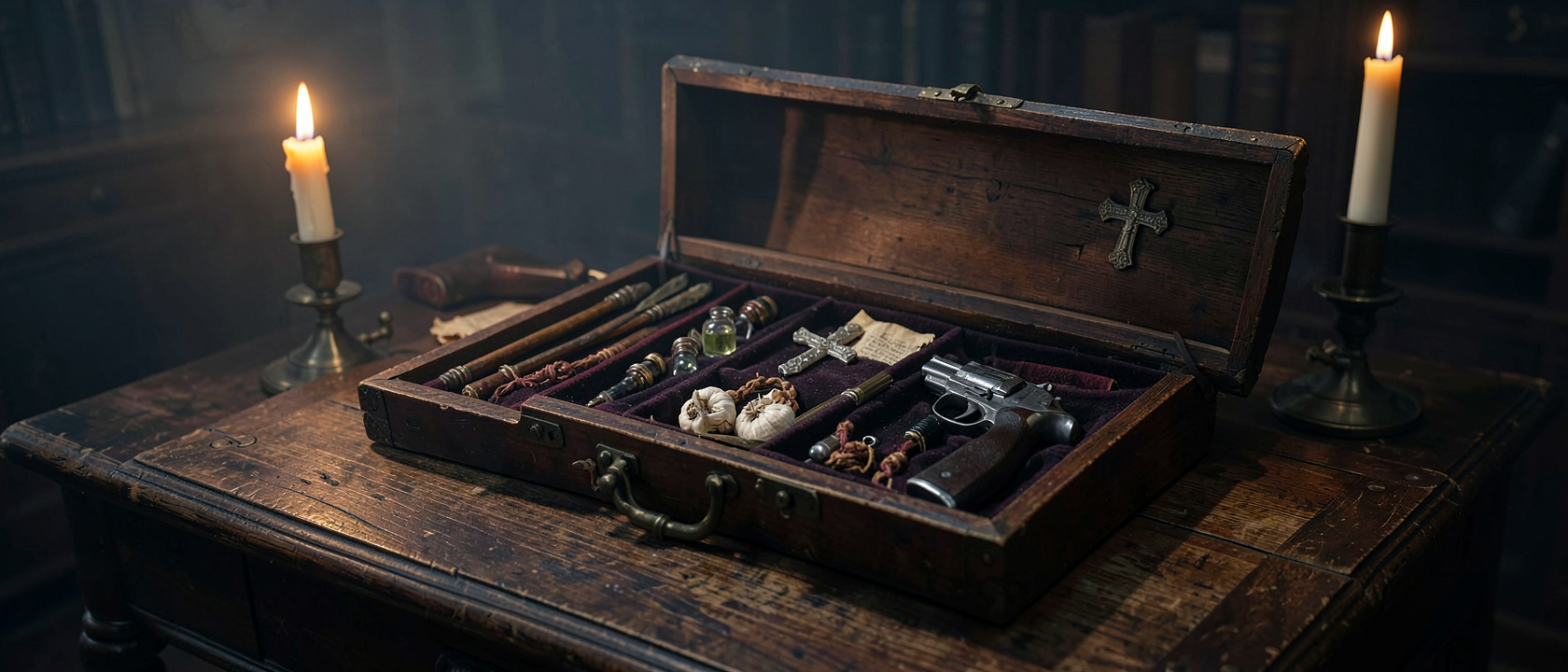
A Walnut Case Full of Protection
In October 2008, at the Jimmy Pippen estate sale in the new Natchez Convention Center in Natchez, Mississippi, Stevens Auction Company sold what was billed as a complete, authentic vampire killing kit for $14,850. The case itself was American walnut, carved with a cross on the lid. Inside, according to the auction report, sat stakes, mirrors, a gun loaded with silver bullets, crosses, a Bible, a vial of holy water, candles, and a head of garlic.
It’s a good image: everything a person could possibly need to fend off the undead, packed into one tidy box. Neatorama, which first put this sale in front of a wider audience on November 13, 2008, described it simply as a “200-year-old vampire killing kit” that had just sold for that same $14,850. The age claim traces back to antiques trade coverage, which dated the kit to roughly 1800.
The Problem With “200 Years Old”
Here’s where the story gets more interesting than the price tag alone. Vampire killing kits, as a category, have a documented history, just not the one their labels usually claim. According to Wikipedia’s overview of the topic, kits like this are generally believed to date no earlier than the second half of the 20th century. The earliest known example on record didn’t belong to a 19th-century traveler at all; it showed up as a prop in the 1985 film Fright Night.
The giveaway is sitting right there in the Natchez kit’s own contents list: the silver bullets. Silver wasn’t connected to vampire lore until well after 1800. A box built by someone genuinely guarding against vampires in the early 1800s would have had no reason to include them, because nobody yet believed silver mattered. Their presence is a strong clue that a kit was assembled much later, then dressed up to look antique.
One Number, Two Different Kits
There’s a second wrinkle worth untangling, because it’s easy to misread. Dwight Stevens, the auctioneer, mentioned that his house had sold four vampire killing kits over 27 years, and that the most recent one before this sale had gone for $1,485 in Natchez a year earlier. That’s a tenth of the $14,850 figure, but it’s not a typo and it’s not the same kit. It’s a separate, earlier sale, mentioned only for context. The two prices look suspiciously related at a glance, but they describe two different objects sold a year apart.
Not the Only “Antique” Kit in Question
The Natchez case isn’t an isolated oddity, either. In 2022, Hansons Auctioneers in the UK sold a kit said to have belonged to Lord William Malcolm Hailey for £13,000, or about $15,736. It was marketed as late 19th century with a specific aristocratic provenance attached.
Fact-checkers at Snopes later found that the consignor wasn’t related to Hailey at all, he was an unrelated owner who said he’d picked up the kit in Nottinghamshire. Snopes concluded there was no real evidence the kit was any more genuine than a modern novelty piece built to look old. It’s the same pattern twice: a compelling backstory, a strong sale price, and an origin story that falls apart once someone actually checks it.
Why This Is the Fun Part, Not the Letdown
None of this means the Natchez sale didn’t happen, or that $14,850 wasn’t a real number changing hands over a real walnut box. It did, and it was. What’s worth noticing is the gap between what an auction listing claims and what actually holds up, and that gap is exactly the kind of detail most people scroll straight past.
If you clocked the silver bullets as the detail that doesn’t fit before you got to the explanation, that’s the whole skill here: noticing when a good story and a true one have quietly drifted apart.