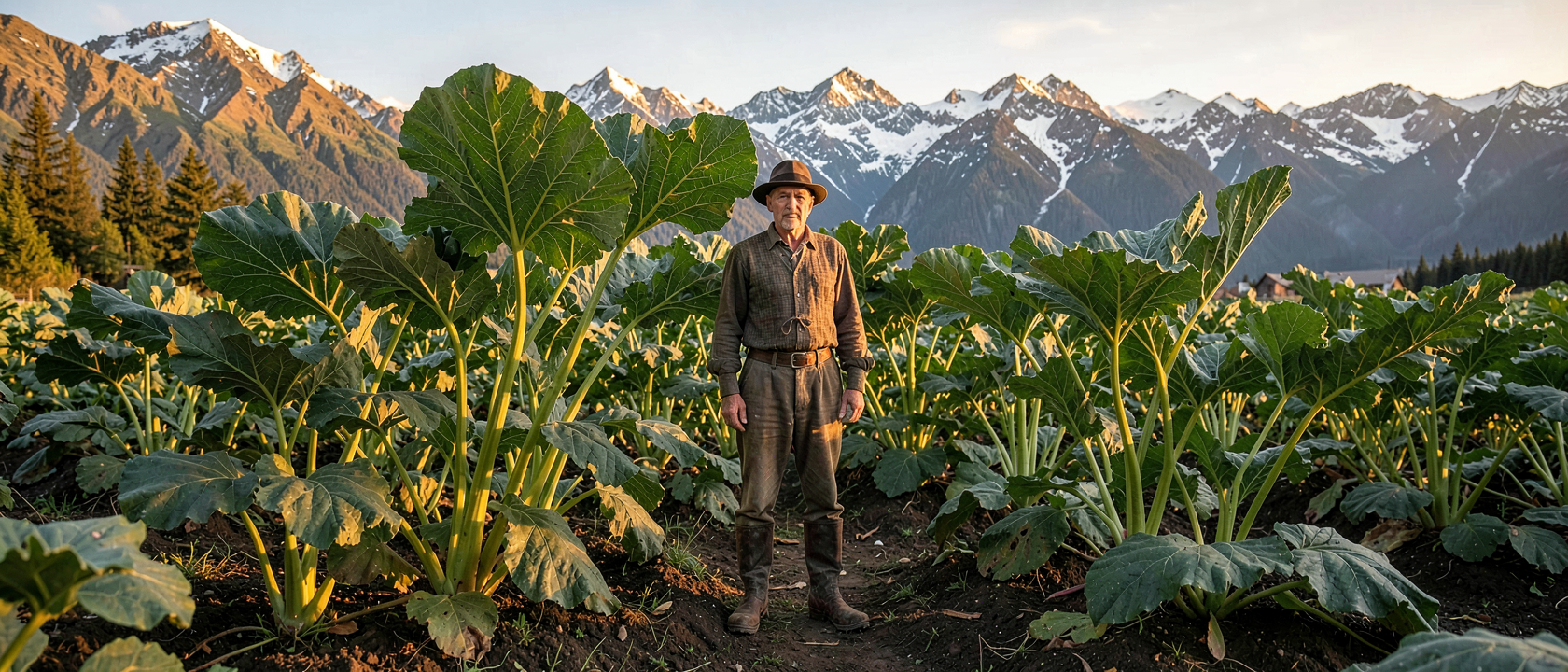
A Vegetable Legend From the Land of Ice
Alaska doesn’t exactly scream “vegetable garden.” Six months of weak daylight, short summers, and ground that stays frozen through much of the year aren’t growing conditions anyone would pick on purpose. Yet this is the place people point to when giant rhubarb comes up, stalks thick enough to pass for baseball bats, grown in a state where the plant isn’t even native. Rhubarb likely got its start thousands of miles away, in the cold mountains of Tibet and China, long before anyone thought to plant it this close to the Arctic Circle.
Cold-Loving Isn’t the Same as Record-Breaking
Rhubarb genuinely likes the cold. It’s one of the rare food plants that actually needs a hard winter chill to grow well, which is why it does fine in Scandinavia, the northern United Kingdom, and plenty of other cold places besides Alaska. A journalist once described rhubarb plants six feet (1.8 m) tall towering over her at a bed-and-breakfast garden in Gustavus, Alaska, a size that goes well past “fine.” Plenty of cold climates grow good rhubarb without anyone writing legends about it, so cold alone doesn’t explain why Alaska, specifically, became the place for record-setting stalks.
A Prospector, a Gold Rush, and a Scurvy Remedy
The answer traces back to a dairy farmer named Henry D. Clark, who left Wisconsin to join the Klondike Gold Rush and trek the brutal White Pass Trail toward Skagway, Alaska. Along the way, he saw fellow travelers weakened by scurvy, the vitamin deficiency disease that comes from going too long without fresh produce. Caroline Hill, general manager of Jewell Gardens, which now occupies part of Clark’s old homestead, says the working theory is that Clark carried rhubarb seeds in his pocket for exactly this reason, since the plant is rich in vitamin C and was a known folk remedy against scurvy. By 1898, he had settled in Skagway and put those seeds in the ground, less as a hobby than as a practical answer to a place with almost no fresh food.
A Photograph and a Yardstick
The proof that this wasn’t exaggeration survives in a photograph, dated to around 1913 by most accounts, though some place it in 1921. It shows Clark holding a rhubarb stalk topped with a broad, fluffy leaf, a yardstick held beside it for scale. “That’s three feet (0.91 m) just there,” Hill says of the stalk alone. It wasn’t a trick of perspective, either, or an unusually small man standing next to an ordinary plant. As Hill points out, Clark wasn’t abnormally short or tall, which only confirms how large that piece of rhubarb really was.
What We Still Don’t Know
Hill is upfront that the seeds-in-the-pocket story is a theory, not a documented fact. It fits the circumstances of the trail, but no surviving record actually confirms it. The agronomy is murkier still. Alaska’s summers bring close to 19 hours of daylight, and that stretch of sun likely pushed the rhubarb to grow taller than usual. How much credit belongs to the daylight, how much to the soil, and how much to Clark simply being good at farming, nobody has fully worked out. Even in Skagway, where the story gets told often, people admit parts of it remain guesswork. That gap between the known and the assumed is part of what makes the story worth passing along instead of just repeating: anyone can quote the legend, but noticing where it turns into guesswork is a different kind of attention.
The Rhubarb King’s Garden Today
Clark’s farm eventually grew past 200 acres (81 hectares), big enough that locals started calling him the “Rhubarb King.” He and his wife Marion, who had followed him from Wisconsin, raised two daughters in Skagway while the farm flourished, with plants reportedly reaching five feet (1.5 m) or taller and leaves photographed over three feet (1 m) across. The operation ended during World War II, when the military took over the land to store fuel, though townspeople rushed in to save the rhubarb before it could be destroyed. Clark died in 1945, but in 1996, gardener Charlotte Jewell acquired part of his original land and built Jewell Gardens there, still growing Clark’s own strain today, a white stalk with a pink tinge, unlike the bright red rhubarb most people picture. Some of his 1898 plantings are still alive on the property, measured every year at the garden’s summer festival.
A Toxic Plant Turned Dessert Staple
One detail often surprises people who grew up on rhubarb pie: the leaves are toxic, loaded with oxalic acid, and only the stalks are safe to eat. For most of its history, rhubarb served as medicine rather than dessert, valued for centuries before cheap sugar made it worth masking the plant’s natural sourness with jam, pie filling, or a simple dip in sugar eaten raw. A gold-rush prospector with a pocketful of seeds turned a scurvy remedy into a state’s unofficial mascot, proof that the plant on a dessert plate can carry a backstory most people never think to ask about.