The Secret Mission to Move Britain’s Gold Across a War-Torn Ocean
A Royal Visit with a Hidden Cargo
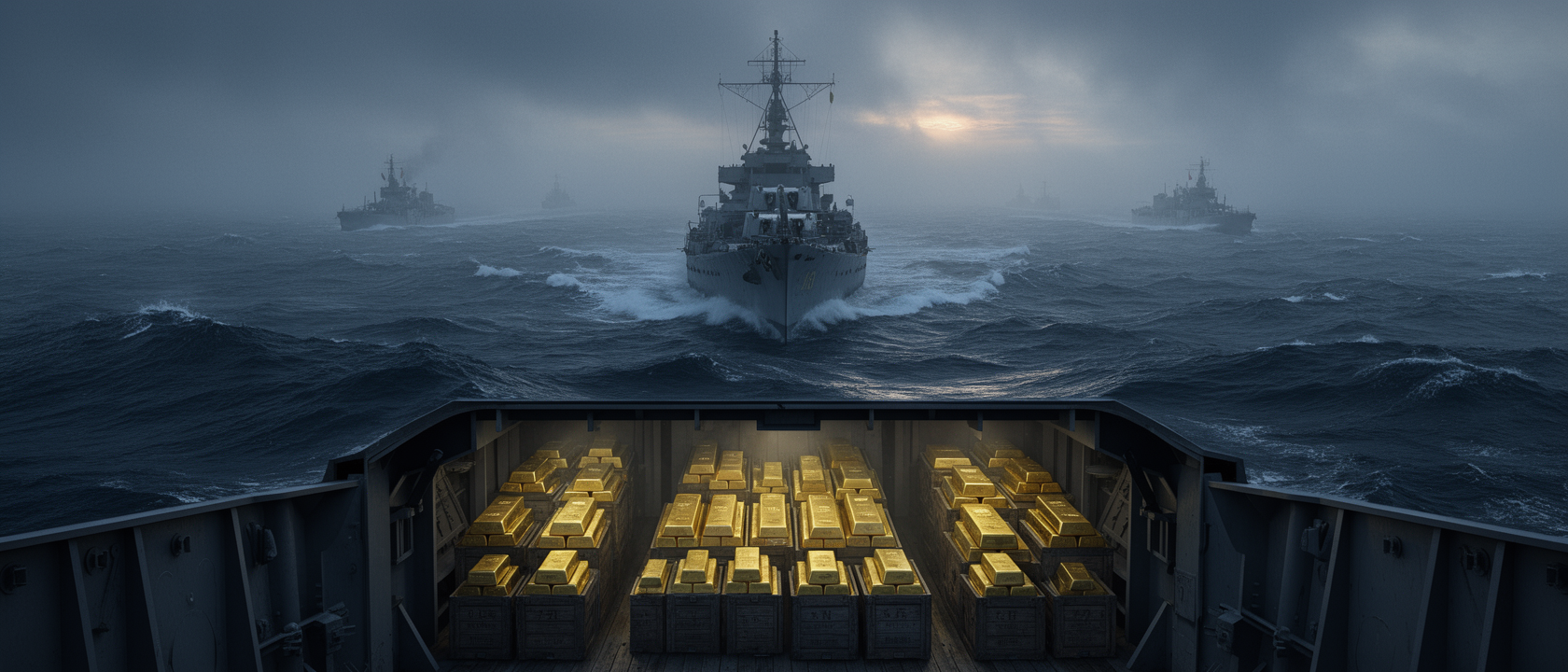
On May 6, 1939, thousands of people crowded the docks at Portsmouth to wave off King George VI and Queen Elizabeth as they sailed for Canada aboard the Empress of Australia. The fanfare was genuine. What the crowds did not know was that three Royal Navy warships, HMS Glasgow, HMS Southampton, and HMS Repulse, were sailing alongside, each carrying £10 million in gold bullion. Midway across the Atlantic, George VI ordered HMS Repulse back to Britain, and its gold was quietly redistributed between the other two ships. No German intelligence officer watching from a distance could easily distinguish a ceremonial naval escort from a covert financial transfer. That was precisely the point.
The disguised shipment was the opening move of Operation Fish, the largest known movement of physical wealth in history. By the time the last convoy arrived safely in Canada, roughly £2.5 billion had crossed the North Atlantic.
Why Risk It at All?
If Nazi Germany invaded Britain and seized the gold reserves, Hitler would have had hard currency to extend the war almost indefinitely. Britain’s gold couldn’t simply sit in a London vault waiting to be taken. There was a second pressure: the United States, officially neutral in 1940, sold war materials only on strict cash-and-carry terms, gold or dollars, up front. Without a secure way to pay, Britain would run out of weapons before it ran out of will to fight. Canada was the answer: close to the U.S. Federal Reserve, politically stable, and sharing a deep central banking relationship with Britain.
Wool Over German Eyes
Naval crews on the first wartime convoy, which departed Plymouth on October 7, 1939, were dressed in tropical white uniforms, standard kit for a Mediterranean or Pacific posting, sending any watching spy to entirely the wrong conclusions about their destination.
To explain the heavy security at the Canadian end, British officials quietly spread word that the Crown Jewels were being stored in Montreal. It was plausible enough to redirect suspicion. The Crown Jewels were never there. What was there was a vault packed with paper securities worth hundreds of millions of pounds. The urban legend of the jewels was government-issued fiction.
Building a Vault Under a Skyscraper
Engineers built a new vault in the third basement of the Sun Life Building in Montreal, roughly 15 meters underground. The walls were about a meter thick, reinforced with 360 tons of concrete and 870 steel rails salvaged from an abandoned railroad. An acoustic alarm system was sensitive enough to register the sound of a single drawer opening, and 24 Royal Canadian Mounted Police officers were permanently barracked inside. The 5,000 Sun Life employees working above them never suspected a thing.
When HMS Emerald arrived at Halifax’s Pier 6 at 7:35 a.m. on July 1, 1940, carrying roughly £30 million in gold and £200 million in securities, 12 specially reinforced rail cars were required to move the bullion. Regular passenger coach floors couldn’t bear the weight. The gold continued to Ottawa, where the Bank of Canada’s vaults eventually held over 1,500 tonnes, at peak storage, second only to Fort Knox.
An Operation That Grew
Operation Fish extended beyond British assets. On June 18, 1940, the French cruiser Émile Bertin arrived in Halifax carrying approximately 286 tonnes of Banque de France gold. After France signed an armistice with Germany on June 22, 1940, the captain received Vichy orders and sailed the gold to Martinique, where the ship remained largely immobilized until joining Allied forces in August 1943. Canada froze all French assets in Ottawa for the rest of the war.
Through 23 completed crossings, not a single Operation Fish shipment was lost at sea. German intelligence never learned what was on board. When Bank of England official Alexander Craig met Bank of Canada Acting Secretary David Mansur at Montreal’s Bonaventure Station on July 2, 1940, he reportedly greeted him with: “Hope you won’t mind our dropping in unexpectedly like this, but we’ve brought along quite a large shipment of fish.”