The Creator Is Also the Game Master
Pendleton Ward, creator of Adventure Time, once ran a live role-playing game where strangers became players just by typing a tweet. No app, no account, no dice. Just a reply box. You’d expect something like this to need a studio and a team of programmers. Instead it was one artist with a pencil, a sketchbook, and a Twitter account, proof that the most elaborate-sounding game can just be a person who likes to play, showing their work in real time.
Adventure Time Was Already a D&D Campaign in Disguise
Watch Adventure Time and you already know the shape of a tabletop role-playing game: a sword-carrying hero, a shape-shifting best friend, a kingdom stuffed with odd rules, odder rulers, and monsters around every corner, from the Ice King to Lemongrab. Ward has said Dungeons & Dragons was the show’s biggest inspiration, and that making it feels like running a campaign for his friends: “I am just writing stories I would want to play over a table with my buds.” He’s described writing for the show as a direct stand-in for playing D&D, whenever Finn ends up in a dungeon, Ward has the board artists make sure he grabs some gold along the way, just like a player would. So a Twitter role-playing game wasn’t a new side project; it was Ward returning to the exact source material his imagination already runs on.
How Do You Play a Game With No Board?
Old text adventures like Zork, and later graphical ones like King’s Quest, needed software underneath: something to read your command, check it against the rules, and update what happened next. Twitter has none of that, no inventory, no map, no memory of your last move. So how do you get a coherent story out of hundreds of strangers shouting commands into the same feed? One outlet, comparing it to Twitch Plays Pokémon, called the results “fairly hectic,” raising a fair question: is this actually a game, or just a performance borrowing a game’s costume?
Quest Attack: Where Your Tweet Becomes the Plot
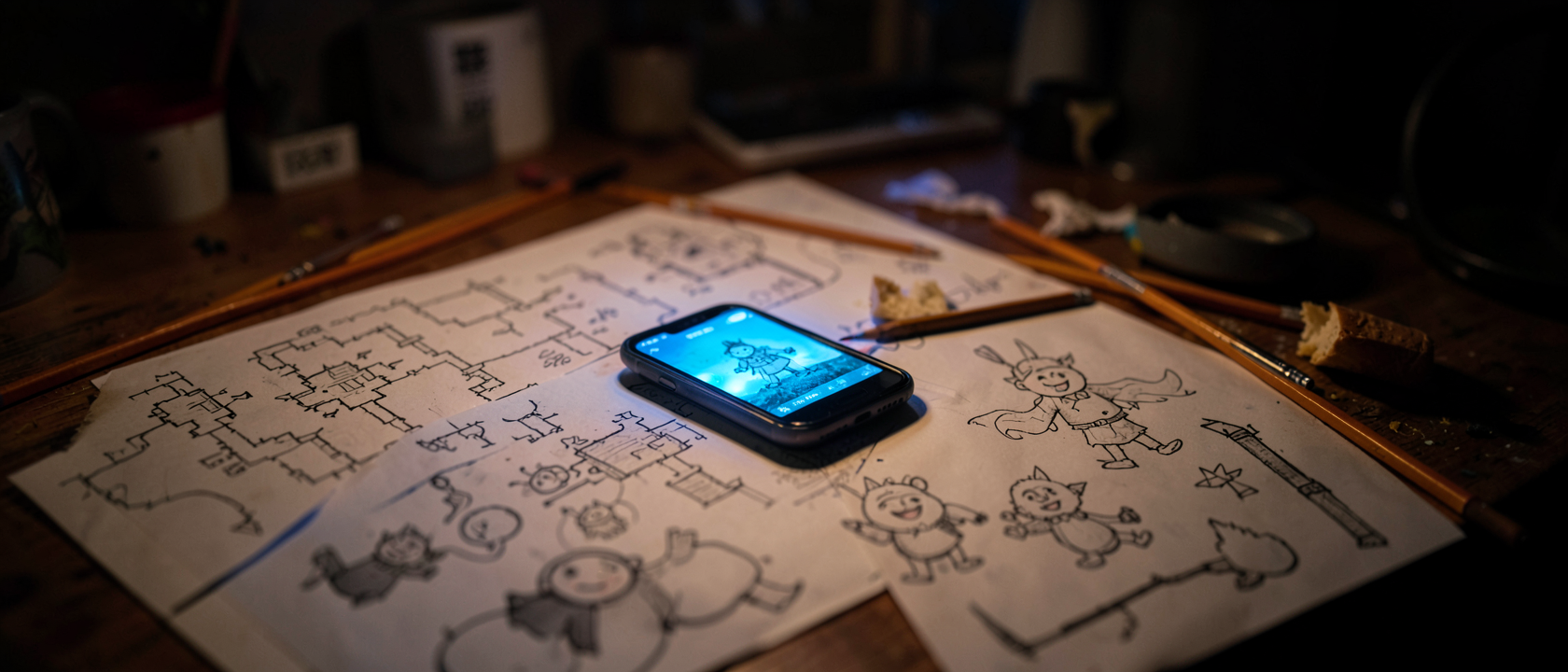
The answer is in how Ward built it. Under the account @buenothebear, he posted the opening scene at 12:47 a.m. on May 20, 2014: “You wake up in a dungeon cell. What do you do?” Anyone could reply with a command written like an old text adventure prompt: talk to the guard, use leg to get key, check toilet, kiss rat. Ward read the replies, picked his favorite, then drew it by hand, and that drawing became the next beat. Viewers who just wanted to watch could follow the thread on Storify, a service built for stitching tweets into a timeline. Nothing about the game lived in software; it lived entirely in Ward’s head and his sketchbook. He wasn’t just the game master choosing a path, he was the engine running the whole thing, one loop at a time: tweet, pick, draw, repeat.
The Pause Button Only Strangers Could Press
One detail makes the design genuinely clever. Since the game ran in real time, Ward had to pause it whenever life got in the way. But once paused, it stayed frozen until someone else, a follower, not Ward, tweeted to unpause it, as simply as “alright. *presses unpause*.” That flips the usual deal between storyteller and audience: Ward controlled what happened next, but a stranger controlled whether there was a “next” at all. It’s a campfire story that goes silent the second nobody’s listening, and only resumes when someone leans in to ask what happens next.
Even Fun Experiments Vanish Without a Trace
Nobody seems to have recorded how long Quest Attack ran, how many people took part, or exactly how Ward chose which command got drawn. Coverage from May 2014 captured it mid-swing, not start to finish, and what happened to it afterward is unclear. That’s not a hole in the story so much as a feature of how the internet works: big, official projects get archived, while small, strange, delightful ones run by one person on a whim often just stop existing when the moment passes. The internet feels permanent until you go looking for something specific and find out it isn’t, and noticing that gap is its own kind of attention most people never bother to pay.