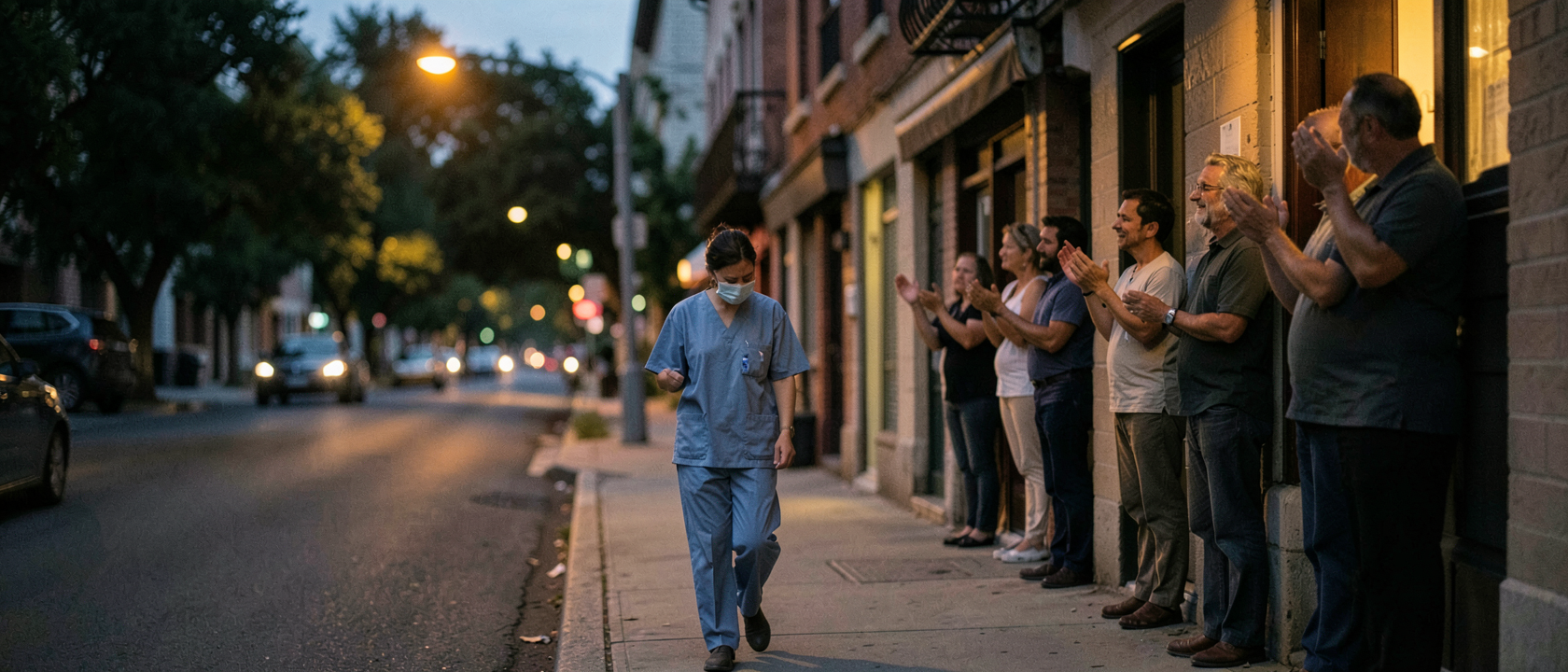
7 PM, Every Night
For a few weeks in the spring of 2020, cities went quiet at exactly the same moment. People stepped onto balconies, leaned out of windows, and banged pots and pans. Some just clapped. It was for nurses, doctors, delivery drivers, anyone keeping things running while the world shut down.
It felt spontaneous because it was. No one organized it from the top. It just happened, night after night, in building after building.
Then one day it didn’t happen anymore. The balconies emptied out. The pandemic itself didn’t end. It just got quieter.
Wrong Direction
That timing should bother you a little. Crises are supposed to pull people together harder as they get worse, not ease off right when things get difficult. Yet the hardest stretch of COVID-19, the long middle with burnout, overflowing waitlists, and worsening mental health, arrived after public attention had already moved on.
The fading applause points to a pattern worth naming, because it shows up far beyond one pandemic.
Acute vs. Chronic
Ayala Danzig, MD, MSW, was a psychiatry resident physician at Yale School of Medicine in New Haven, Connecticut, in March 2020. As hospitals converted surgical and pediatric units into COVID wards, she was one of the non-specialist physicians called in to help treat patients directly, working alongside internal medicine colleagues, reusing protective equipment that was in short supply.
In medicine, illness often runs in two phases. The acute phase is short and dramatic: survival is the only goal, and it mobilizes people fast. Teams pull all-nighters, improvise, and feel heroic doing it. The chronic phase comes after. It’s slower, less visible, and far less inspiring, even though the underlying problem hasn’t gone away.
Danzig argues COVID followed that same arc. The 7 PM clapping matched the acute phase: urgent, visible, energizing. Its disappearance marked the shift into the chronic phase, the part that actually requires the most from people.
Why Chronic Is Harder
Danzig draws on everyday chronic-illness care to explain why. Think about diabetes: the diagnosis is one dramatic moment, but managing it is years of small, invisible decisions, meal after meal, with no single day that counts as “winning.” Or consider how slowly some psychiatric medications have to be introduced, drug by drug, dose by dose, over weeks, with no instant fix. Chronic pain works the same way: there’s nothing to defeat, only something to manage, indefinitely.
Human motivation wasn’t built for that. People rally hard for a short, clear emergency. Sustaining effort at a low simmer, with no finish line in sight, is a different and much harder skill, and it rarely earns anyone a round of applause.
The Invisible Toll
In her own psychiatric practice during the pandemic, Danzig saw the quiet phase up close: patients with worsening paranoia and hallucinations, new suicidal ideation appearing in people who hadn’t had it before, and relapses during opioid recovery. This wasn’t just an emotional slump. It was medically dangerous, precisely because it was unfolding where nobody was looking.
No Single Fix
It’s tempting to think a vaccine or medical breakthrough simply ends a pandemic, like flipping a switch. Danzig’s essay pushes back on that. Much of the damage done by COVID-19, she argues, was structural: inequality, poverty, and fragile health systems that let the disease spread harder in some communities than others. A medical breakthrough doesn’t undo any of that.
“The pandemic is over” was never going to be one clean sentence. It was always going to be a slow unwinding of problems that predated the virus and would outlast it.
What This Says About You
Zoom out from COVID and the pattern holds everywhere. Real resilience is rarely the adrenaline moment, the ER night shift, the all-hands crisis meeting. It’s the unglamorous follow-through afterward: the daily caregiving, the slow recovery, the relationship repair that takes months instead of one grand gesture.
Most people are trained to look for drama. They clap when the drama is visible and quietly check out once it fades, assuming fading means it’s handled. Noticing that crises actually have two phases, and that the second one is the real test, is a distinction most people overlook.
The clapping stopped. That was never the sign that the hard part was over. It was the sign that the hard part had just begun.