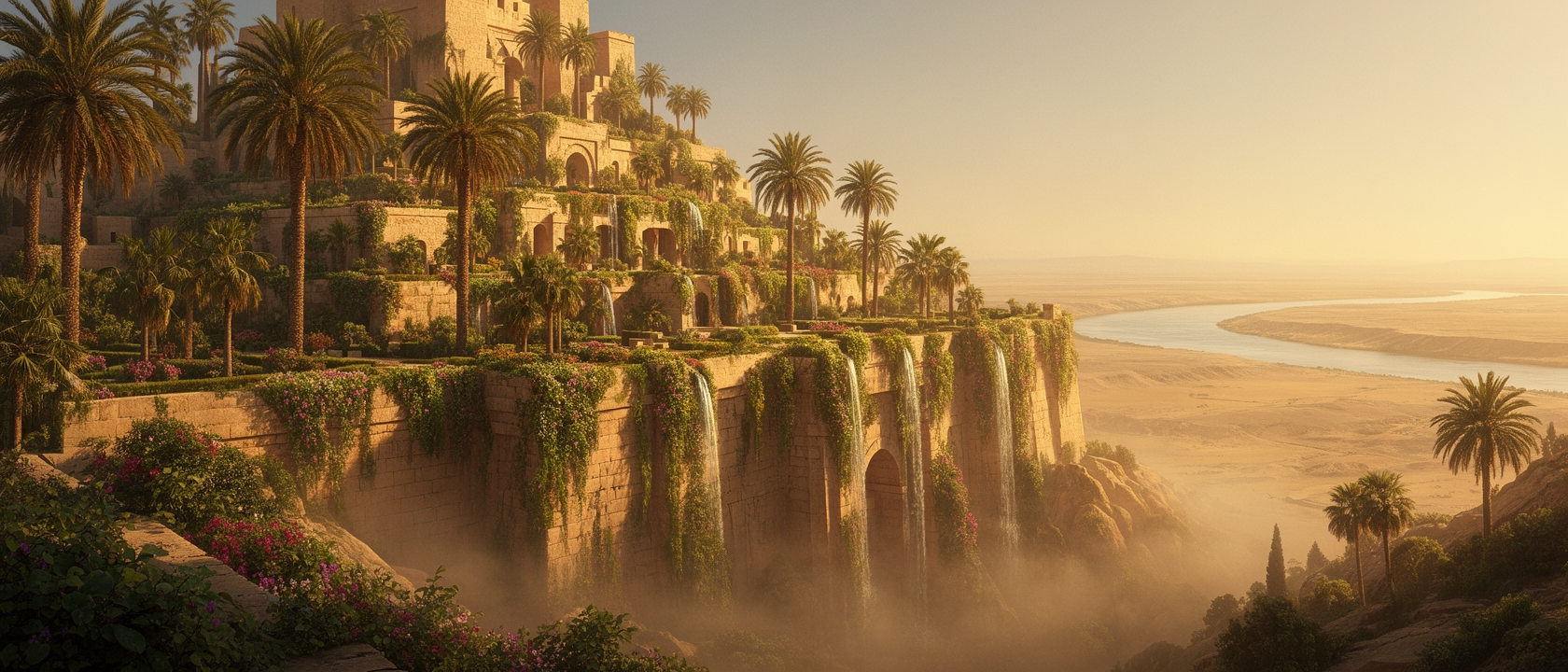
The Wonder Nobody Can Find
Six of the Seven Wonders of the Ancient World left something behind. The Great Pyramid still stands. The Lighthouse of Alexandria left physical traces before its final collapse. The Mausoleum at Halicarnassus left ruins behind. But the Hanging Gardens of Babylon? Nothing. Not a foundation stone, not a clay tablet, not a single Babylonian word about them.
A City That Kept Records of Everything Else
The Babylonians were meticulous record-keepers. A collection of cuneiform tablets known as the Topography of Babylon lists Nebuchadnezzar’s city in exhaustive detail, its walls, gates, temples, even individual street names. The gardens do not appear. Not once.
The accounts we have come from Greek and Roman writers, all working centuries after the gardens were supposedly built. Berossus, a Babylonian priest writing around 290–280 BCE, is the earliest source and the only ancient writer to credit Nebuchadnezzar II specifically, yet his original text has not survived, known only through later quotations. The other ancient writers who describe the gardens are at an even greater remove. Herodotus, who visited Babylon in the 5th century BCE and wrote extensively about its irrigation, never mentioned them at all.
What It Would Have Taken to Build Them
If the gardens existed, they were a serious feat of engineering. According to Diodorus Siculus, the structure measured roughly 120 meters per side and rose to about 26 meters, a stepped pyramid covered in soil and trees, designed to resemble a forested mountain rising from the Mesopotamian plain.
Mesopotamia has almost no natural stone, so buildings relied on sun-dried mud brick, which constant water dissolves. Ancient descriptions specify a layered waterproofing system: reeds mixed with bitumen, two courses of baked brick bonded with cement, then a layer of lead. Getting water to the upper terraces was a separate problem. Cuneiform inscriptions from Assyrian king Sennacherib (704–681 BCE) describe bronze water-raising screws that predate Archimedes by roughly 400 years, complicating the traditional story of who invented that device.
The Eighteen-Year Search
German archaeologist Robert Koldewey began excavating at Babylon on March 26, 1899, and kept at it for 18 years, until World War I forced a halt in 1917, with more than 200 workers employed daily. He uncovered the Ishtar Gate, the Processional Way, and the foundations of the great ziggurat linked to the Tower of Babel legend. In the southern citadel he found a vaulted basement with holes he read as pump shafts, and concluded he had found the gardens. Later researchers disagreed: a cuneiform tablet from the same site identified the building as a distribution center for grain, oil, and spices. Most scholars now read it as a warehouse.
Three Ways to Explain a Missing Wonder
The simplest explanation is that the gardens never existed, that Greek and Roman writers invented or embellished a legend of lush paradise in the desert East. Even the name may carry a mistranslation: the Greek kremastos, rendered as “hanging,” more precisely means “overhanging,” evoking stepped terraces rather than anything suspended in mid-air.
A second possibility: they were real but left nothing to find. An earthquake in the 2nd century BCE could have cracked the waterproofing, letting water reach the mud-brick core and dissolving the structure within a generation. After Persia conquered Babylon in 539 BCE, the Euphrates was also intentionally diverted away from the city, which would have killed any garden dependent on continuous irrigation.
A third argument comes from Assyriologist Stephanie Dalley, who published her research in 2013 after roughly two decades studying Akkadian cuneiform texts. Her hypothesis is that the gardens were real but built at Nineveh, the Assyrian capital about 480 kilometers north of Babylon, by Sennacherib rather than Nebuchadnezzar. Sennacherib’s own inscriptions describe a spectacular garden and bronze water-raising screws matching the Greek accounts. Satellite imagery has revealed a canal system approximately 97 kilometers long running from the mountains to Nineveh, and the Jerwan Aqueduct, built from roughly 2 million stones, portions of which still stand, supplied water to the city. Dalley argues that Greek writers confused Nineveh with Babylon, since “Babylon” functioned as a loose term for multiple Mesopotamian cities. The theory is not universally accepted, but it offers physical evidence the Babylon hypothesis has never matched.
The most famous garden in ancient history is either a romantic myth, a dissolved ruin, or sitting in the wrong city on every ancient map. One of those three has to be right, and nobody has been able to prove which.