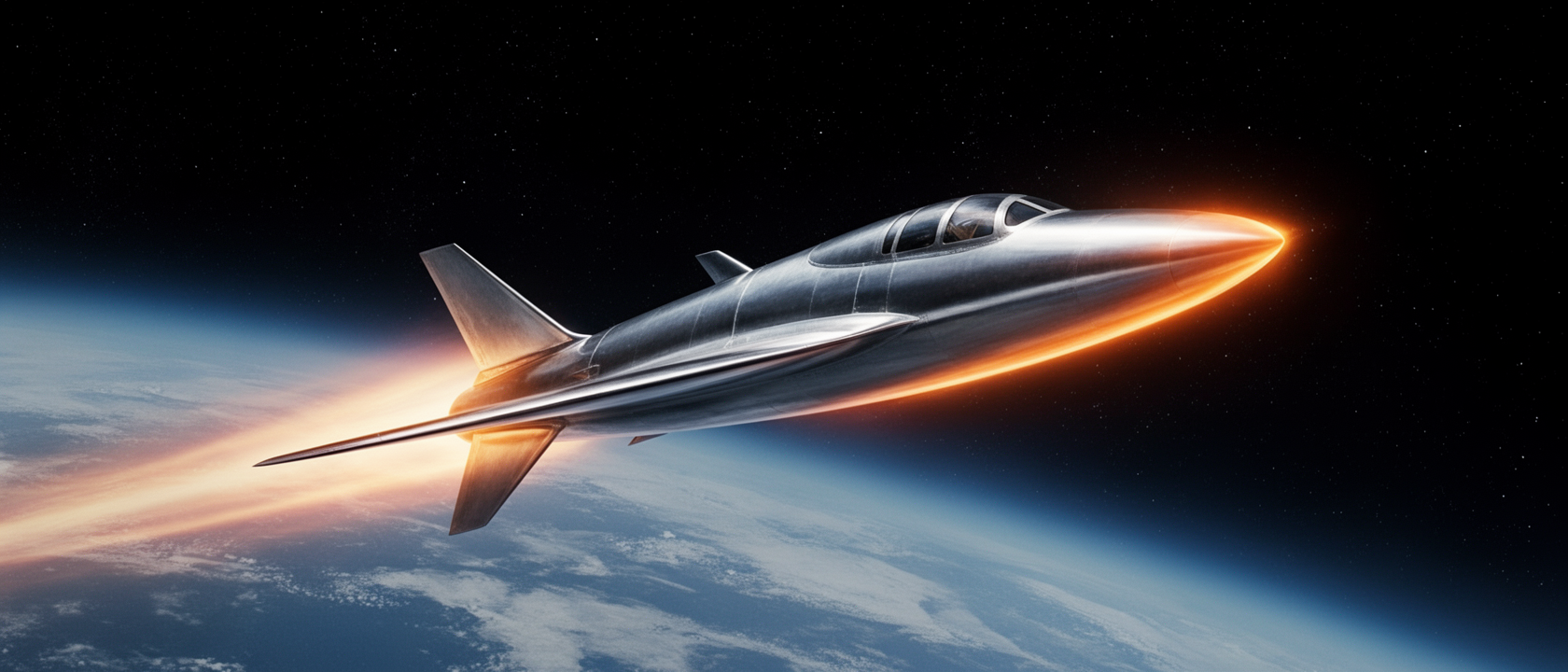
The Rocket Plane That Wanted to Skip Across the Atmosphere
In 1941, Austrian aerospace engineer Eugen Sänger handed the German Air Ministry a 900-page document outlining a plan to strike New York City from a launchpad in Europe, continue across the Atlantic and the United States, and land on a Japanese-held island in the Pacific, somewhere between 19,000 and 24,000 kilometers, no refueling, no second aircraft. The vehicle was called the Silbervogel, German for “Silver Bird.” It never flew. But the ideas embedded in its design shaped aerospace engineering for decades.
A Gap in the Physics
Conventional aircraft are limited by fuel range. Ballistic missiles arc high and fall straight down, with no cross-continent steering. Orbit requires far more speed than Sänger’s design could achieve. The Silbervogel fit none of those categories. So Sänger and his collaborator, mathematician Irene Bredt, proposed something different: skip the craft across the top of the atmosphere the way a flat stone skips across water.
How the Skip Works
A 3-kilometer rocket sled accelerated the craft to roughly 1,930 km/h in about 10 seconds. The Silbervogel’s own engine then fired for 168 seconds, pushing it to 145 kilometers altitude at 21,800 km/h, about 18 times the speed of sound and above the 100-kilometer Kármán line. Rather than entering orbit, the craft would descend until its flat underside generated lift, bouncing it back up. Each skip shortened as drag bled speed, carrying a 4,000-kilogram payload from Germany to the American eastern seaboard. This flight profile is now called boost-glide, and versions of it appear in hypersonic research programs active in the 2020s.
Keeping the Engine From Melting
Sänger’s solution to engine heat, patented in 1935, was to route fuel through channels in the engine walls before combustion. The cold fuel absorbed heat, prevented meltdown, and arrived pre-warmed. This is called regenerative cooling, and nearly every liquid-fueled rocket engine since uses it, including engines that currently launch satellites and crew vehicles. Sänger and Bredt worked it out on paper for a weapon never built, and the method outlasted everything else about the project.
The Numbers and the Outcome
The Silbervogel was 28 meters long, roughly 10 tonnes empty, and nearly 100 tonnes fully loaded. Sänger submitted the full proposal on December 3, 1941. The Air Ministry filed it away as too large and complex. A revised version appeared in August 1944; it too was shelved. Post-war analysis revealed a fatal flaw: aerodynamic heating on the first skip was far greater than Sänger and Bredt had calculated. The craft would likely have been destroyed by atmospheric friction before delivering anything. A thicker heat shield would have gutted the payload capacity, and since Germany never developed an atomic weapon, the conventional bomb load was already hard to justify against simpler alternatives.
What the Silver Bird Left Behind
Sänger founded the Fédération Astronautique in 1949, returned to Germany in 1954, and became a professor at the Technische Universität Berlin. He died in Berlin on February 10, 1964, at 58. The boost-glide concept from his 900-page document directly influenced the U.S. Air Force’s X-20 Dyna-Soar program, which ran from October 24, 1957, to December 10, 1963, and fed into the design lineage that produced the Space Shuttle. The regenerative cooling patent is now standard engineering practice. The Silbervogel never left the ground, but the two ideas at its core ended up in almost every serious rocket program that followed.