The Image Doesn’t Match
Picture Lincoln the way everyone does: gaunt, bearded, delivering the Gettysburg Address in a tall black hat. Now picture Pappsville, Illinois, 1832. A much younger Lincoln gives his first political speech, and when a man in the crowd shoves one of his supporters, Lincoln stops mid-sentence, throws the man down, then calmly finishes his remarks.
Around those same years he was already known as the man who’d thrown the toughest brawler in a rough local gang flat on his back. How does the president we remember start out as that guy?
The Two Lincolns
The Lincoln of textbooks is careful with words, prone to melancholy, morally serious. The Lincoln almost nobody teaches is a frontier wrestler, one of the toughest hands around.
Historians didn’t invent this for color. His family moved from Kentucky to Indiana when he was seven, and from there into his early twenties, wrestling was simply part of growing up male on the frontier. The puzzle is how the two men fit together.
Built by an Axe, Not a Gym
Lincoln stood 6 feet 4 inches (1.93 m) and, in his younger years, weighed around 180 to 185 pounds (82 to 84 kg). People who knew him didn’t call him bulky. They called him unnaturally strong.
That strength came from work, not training: swinging an axe, splitting rails, hauling loads for years. It builds a strong back and a grip that won’t quit, and combined with his reach, that’s what wins in catch-as-catch-can wrestling, a grab-and-throw style where the match ends once you put a man flat on his back. On the frontier, that settled a young man’s pecking order.
The Jack Armstrong Fight, Corrected
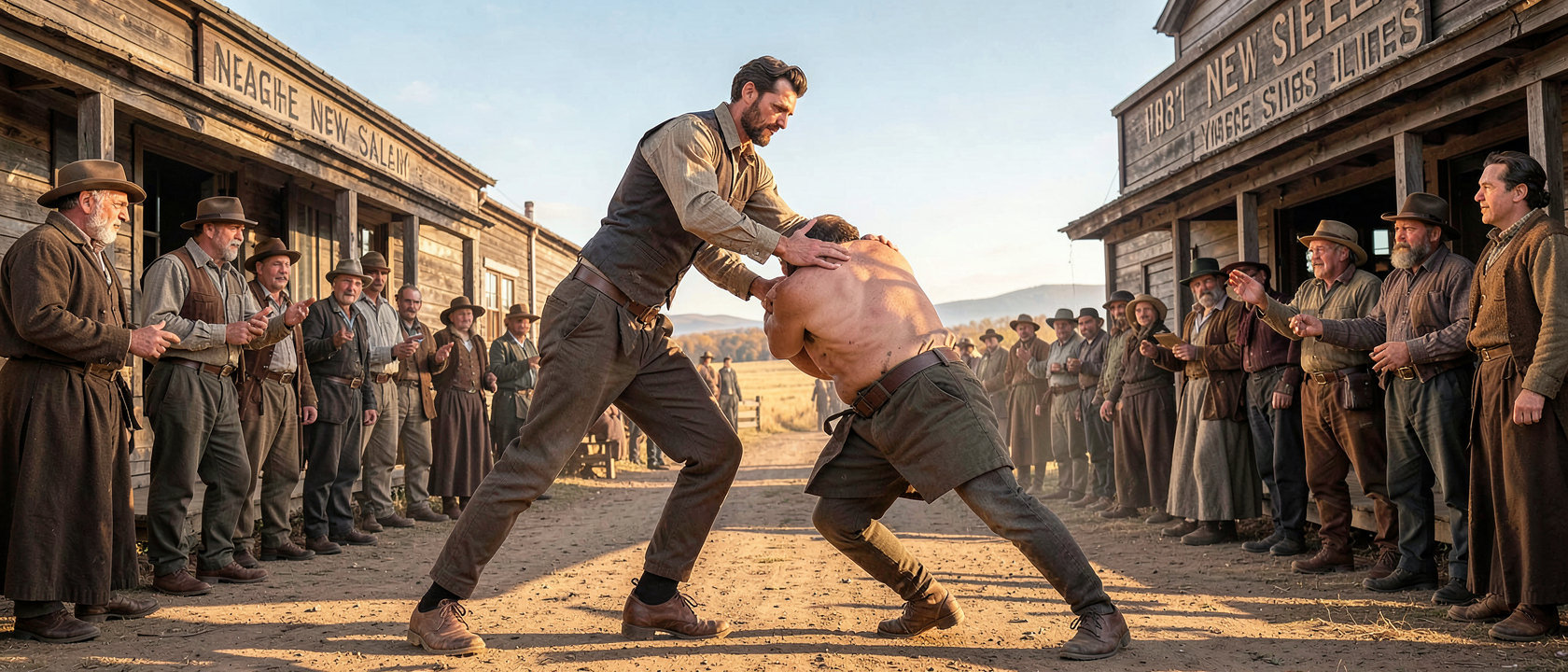
His most famous match came in 1831 in New Salem, Illinois, when he was 22. His employer, Denton Offutt, had bragged that his clerk could beat anyone in the Clary’s Grove Boys, a crew led by Jack Armstrong, who stood about 5 feet 8 inches (173 cm) but had a reputation for raw strength.
The town turned out to watch and bet. Accounts disagree on the finish, but Armstrong’s gang ended up impressed rather than angry, and Armstrong became one of Lincoln’s closest friends. It helped the next year, when Lincoln lost his first run for the state legislature overall but still took all but three of the 300 votes cast in his own precinct.
What the legend usually skips: there was no state title at stake. Illinois had no official wrestling championship, and Armstrong was simply the toughest man inside one small gang. Even the famous boast sometimes put in Lincoln’s mouth that day isn’t reliably documented.
The Barrel, the Brother, and a Disputed Loss
A few smaller stories round out the picture. By one account, Lincoln won a bet by lifting a full whiskey barrel overhead and drinking from the bunghole, the hole used to fill it. In another, after his family was snubbed from a wedding, a mocking poem he wrote led to a wrestling challenge; Lincoln let his stepbrother John Johnston take the match, then stepped in himself when Johnston started losing, throwing the challenger down.
Then there’s the one loss that shows up in his story. According to a single retelling, during the Black Hawk War in 1832, as a militia captain, Lincoln lost a best-of-three match to a soldier named Lorenzo Dow Thompson, who reportedly took two straight falls, the second with what a friend called a “crotch lock.” It’s a detail historians haven’t been able to confirm elsewhere, so take it as a good story rather than a settled fact. Either way, the undefeated version of him was never quite true.
An Old Man’s Party Trick
Decades later, in the White House, Lincoln reportedly kept one trick from the farm: holding a full-sized axe straight out, gripping only the very end of the handle, for several minutes at a stretch. That claim also comes from a single account rather than multiple independent sources, but it fits everything else we know about his strength. It takes real shoulder and forearm strength at any age. He never did it for crowds, just for people close to him, a quiet sign the farm boy was still there, under the statesman.
What’s Real and What’s Tall Tale
Two claims about those years don’t hold up well: that Lincoln fought roughly 300 matches and lost only once, and that he once split a railroad tie in a single swing of an axe. No record backs either number, and historians treat both as folklore that grew with retelling.
That’s how strength stories about real people tend to work: easy to exaggerate, nearly impossible to verify decades later, and satisfying to repeat because they sound almost too good. Lincoln really did stand 6 feet 4 inches, beat a gang leader, and, by at least one account, lose a match and hold an axe at arm’s length long after his farm years. He probably never fought anywhere close to 300 times. Knowing which detail to trust is the real trick, and that’s exactly the kind of thing you’re good at.