The Wrong Kind of Power
By the end of the nineteenth century, the men most likely to conquer the air seemed obvious: funded by governments, armed with engineering degrees, building machines that weighed as much as a small car. Against them, two brothers from Dayton, Ohio, were tinkering with bicycle parts. The brothers won.
The explanation has almost nothing to do with luck. It comes down to a misunderstanding that nearly everyone else in the field shared.
The Establishment and Its Money
Hiram Maxim poured enormous resources into his flying machine: a wingspan of around 110 feet, 3.5 tons, and two steam engines producing 180 horsepower each. His reasoning was that enough lift would force the weight off the ground. On July 31, 1894, the machine broke free of its guard rails, briefly left the track, then crashed. It had never been designed with a directional control system, a very expensive demonstration that lift alone doesn’t get you anywhere useful.
In France, Clément Ader constructed a bat-like monoplane called Éole. On October 9, 1890, at Château d’Armainvilliers, it skimmed 50 meters at about 20 centimeters height, the first powered aircraft to lift a human from level ground under its own power. But it could not be steered. His follow-up, Avion III, failed at trials on October 12 and 14, 1897, when wind pushed it sideways. The official army report stated no flight had occurred; Ader’s later claim of nearly 1,000 feet is not accepted by historians. The French War Ministry had funded him with 650,000 francs. The Wrights built their first successful aircraft for under $1,000.
The Question Everyone Was Getting Wrong
Both Maxim and Ader treated flight as a problem of brute force: enough power, enough lift, and the machine would go up. Any working aircraft actually had to solve three distinct problems, generating lift, getting sufficient power from a light enough engine, and controlling the aircraft once airborne. Both men focused heavily on the first two and largely ignored the third.
Learning by Falling
Otto Lilienthal understood control better than anyone. Before his fatal crash on August 9, 1896, he died in a Berlin hospital the following day, he had made more than 2,000 glider flights across at least 16 designs, controlling them by shifting his body weight. His central argument: you cannot add an engine to something you do not yet know how to fly.
News of Lilienthal’s death reached Wilbur Wright, who later wrote that his active interest in flight dated precisely to that moment. Starting in 1899, the brothers ran a systematic four-year program before attempting powered flight, building and testing three full-sized gliders. In late 1901, they constructed a wind tunnel in their bicycle shop and tested more than 200 wing shapes. What they found invalidated nearly every reference engineers had been using: almost every published wing-lift table in the world was wrong. They built corrected tables from their own data.
Three Axes, One Solution
Any aircraft can rotate around three axes: pitch (nose up or down), roll (one wing dipping lower), and yaw (nose swinging left or right). Controlling all three simultaneously separates controlled flight from a short, dramatic accident. The standard thinking was to build a stable airframe and push it forward with power. The Wrights reversed this entirely.
In 1899, Wilbur tested wing warping using a 5-foot biplane kite: twisting the wings in opposite directions induced and corrected roll, giving the pilot active control over balance. By 1902, their third glider combined corrected aerodynamic data, wing warping, and a moveable rudder linked to the warping system. It proved three-axis control was achievable. Only then did they build an engine.
December 17, 1903
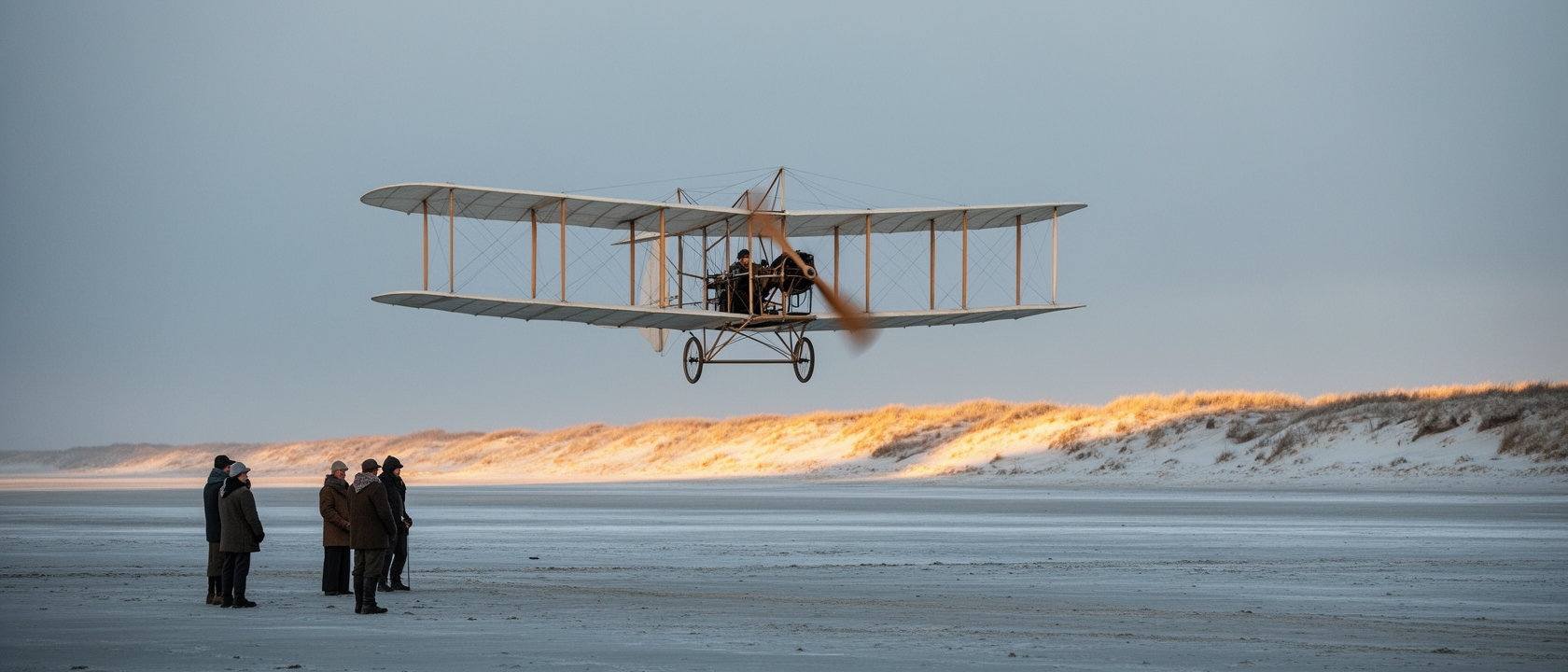
The engine, built largely by their mechanic Charlie Taylor, produced 12 horsepower, against Maxim’s 360. The difference was weight: it was light enough to fly, and the aircraft it powered could actually be steered. At Kill Devil Hills, North Carolina, starting at 10:35 a.m. on December 17, 1903, Orville flew first: 120 feet in 12 seconds. On the fourth flight, Wilbur stayed airborne 59 seconds and covered 852 feet. A gust of wind damaged the aircraft after landing, and it never flew again.
Five witnesses were present. The French War Ministry had spent 650,000 francs on machines that could not be steered. Maxim’s aircraft had weighed 3.5 tons and smashed through its own safety rails trying to demonstrate lift. The Wrights had done something neither man managed: built an aircraft a pilot could actually control. That, it turned out, was the whole problem.