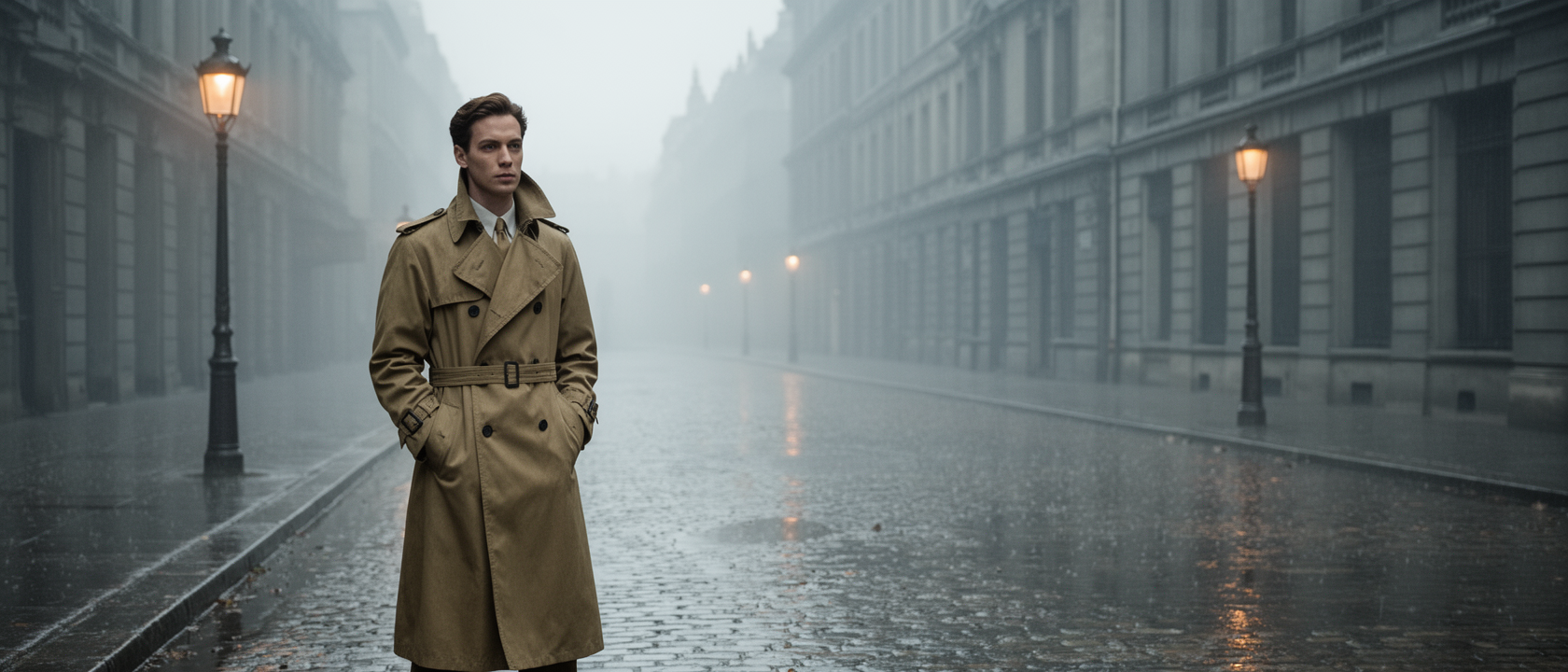
The Coat Built for Mud and Snipers
Picture a trench coat and a specific image arrives: Humphrey Bogart as Rick Blaine in Casablanca, collar up; Audrey Hepburn as Holly Golightly stepping onto a Manhattan sidewalk. The garment reads as classic, even quietly authoritative. Every feature that looks elegant was engineered to keep a person alive in the mud of the Western Front.
A Fabric Problem With a Smelly History
For decades before World War I, “waterproof” meant rubberized. In 1823, Scottish chemist Charles Macintosh patented a process sandwiching dissolved rubber between two layers of wool. It kept rain out but trapped body heat, smelled in warm weather, and turned rigid in the cold.
The real advance came in 1879, when Thomas Burberry watched shepherds in Hampshire wear lanolin-coated smocks and approached the problem differently. Instead of coating finished fabric with rubber, he treated individual threads with lanolin before weaving them into a tight twill. The result was gabardine: breathable and waterproof simultaneously. The formal patent followed in 1888.
By 1901, Burberry had submitted a military raincoat design to the British War Office, and the coat saw use during the Second Anglo-Boer War (1899–1902). That is where khaki entered the picture: calculated camouflage replacing the bright uniforms that had made soldiers conspicuous.
What Those “Decorative” Details Actually Did
In 1912, Burberry patented the Tielocken, the direct ancestor of every trench coat since. When WWI broke out in August 1914, the design was adapted for the trenches, and each modification addressed a specific problem.
The epaulettes identified an officer’s rank at a glance, a function that was practically necessary but, as it turned out, came with serious tactical consequences. The storm flap across the chest blocked rain from pooling in the front opening and padded the shoulder against rifle recoil. The large chest pockets were sized for military maps. Buckled cuffs sealed the sleeve against the wrist to stop rain running down the arm. The wide, high collar was designed to accommodate bulky gas masks; a low collar would not close around one.
The Back Cape
The panel sewn across the upper back, called the yoke, is the feature most people assume is purely a styling choice. It is a drainage system: water hitting the shoulders is channeled away and drops off the rear hem of that extra layer rather than soaking through to the back. The removable wool lining handled temperature with equal practicality, letting one coat cover the cold night watch and the temperate afternoon.
The Problem With Looking Like an Officer
The coat was not standard issue. It was restricted to Warrant Officers Class I and above and had to be privately purchased, making it a visible class marker. Men promoted from working-class backgrounds to officer rank, known as “temporary gentlemen”, spent heavily on the coat to signal they belonged.
The consequences were grim. Junior officers were dying at roughly double the rate of enlisted men: historian John Ellis, in his 1989 work Eye-Deep in Hell, put the mortality rate for subalterns between 65% and 81%. The average life expectancy of a lieutenant on the Western Front ran to approximately 42 days. Wearing a coat that clearly identified you as an officer was not a social advantage when snipers were watching the parapet.
One Myth Worth Clearing Up
The metal D-rings on the belt generate reliable speculation, grenades come up, swords come up. Both are wrong. The rings were for hanging general equipment, the same function a D-ring serves on a pack.
The phrase “trench coat” first appeared in a tailoring trade journal in 1916, two years into the war that created the need for it. Both Burberry and Aquascutum claim credit for inventing the garment, and historians have not settled the dispute. What is settled: the coat most people think of as a fashion staple was a piece of field engineering, refined by the specific miseries of the Western Front.