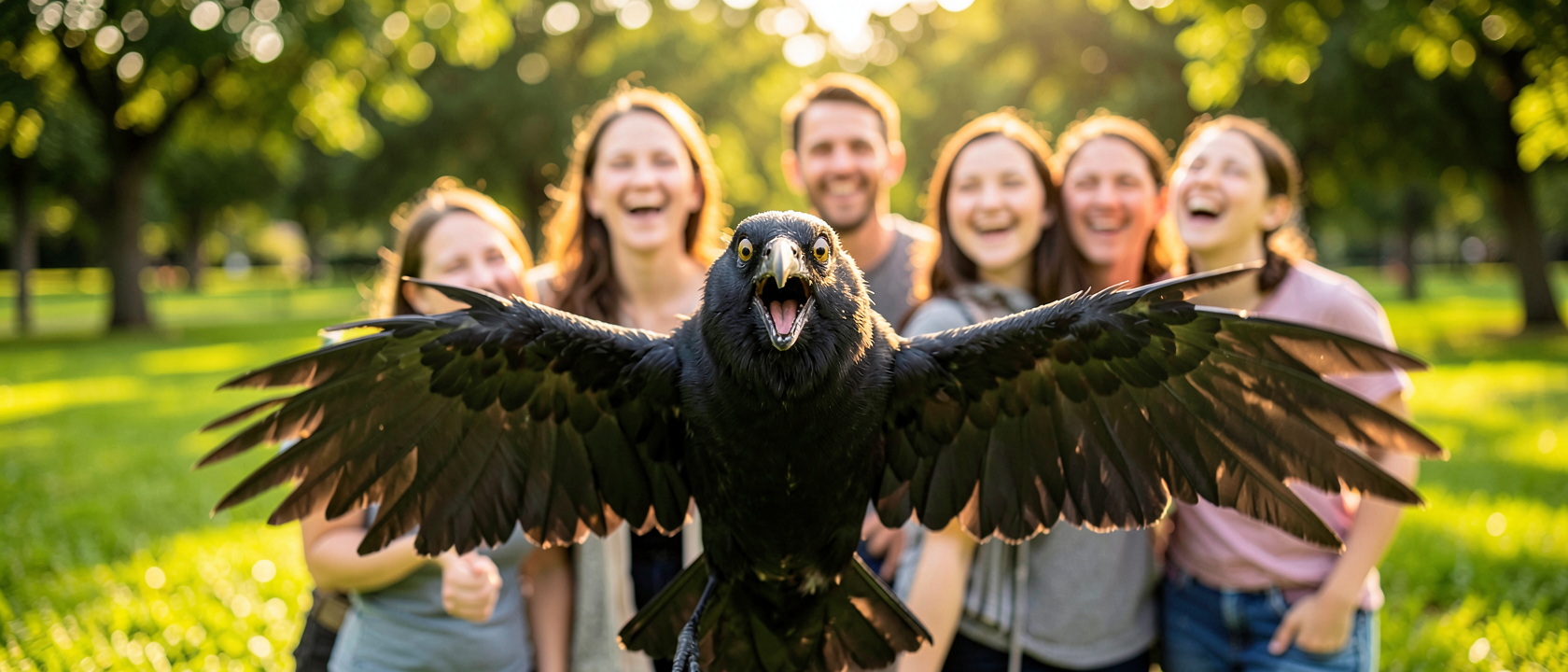
The Uninvited Guest with the Best Timing
Dogs fill the internet with charm. Cats supply the attitude. But there is one photographic scenario where birds hold an uncontested position: the photobomb. Not just any photobomb, the kind where the bird arrives at the exact wrong moment, locks eyes with the lens, and makes the original photo irrelevant. A seagull materializing above someone’s lunch. A red robin inserting itself, repeatedly, into visitors’ portraits at Dalkeith Country Park in the UK. The question is not whether it happens. The question is why birds do it so consistently well.
It’s All in the Eyes
The detail that separates a bird photobomb from a dog blundering through a frame is the gaze. Birds stop and stare directly at the lens, and that look reads, to human eyes, as deliberate and a little evaluative. There is a biological reason they look at a camera rather than past it. Most birds have four types of cone photoreceptors, compared to three in humans, what scientists call tetrachromatic vision, extending into ultraviolet wavelengths our eyes cannot process. A glass lens catching light is something their visual system is genuinely well-suited to detect. Whether a bird finds a camera lens interesting is a separate question. What the unblinking stare reliably produces in the viewer, though, is the impression that the bird assessed the situation and decided to stay.
The Bird Could Leave. It Didn’t.
Here is the central thing. A toddler wandering into a family portrait cannot fly. A stranger on a beach takes a moment to step aside. A bird can exit the frame in under a second by simply opening its wings. Every moment it stays is therefore perceived, however anthropomorphically, as a choice. That is what gives a bird photobomb its theatrical quality. When a meteorologist at KTVU was photobombed live on air in early 2018, the bird’s composed presence in front of an entire television setup was funny precisely because it so obviously had no reason to stay. It stayed anyway.
Shiny Object Hypothesis (Handle With Care)
One plausible explanation for why birds approach cameras involves the lens itself. Corvids, crows, ravens, magpies, jays, are scientifically documented to investigate novel and reflective objects, a behavior attributed to curiosity and exploratory instinct. The popular idea that magpies compulsively steal shiny things has been largely debunked. Research suggests they are drawn to novelty broadly, and some studies found they actually avoided unfamiliar shiny objects. Whether a camera lens specifically attracts birds this way is a reasonable hypothesis, but no published research confirms it. These are plausible guesses, not ornithological conclusions, and the difference matters.
Let’s Be Clear: Nobody Measured This
No peer-reviewed study ranks animals by photobombing effectiveness. Calling a bird’s timing “impeccable” or its expression “contemptuous” is anthropomorphism, a normal cognitive shortcut humans use to interpret animal behavior, not a description of what the bird intended. Recognizing that does not flatten the joke; it makes the whole thing more interesting. What birds demonstrably do have, in at least some species, is genuine curiosity. Researchers identified a variant of the Drd4 gene, which codes for a dopamine receptor, in great tits that correlates with stronger exploratory behavior. A 2025 study in the journal Open Mind found that kea parrots sought additional information after an unexpected event more often than three-year-old children did. Birds are curious. Cameras are novel. The rest is our interpretation.
Why We Laugh (and Why We Don’t Get Annoyed)
When a person photobombs a picture, the reaction is often a mix of amusement and mild irritation. A bird carries none of that social weight. There is no perceived rudeness, no invasion of personal space in any meaningful sense. The comedy is clean. There is also a subverted-expectation effect at work: wildlife is usually fleeting, and a bird holding its position long enough to ruin a carefully framed shot runs against every instinct we have about how animals behave near people. Subverted expectations are one of the most reliable engines of humor. Collins English Dictionary did not name “photobomb” its Word of the Year in 2014, chosen from nearly 50,000 new additions, because the phenomenon was obscure. The bird gets the credit. The laugh, strictly speaking, is ours.