The Jeep That Landed Upside Down
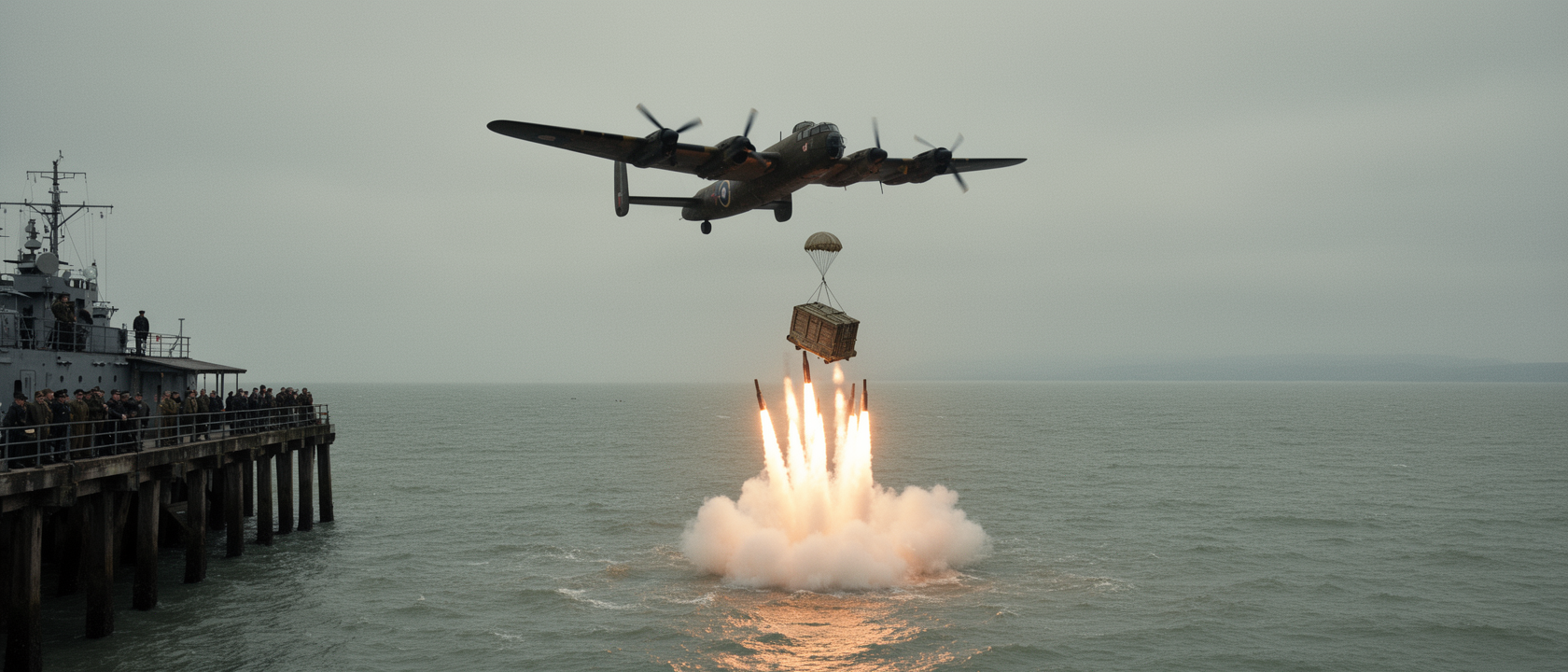
Somewhere over the Bristol Channel in 1943, an Avro Lancaster bomber released a concrete block fitted with cordite rockets. The block shot past the target area, punched through the roof of the testing team’s own engineering shop, sheared a steel joist, and demolished a covered walkway. Nobody was hurt, but the irony was hard to ignore: the British military’s newest secret weapon had just bombed its own headquarters.
The project was called Hajile. Captain G.O.C. Davies coined the name during an earlier test, when a prototype fired upward rather than braking downward and he shouted that it looked like Elijah in reverse, the biblical prophet who ascended to heaven in a chariot of fire. This device did much the same, just without the heaven part.
The Problem Parachutes Could Not Solve
Parachutes make you drift. Wind carries a soldier or supply drop sideways, sometimes far enough to miss the target entirely, while slow descent leaves troops exposed to enemy fire. The British Army wanted a system that would let a payload fall fast and brake only at the very last second.
The fix: mount downward-facing cordite rockets beneath the falling load and fire them just before impact. To nail the timing, engineers hung a weighted wire, a plumb-bob, below the platform. The moment it touched ground, it would trigger ignition. A last-second brake, calibrated by gravity itself.
Physics vs. Wet Fuses
In practice, three things went wrong repeatedly. The cordite rockets were sensitive to moisture. The first jeep drop, the Royal Navy refused to supply vehicles for such a speculative device, so the United States Navy eventually provided two, ended when snowfall dampened the fuses and prevented ignition entirely. The jeep hit the ground at terminal velocity and was destroyed.
Second, even when rockets fired, they rarely all ignited at exactly the same instant. Uneven thrust sent the payload tumbling sideways. The second jeep landed upside down. Third, soft or irregular ground fooled the trigger: the plumb-bob could brush a raised patch of earth and set off the rockets well above the right altitude.
The project ended on June 6, 1944, at the Shoeburyness testing range in Essex. An electrician was checking wiring on a rig he did not know was live. All eight rockets ignited simultaneously, launching the iron framework roughly 40 feet into the air before it crashed back down. Several team members were injured, and photographer Louis Klemantaski was temporarily blinded by a sand blast to his eyes.
The Wheezers and Dodgers
Hajile came from the Directorate of Miscellaneous Weapons Development, known inside British military circles as the “Wheezers and Dodgers.” Led by Canadian chemist Charles Goodeve and staffed by an eclectic mix that included Barnes Wallis, inventor of the bouncing bomb used in the 1943 Dambusters raid, the group pursued ideas more conventional departments would not touch. The DMWD also developed the Hedgehog and Squid anti-submarine mortars and contributed to the Mulberry floating harbors built for the Normandy landings. Other ideas, like the Great Panjandrum, a rocket-propelled explosive wheel designed to roll up beaches and destroy coastal defenses, did not go according to plan.
What Came After
The core concept was never wrong, only premature. By 1975, the Soviet Union had a working ground-contact retrorocket system in operational service on the BMD-1 airborne infantry vehicle: four long rods extended below the landing pallet, and the moment they touched earth, rockets fired, bringing impact speed down to 6 to 7 meters per second, hard, but survivable, with crew riding inside.
The Soyuz spacecraft uses the same principle. Six solid-fuel engines fire when a gamma-ray altimeter detects the capsule is approximately 1 meter above the surface, slowing it from 7.2 to around 1.5 meters per second. The trigger is a sensor rather than a weight on a wire, but the underlying logic, fall fast and brake at the last possible moment, is exactly what the Wheezers and Dodgers were attempting over the Bristol Channel, with concrete blocks and damp fuses, more than three decades earlier.