A Sandwich Counter With a Secret Room
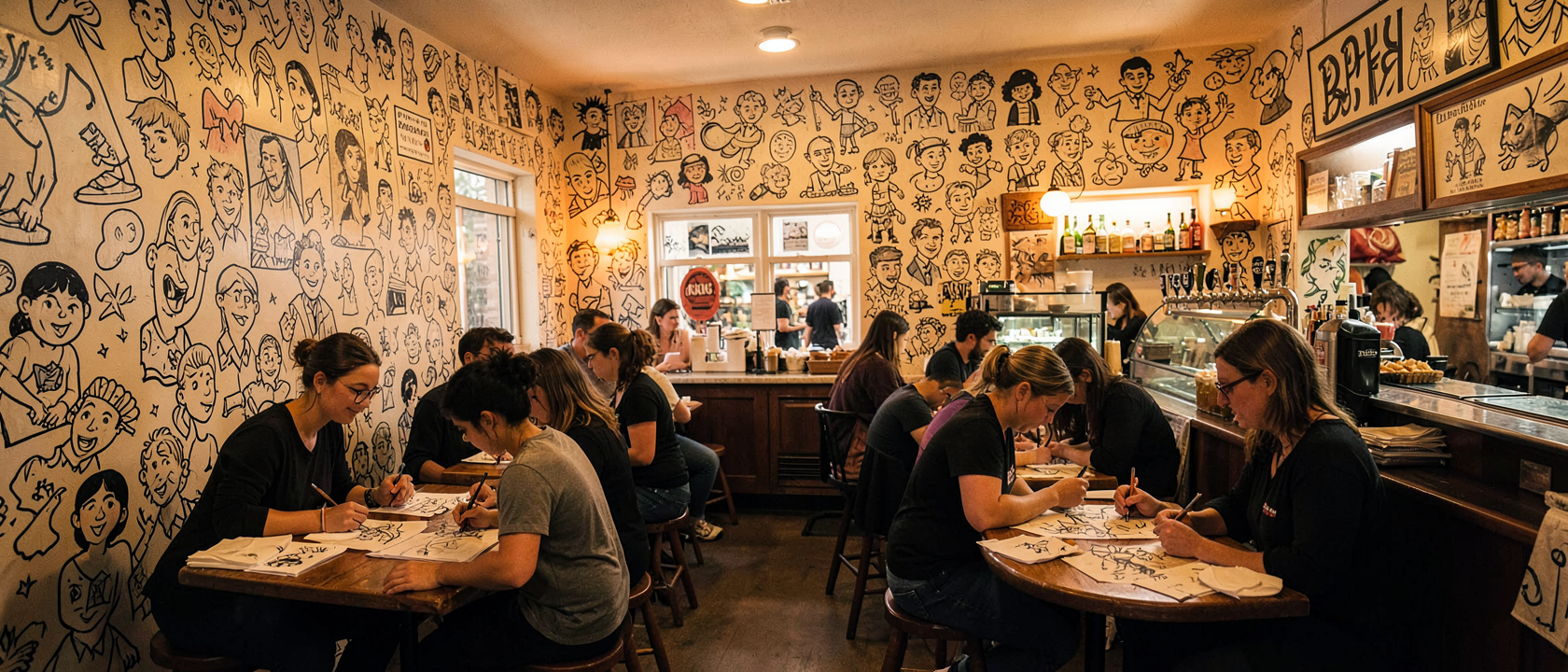
If you walked into Moore’s Delicatessen in Burbank, California, the front of the house looked like any neighborhood deli: a counter, a menu board, the smell of coffee and bread. Head toward the back dining room, though, and the character of the place changed completely. SpongeBob SquarePants held up a spatula on one wall. Patrick Star grinned a few feet away. Manny Rivera, the hero of El Tigre, shared space with Flapjack, Mordecai from Regular Show, and a character named Lumpy from Adventure Time. None of it was framed, none of it printed on canvas. Every character had been drawn straight onto the wall itself, in marker, signed by whoever put it there. By the time the mural wrapped around the room, it added up to an 80-foot (24-meter) run of characters, crammed floor to ceiling in places, in a space built for sandwiches.
Why Would Anyone Let This Happen to Their Walls?
Any other restaurant owner would look at a wall covered in marker and reach for a paint roller. A drawing nobody authorized usually counts as damage to fix, not art to keep. Moore’s Delicatessen did the opposite. Year after year, nobody painted over a single sketch, and nobody hired a professional muralist to tidy things up either. The drawings kept appearing one at a time, clearly the work of customers rather than contractors. So what kind of deli ends up with a clientele whose doodles are worth preserving instead of scrubbing off?
Burbank Explains Everything
The answer is in the location. Moore’s Delicatessen opened in October 2010, within reach of Cartoon Network Studios, Nickelodeon Animation Studio, and Walt Disney Studios. It was started by Robert Moore, a former executive chef who had spent six years running the kitchens at Dodger Stadium before opening a deli of his own with his wife, Christine Moore. Burbank is not just a city where cartoons happen to be popular. It is one of the real working centers of American animation, which meant Moore’s regulars were not fans doodling characters from memory. They were the animators, illustrators, and designers who draw those characters for a living, on a lunch break, with the same hand they use back at the studio.
The Bowl of Sharpies That Started It All
What turned stray sketches into a standing tradition was one small decision. Moore noticed his animator customers doodling on napkins while they waited for their food, so he bought a bowl of Sharpie markers, set it by the counter, and told them to draw on the walls instead and sign their work. That removed every excuse. Nobody had to bring a pen, ask permission, or plan ahead. All it took was showing up hungry. The first drawing to go up was SpongeBob SquarePants holding a spatula, done by character designer Robert Ryan Cory, and it set the tone for everything that followed: fast, casual, and entirely unplanned.
One Sketch, Then Another, Then a Landmark
From there, the wall filled in the way these things actually happen: slowly, with no one directing it. El Tigre creator Jorge Gutierrez added his own character, Manny Rivera. The Marvelous Misadventures of Flapjack creator Thurop Van Orman drew Flapjack. Writer Sean Szeles sketched Mordecai from Regular Show. Adventure Time creator Pendleton Ward added Lumpy. SpongeBob SquarePants creator Stephen Hillenburg, who visited the deli about once a week, drew Patrick Star. Nickelodeon characters ended up a few feet from Cartoon Network characters, sharing a wall in a way that would never happen on a studio lot. The deli even hosted premieres: in 2010, storyboard artist Kent Osborne and his colleagues needed somewhere to watch the debut of Adventure Time, and Moore offered his restaurant. None of it was planned as a landmark. It became one simply because nobody ever said no.
The Food Held Its Own, Too
It would be easy to assume the deli survived on novelty alone, but the food carried its own weight. Moore’s served deli sandwiches, burgers, breakfast, soups, salads, coffee, and craft beer, including a signature sandwich called the “city hall,” built from corned beef, pastrami, or ham on rye with melted Swiss, coleslaw, and Russian dressing. People came back for the sandwiches whether or not they cared about cartoons, and that ordinary reliability is part of why the extraordinary back room worked at all. Moore’s Delicatessen closed on August 31, 2020, after the COVID-19 pandemic cut its business by 80 percent despite a shift to takeout, delivery, and patio seating. When Robert Moore announced the closure, he wrote four words that fit a deli full of cartoonists perfectly: “That’s all folks.”