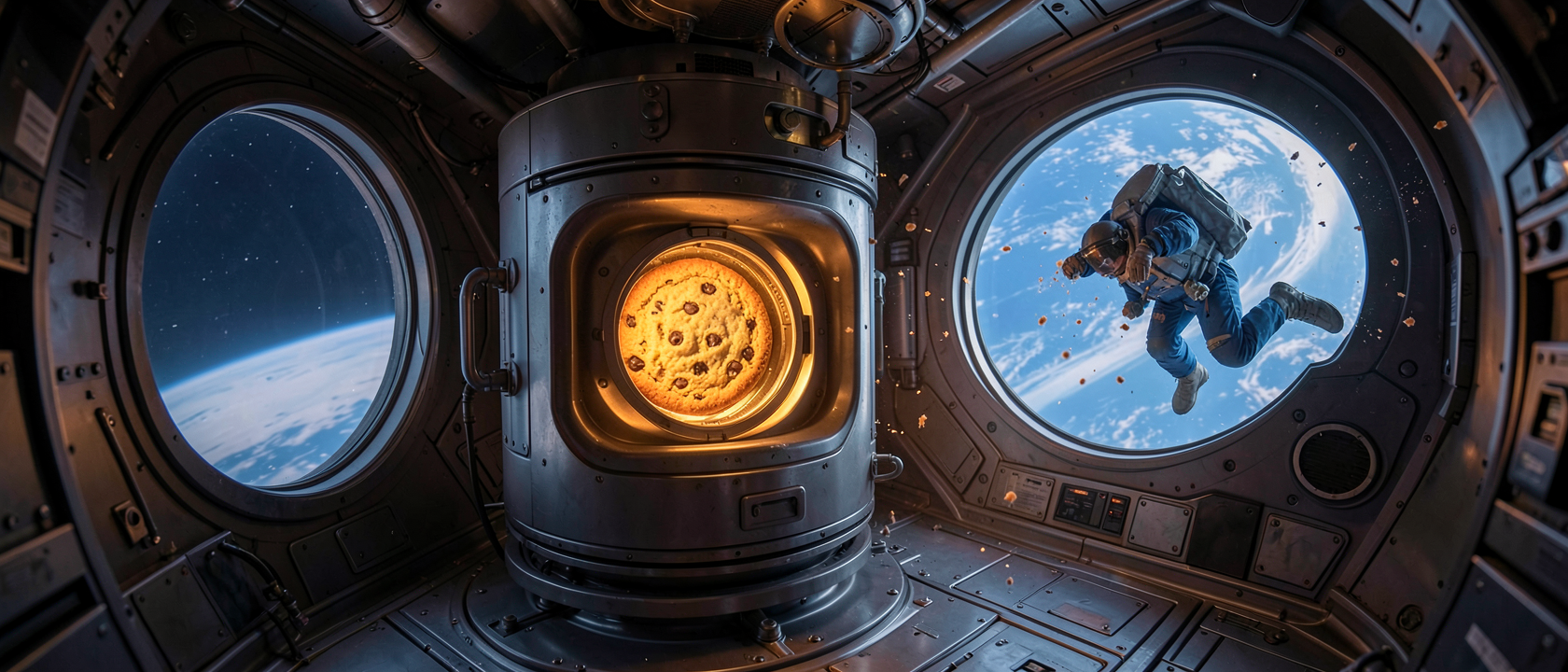
The Cookie That Took Two Hours
In December 2019, the crew of the International Space Station set out to bake a batch of chocolate chip cookies. On Earth, the DoubleTree by Hilton recipe they were using takes about 16 to 18 minutes in a convection oven at 300°F (149°C). In orbit, the same dough took anywhere from 25 minutes to a full two hours, and the best attempt of all still ran past the two-hour mark. This wasn’t a holiday snack run. DoubleTree had teamed up with Nanoracks and Zero G Kitchen to try the first real test of baking from raw dough in space. The outcome was uncertain enough that two of the finished cookies went into storage for a trip back to Earth instead of straight into anyone’s mouth.
Why Send a Cookie Back to Earth?
Baking ranks among the simplest things anyone does in a kitchen. So why would it take a trained astronaut this long, and why would anyone bother shipping half-baked cookies back to Earth instead of just letting the crew eat them? The question sounds almost too basic to need an answer, until you realize nobody had ever baked anything from raw dough in space before. No one could say for certain what heat would do to flour, sugar, and butter with gravity out of the picture. So the whole thing got treated the way any new process does the first time around: as something to measure, not assume.
No Up, No Rising Heat
Here’s the part that trips people up. An oven on Earth doesn’t just add heat, it circulates it. Warm air rises because gravity pulls cooler, denser air downward, which lets the lighter warm air float up and around whatever is cooking. That constant rising and sinking is convection, and it’s what gives a home oven its even heat. Take gravity out of the equation, and there’s no “up” for warm air to rise toward. Heat just stays wherever it started instead of swirling through the oven and wrapping around the dough.
Two other details likely didn’t help. The prototype oven built for the station topped out at 325°F (163°C), cooler than plenty of standard cookie recipes call for. And each raw cookie baked sealed inside its own silicone pouch, designed to keep crumbs from drifting loose through the cabin, which may have slowed the heat reaching the dough even more.
Five Attempts, Logged Like an Experiment
Italian astronaut Luca Parmitano ran the bake one cookie at a time, radioing down results while NASA’s Christina Koch kept watch. The first cookie went in for 25 minutes at 300°F and came out badly under-baked. The next two pushed the clock further, 75 minutes and then 120 minutes, both still at 300°F, with results Parmitano described as so-so. The fourth cookie stayed in for a full two hours before he finally saw what he’d been waiting for: visible browning, and dough that no longer looked raw, though he still couldn’t say for certain it was fully cooked through. For the fifth cookie, he pushed the oven to its maximum setting of 325°F and baked it for 130 minutes, letting it cool outside the oven for another 10 minutes. That one came back with the best results of the whole batch.
Looks Done. Is It, Though?
Browning reads as proof that a cookie is done. In a normal kitchen, it basically is. On the space station, even the best-looking cookie from the batch wasn’t cleared to eat on the spot. A Nanoracks manager overseeing the project said there was still plenty to work out about what was driving the gap between baking in orbit and baking anywhere on Earth. The cues that work in a kitchen here don’t automatically transfer once gravity drops out. Something can look finished and still need a lab to confirm that it actually is. Take gravity away, and eyeballing a cookie stops being good enough.
Two Go Home, Three Stay Behind
Of the five cookies baked, two were packed up and sent home aboard a SpaceX cargo capsule, becoming the first cookies ever baked from raw dough in space to reach a lab on Earth for analysis. The other three stayed aboard the station, waiting on word about whether they were safe to eat. Somewhere in that chain is the detail worth holding onto: a bake that takes minutes in any kitchen on Earth needed an international cargo flight and laboratory testing just to answer one plain question, is it edible. Nobody could say yet, not from looks alone. That’s the kind of gap that only shows up once you stop assuming gravity comes with the deal.