The Death Ray That Became a Checkout Scanner
Pull a box of cereal off a supermarket shelf and somewhere beneath that glass plate a tight beam of red light reads the barcode. The laser, once the signature weapon of science fiction villains, has become the most unremarkable piece of technology in the building. Which makes the backstory stranger: that unassuming beam took humanity 43 years to build, from the moment Albert Einstein first wrote down the theory that makes it possible.
Einstein’s Theoretical Loose End
In 1917, Einstein was working through how atoms and light swap energy until they reach thermal equilibrium. To make the math work, he proposed a mechanism nobody had described before: stimulated emission. Electrons occupy specific energy levels inside an atom. An incoming photon can force an excited electron to drop early, releasing a second photon identical to the first in frequency, phase, and direction. One photon in; two out. Those two trigger two more. A chain reaction of identical light.
The concept was mathematically elegant, but in 1917 there was no way to test it. It sat in the physics literature for decades, noted and filed away.
The Missing Ingredient: Population Inversion
For stimulated emission to produce a useful beam, more atoms in the material must be in an excited state than in the ground state, a condition called population inversion. In any ordinary material, most atoms rest quietly at their lowest energy level. Achieving the inverted ratio requires a constant energy pump feeding the system faster than atoms can relax back down. Get the balance right and photons multiply; get it wrong and the material simply absorbs whatever light you send through it.
The path from Einstein’s idea to a working device required quantum physics to mature. Max Planck established in 1900 that radiation comes in discrete packets. Niels Bohr’s 1913 atomic model gave physicists a clear framework for electron energy levels. Each discovery handed the next researcher a sharper set of tools.
The Maser Comes First
By the early 1950s, Charles Townes at Columbia University had been thinking about using stimulated emission to amplify microwaves. He and two students completed the first working device by December 1953, named the maser, for “microwave amplification by stimulated emission of radiation.” Soviet physicists Aleksandr Prokhorov and Nikolay Basov arrived at the same theory independently in Moscow. All three shared the Nobel Prize in Physics in 1964.
In 1957, Gordon Gould sketched out what a maser working with visible light might look like and coined the acronym “laser.” In December 1958, Townes and Arthur Schawlow published a formal theoretical paper showing how maser techniques could extend into the optical range. The blueprint existed on paper. Someone had to build it.
Theodore Maiman’s Fifty-Thousand-Dollar Machine
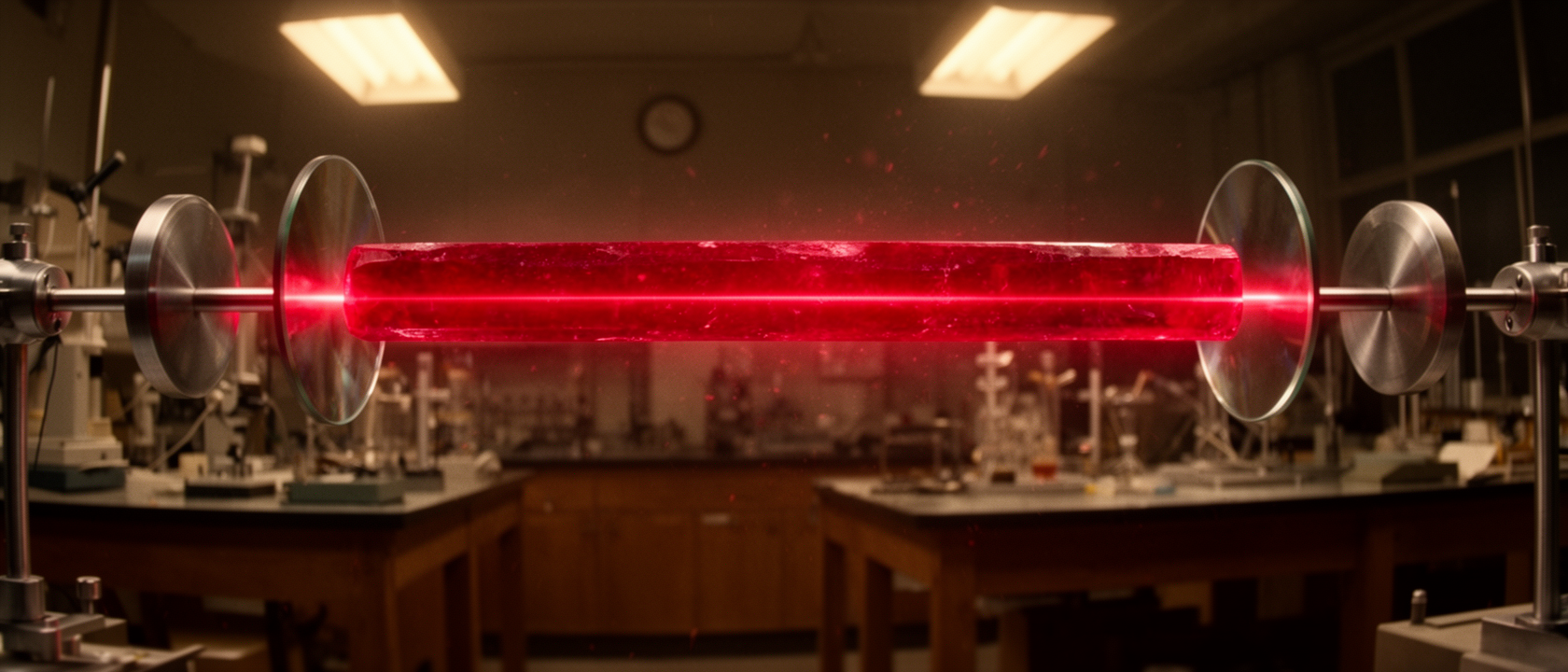
On May 16, 1960, Theodore Maiman answered that question at Hughes Research Laboratories in Malibu, California. His device used a rod of synthetic ruby wrapped in a coiled xenon flash lamp, with flat mirrors at each end, one fully silvered, one partially so. When the lamp fired, it drove chromium ions into an excited metastable state, achieving population inversion. Photons bounced between the mirrors, each pass triggering more stimulated emission, until light punched through the partial mirror as a coherent red beam at 694.3 nanometers. The project cost an estimated $50,000, including Maiman’s salary.
His initial paper was turned down by Physical Review, apparently because the editor had already published a similar paper that year, but was accepted by Nature in shorter form. The timing was awkward; the science was not dismissed.
Why the First Laser Could Only Pulse
Maiman’s ruby laser could not sustain a continuous beam. Ruby is a three-level system: atoms emit and fall straight back to the ground state, which quickly fills up and makes population inversion increasingly hard to maintain. Continuous operation requires a four-level system, where a fourth energy level gives atoms somewhere intermediate to land, keeping the ground state mostly empty.
That solution arrived months later. On December 13, 1960, Ali Javan, William Bennett Jr. and Donald Herriott at Bell Labs in Murray Hill, New Jersey demonstrated the first gas laser, using helium and neon. It produced a continuous infrared beam and drew only about 25 watts, compared to the thousands required by Maiman’s flash lamp.
The Lineage Spreads
In 1962, Robert N. Hall at General Electric in Schenectady, New York built the first semiconductor laser from a gallium arsenide junction, emitting infrared light at 850 nanometers. Compact and efficient, that design eventually found its way into CD players, laser printers, and fiber optic communications. In 1964, Kumar Patel at Bell Labs invented the carbon dioxide laser, which can achieve continuous output with a conversion efficiency of up to 20 percent, high by any standard in optics.
From the Lab to the Checkout Line
The first supermarket barcode scanners used helium-neon beams of the same type Javan’s team had demonstrated at Bell Labs. The semiconductor laser Hall built went on to carry telephone calls through undersea fiber optic cables and read the data off every CD ever pressed.
Einstein’s 1917 paper described a mechanism, not a device. The device required quantum theory to mature, a working maser as proof of concept, a clear understanding of population inversion, and one physicist in Malibu with a ruby rod and a flash lamp. The chain reaction of identical photons he worked out to solve a problem about thermal equilibrium now reads barcodes in supermarkets around the world.