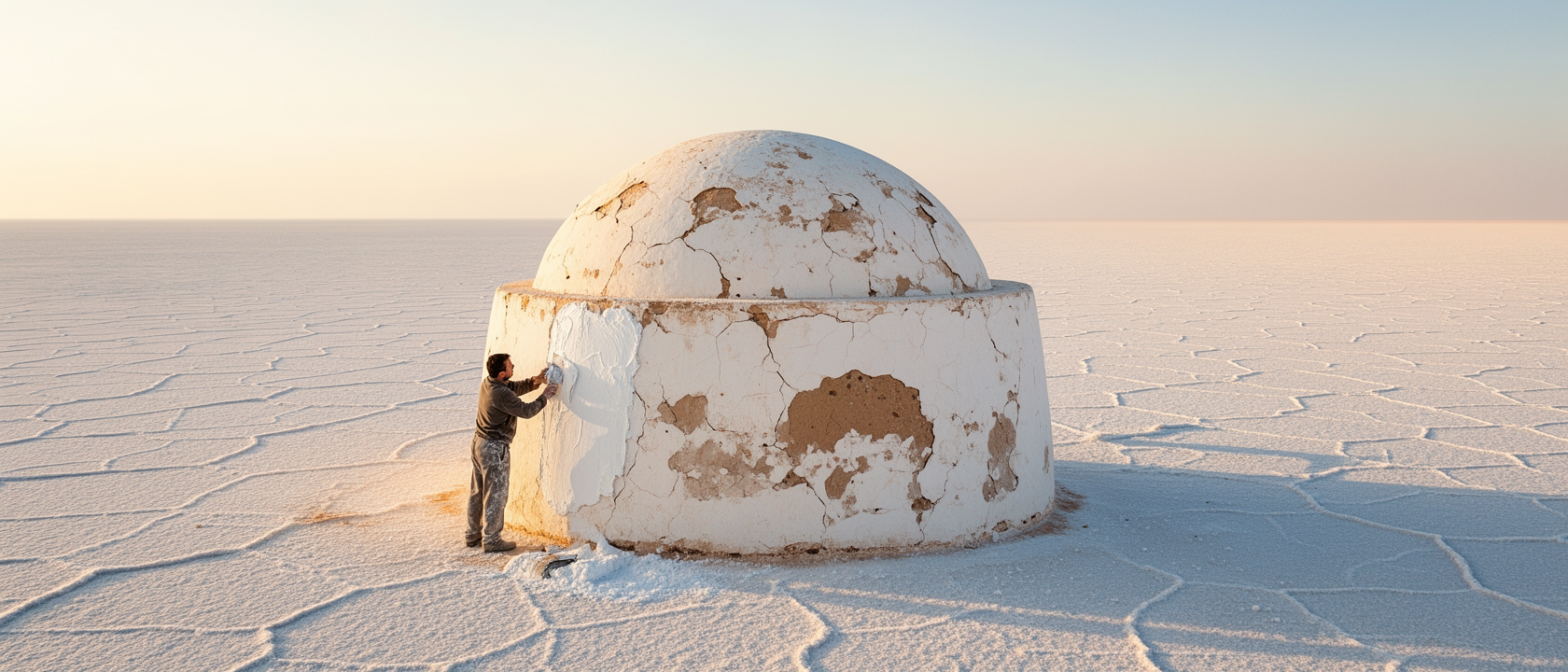
A Fictional Home Made of Real Plaster
The Lars homestead appears in three Star Wars films. In A New Hope (1977), it’s where a young Luke Skywalker stares at the twin suns before his life changes; it appears again briefly in Attack of the Clones (2002) and Revenge of the Sith (2005). On screen it looks permanent. In reality, it’s a plaster dome sitting on the Chott el Jerid, the Sahara’s largest saline dry lake, at roughly 2,278 square miles (5,900 km²), and for decades it was nobody’s job to keep it standing.
George Lucas’s crew built it there in mid-February 1976. Filming wrapped across late March of that year, and then the crew left. The dome stayed behind. That pattern repeated itself. For the prequel films it was rebuilt in 2000, construction started in early August, with filming on September 7 and 9, then abandoned again. By 2010, the desert wind, salt air, and extreme heat had stripped away large sections of the exterior, exposing bare wood framing underneath.
A Problem Nobody Officially Owned
The dome carried no heritage protection. Lucasfilm had no legal obligation to maintain it. The Tunisian government hadn’t designated it as a protected site. And the fans who cared most, scattered across Europe, North America, and beyond, had no obvious mechanism to act from thousands of miles away.
Mark Dermul, a Belgian Star Wars fan who had been guiding tours to Tunisian filming locations since 2001, arrived at the dome during a trip in May 2010 and found the state of it alarming. He had brought more than 50 fans to these locations over the years and knew exactly how far it had deteriorated.
Four Countries, $10,000, Six Days
Dermul launched the “Save the Lars Homestead” campaign online, with a minimum donation of $2, a Facebook group, and a Kickstarter running alongside the main donation site. The ask: raise $10,000 to fund a restoration trip and buy materials to re-plaster and repaint the dome.
More than 400 people contributed, raising between $10,000 and $12,000, no studio money, no government grants. The Tunisian civil revolution, which began in December 2010, stalled permit negotiations until a new government was in place. The upheaval added months of uncertainty: a campaign that had raised its funds in under ten months couldn’t move forward until the political situation settled. By the end of 2011, the new administration had granted permission, and Tunisia’s National Tourism Office officially approved and visited the site during the restoration.
The team that flew to Tunisia was six people from four countries: Mark Dermul and Michel Verpoorten (Belgium), Mark Cox and Terry Cooper (UK), Robert Cunningham (United States), and Imanuel Dijk (the Netherlands). They arrived around May 25, 2012, the 35th anniversary of the original film’s release. The total mission ran six days; three of those were spent on the plastering and painting itself. By June 2, 2012, the restoration was declared complete.
A Victory with an Expiration Date
To document the project and raise additional funds, the team produced a 246-page hardcover book with more than 700 photographs, artwork by Dave Dorman and Eric Siebeneck, and a foreword from Mark Hamill. They also sold a limited-edition watch with sand from the filming locations set into the face, hour markers in Aurebesh (the in-universe Star Wars script), and a casing machined from 316L stainless steel and brass with Seiko movements inside, though available sources leave unclear how much of those proceeds ultimately funded on-site work.
The deeper issue is structural. Between 1976 and 2022, the dome has been built, abandoned, rebuilt, and repaired at least six times. A second fan-funded restoration, “Discover Tatooine,” took place on April 28, 2018. What the 2012 campaign demonstrated is that dispersed internet enthusiasm can become a funded work crew standing on-site with trowels. What it didn’t solve is basic physics: the wind and salt will keep doing what they do, and eventually someone will have to come back with more plaster.