The Glowing Fungus, the Wooden Egg, and the First Submarine Attack in History
Picture a soldier sealed inside a wooden container about the size of a bathtub, breathing borrowed air in complete darkness, turning hand cranks toward an enemy warship. His only light: a faint glow from bioluminescent fungus painted onto his compass needle. This was American military technology in 1776.
The Wooden Egg
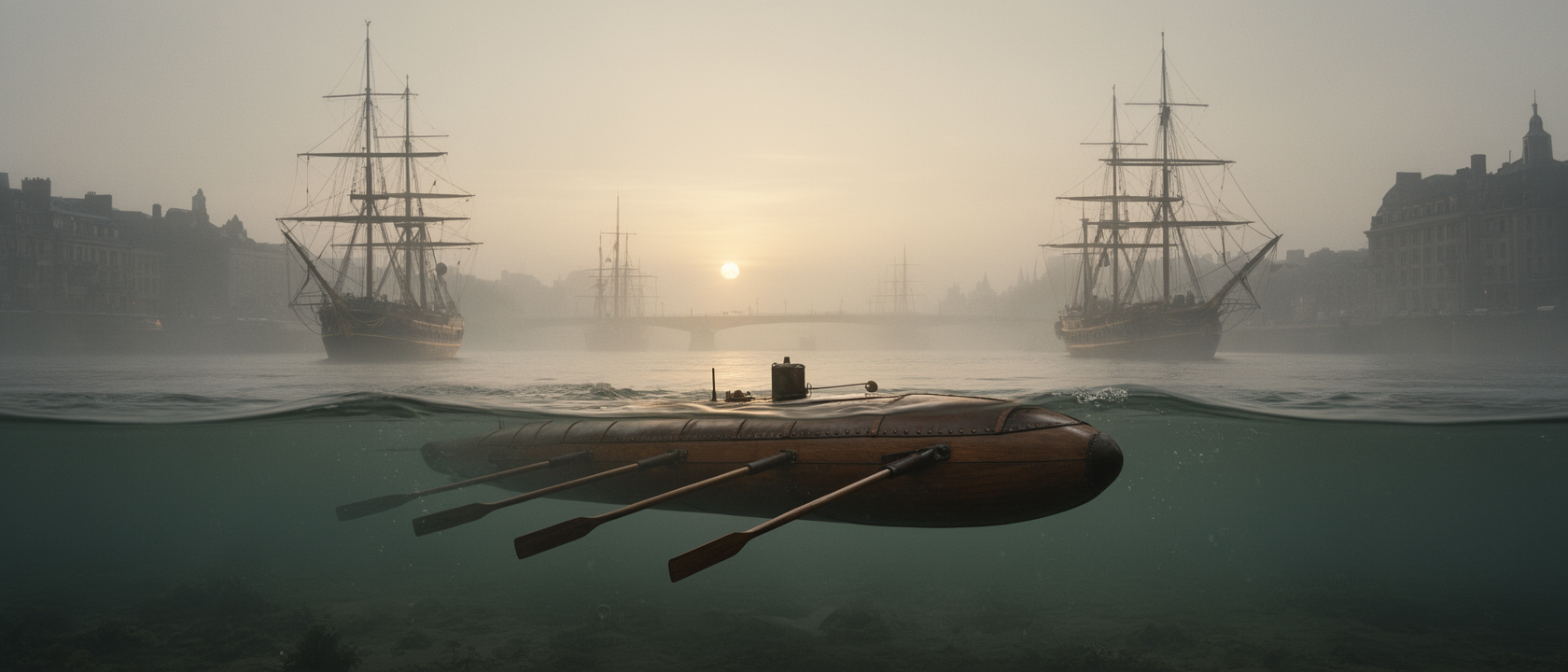
David Bushnell built the Turtle from oak staves bound with iron hoops, roughly 2.3 meters long and 1.8 meters wide, two turtle shells pressed together, with a brass conning tower and glass viewports on top. Inside, the pilot had no candle or lamp. Instead, the compass and depth gauge needles were coated in foxfire, a bioluminescent fungus producing a faint cold glow. The craft held roughly 30 minutes of breathable air. For 1776, this represented the outermost reach of military engineering.
A Century of Dangerous Ideas Before It
Around 1515, Leonardo da Vinci sketched a “ship for sinking another ship” in the Codex Leicester but deliberately omitted how a pilot would breathe underwater. His reasoning, recorded in his own notes, was blunt: he refused to describe it, citing “the evil nature of men who practice assassination at the bottom of the sea.”
In 1578, mathematician William Bourne published a design for a leather-and-wood submersible with ballast tanks. He built nothing, but Dutch engineer Cornelis Jacobszoon Drebbel read that design and between 1620 and 1624 built three working submarines for King James I. His final model carried 16 passengers along the Thames from Westminster to Greenwich and back, at around 12 to 15 feet depth, staying submerged for three hours. King James I reportedly rode in it. Bushnell knew this lineage and was building on over a century of near-misses.
How the Thing Actually Worked
Bushnell solved three problems: buoyancy, propulsion, and weapons delivery. Ballast tanks beneath the operator’s feet took on water to sink and pumped it out to surface. Two brass propellers, one for horizontal travel, one for vertical, were driven by foot pedals and hand crank, making the Turtle the first recorded vessel to use screw propellers, a full generation before they became standard on steamships.
The weapon was a 150-pound gunpowder charge on the hull’s exterior. The pilot would drill into an enemy ship’s planking with a hand-cranked auger, screw in the powder magazine, and withdraw while a clockwork fuze triggered a flintlock mechanism on a timer. All of this had to be done in near-darkness within roughly 30 minutes of air.
The Mission Against HMS Eagle
On the night of September 6 into the early morning of September 7, 1776, Sergeant Ezra Lee piloted the Turtle into New York Harbor. The original pilot, Bushnell’s brother, had fallen seriously ill; Lee had spent about two weeks learning the controls. The target was HMS Eagle, a 64-gun warship and flagship of Admiral Richard Howe. Towed partway out, Lee then fought a strong tidal current alone, taking roughly two hours to reach the hull.
There the mission ended. The auger would not bite. After multiple attempts Lee abandoned the effort, released the mine, and navigated back. The mine detonated harmlessly in the water, proving the clockwork fuze worked exactly as designed.
What Actually Stopped It
The popular explanation, that copper anti-fouling plates on the Eagle’s hull defeated the drill, is almost certainly wrong. Most credible historians, including those at American Heritage, conclude the Eagle had not yet been fitted with copper sheathing, and thin copper would not have stopped a hand-cranked auger anyway. The more likely explanation is that Lee struck an iron fitting, probably rudder hardware the wood-boring drill could not cut.
CO₂ buildup may have played a role as well. The Turtle held 30 minutes of air, and Lee had already spent roughly two hours fighting the current before reaching the ship. Accumulating carbon dioxide causes confusion, muscle weakness, and impaired judgment, a condition known as hypercapnia. Whether it affected Lee on September 7, 1776 is unconfirmed but considered plausible by historians.
George Washington called Bushnell “a Man of great Mechanical Powers, fertile of invention and a master in execution.” The Turtle was lost on October 9, 1776, when British warships sank the sloop transporting it. It never sank a warship. The foxfire compass worked. The screw propellers worked. The clockwork fuze worked. What the mission came down to was a drill hitting the wrong piece of metal in the dark.