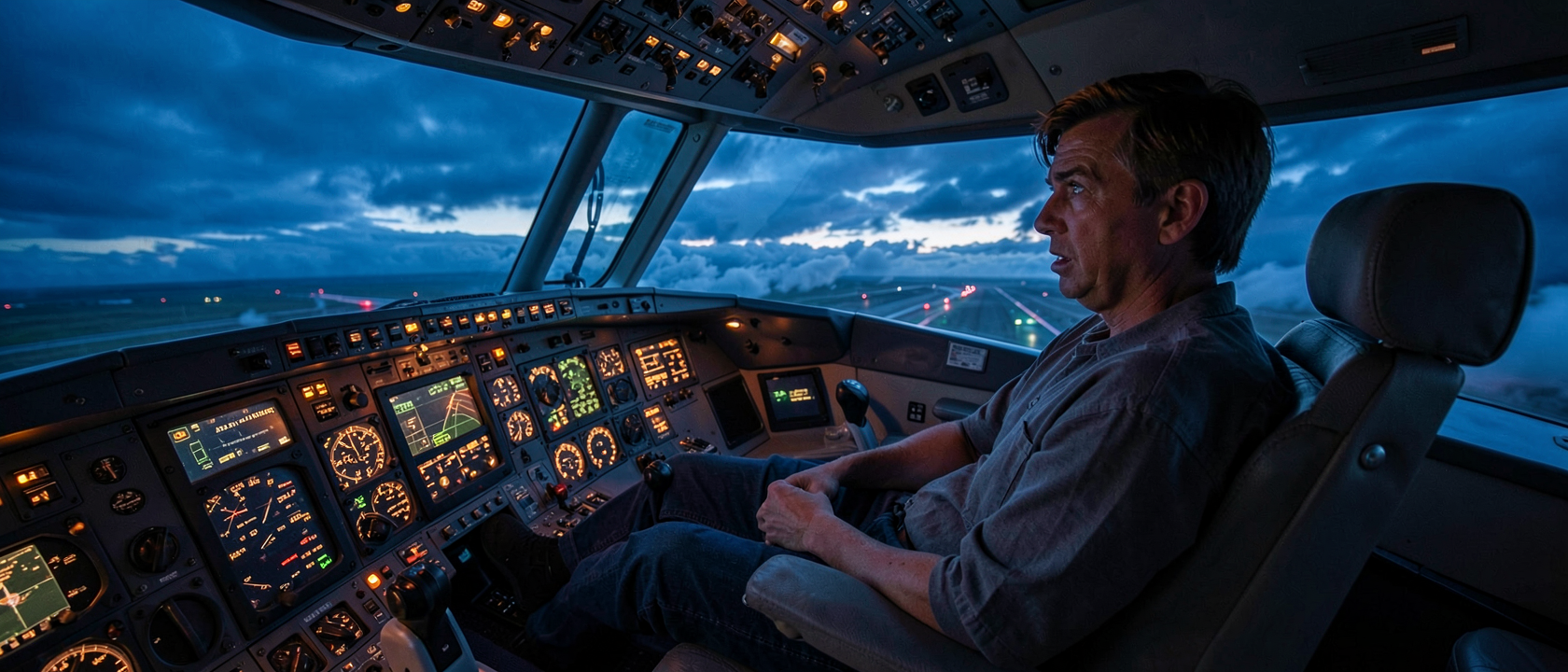
“Just Follow My Voice”
You know the scene: the pilot is down, a passenger with zero flight hours gets handed a headset, and a calm voice on the radio talks them through landing the plane. Hollywood has sold this fantasy since Airport 1975 (Universal Pictures, October 18, 1974), in which a small aircraft crashes into a 747’s cockpit, killing the first officer and flight engineer and blinding the captain. A stewardess, played by Karen Black, takes over on radioed instructions until a rescue pilot (Charlton Heston) can be lowered in to land it. Despite rough reviews, it was the seventh-highest-grossing film of 1974 in the US and Canada.
Here’s the twist: aviation experts put the real odds of a civilian pulling this off safely at under 1 percent.
What’s So Hard About a Few Switches?
If a controller can talk someone through every lever and dial, shouldn’t that be basically remote-control flying? The gap isn’t only nerve; it comes down to one piece of equipment most passengers never think about: the plane’s auto-land system.
The Hidden Hero: Auto-Land
Whether an aircraft has auto-land is, by most accounts, the single biggest factor in how this scenario ends. Dale Wright, director of safety and technology for the National Air Traffic Controllers Association, compares the process to programming a VCR, only far more demanding. The controller walks the passenger through adjusting altitude, airspeed, and direction; get the settings right and engage autopilot, and the aircraft takes over.
But the person still has to activate the system, lower the flaps, drop the landing gear, and keep feeding in updated speed settings during descent. Auto-land is a precision tool, not a self-driving car, miss a step, and it has nothing to work with.
Not Every Jumbo Has a Safety Net
Not every large commercial aircraft has auto-land. Without it, the passenger must disconnect autopilot and fly, and land, entirely by hand. Chris Dancy of the Aircraft Owners and Pilots Association says the most likely amateur mistake is flying too low or too slow, triggering a stall, where airflow over the wing stops generating lift. There’s no radio instruction that fixes that in real time; by the time you recognize it, you’re already losing altitude you don’t have to spare.
The Part the Movie Skips
Even if the settings are correct and auto-land engages within the final 10-mile (16-kilometer) stretch, flying the plane down to touchdown isn’t the end of the job. The passenger still has to work the brakes, far more complex than a car’s, and may need to trigger reverse engine thrust if the runway is short. Notably, amateurs have landed small private planes after a pilot became incapacitated. Outside 1970s disaster movies, it has never happened with a commercial airliner.
Less Than 1 Percent, on a Good Day
Wright estimates a novice has less than a 1 percent chance of landing a roughly 400-ton jet (363 metric tonnes) and keeping it on the runway without hurting anyone, “and that’s on a good day,” he adds. It’s a working estimate from a career aviation-safety expert, not a clinical study, but the scale is worth sitting with: 400 tons is like several dozen city buses rolling down a runway at landing speed, steered by someone who has never touched the controls before.
So the next time that scene plays out on screen, you’ll know where the fantasy cracks: not the panic, not the radio instructions, but whether that jumbo jet carries a system that can land itself, and whether the person inside knows when to flip it on.