Where Did “The Axis” and “The Allies” Actually Come From?
Most people absorb the labels without questioning them. The Axis. The Allies. They feel like they were always there, baked into the war from the start. But names like these come from somewhere. One of them came from a speech in front of a cathedral, and it started as a line drawn on a map.
A Geometric Idea in Milan
On November 1, 1936, Benito Mussolini spoke to roughly 250,000 people outside Milan’s cathedral. He had just concluded an informal friendship agreement with Germany and wanted a phrase to give it shape. The Berlin-Rome agreement, he told the crowd, was not a wall dividing Europe from the outside. It was “an axis around which all European States animated by a desire for peace may collaborate.” Picture a globe on its vertical pole: Germany in the north, Italy further south, a line connecting them through the middle of the continent. The New York Times ran the speech the following day with front-page commentary calling out the “axis” remark specifically.
Hungarian Prime Minister Gyula Gömbös had reportedly been working toward a similar concept in the early 1930s, envisioning an alignment of Hungary, Italy, and Germany. Historians credit him with helping develop the idea, though the exact wording hasn’t been confirmed in primary sources. Gömbös died on October 6, 1936, just weeks before the Rome-Berlin pact was announced.
From Metaphor to Signed Paper
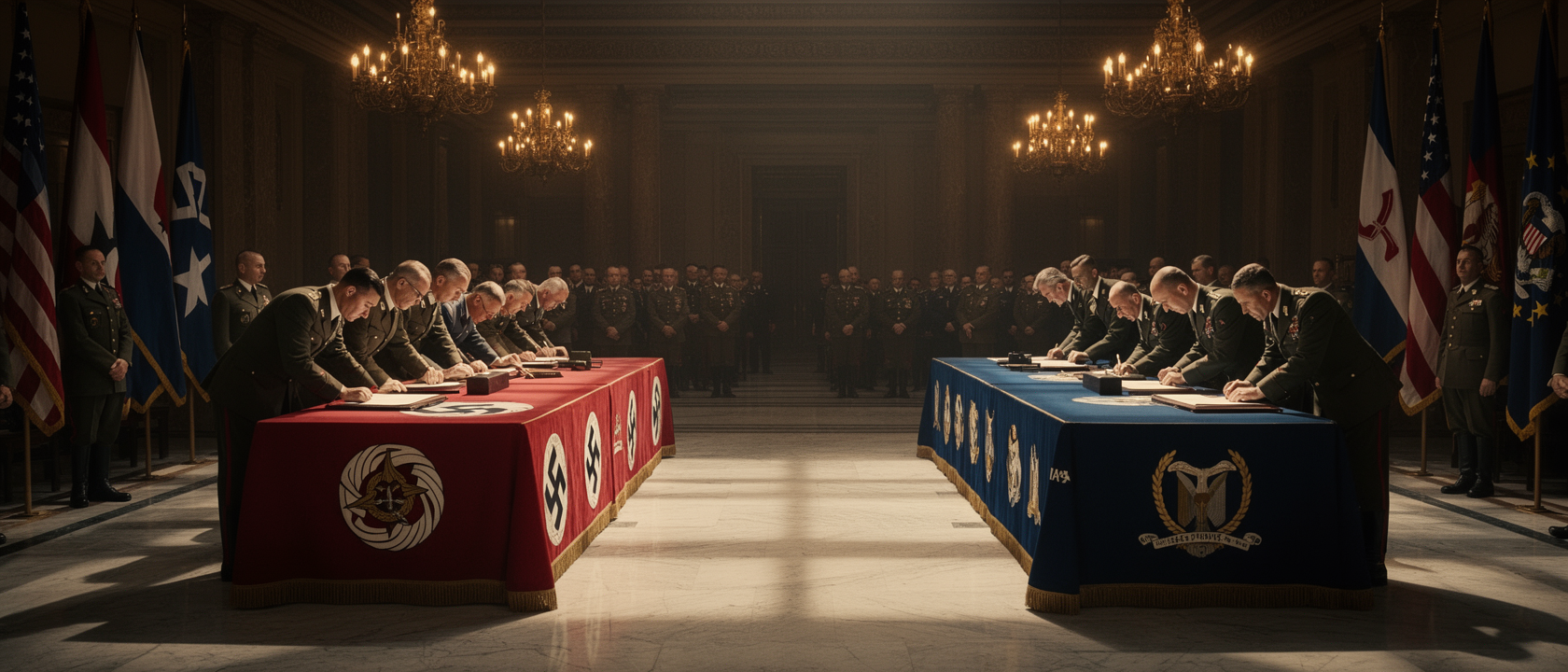
A speech plants a word; treaties root it in place. Germany and Japan signed the Anti-Comintern Pact on November 25, 1936. Italy joined on November 6, 1937, bringing the three major powers into a shared framework for the first time. Germany and Italy then signed the Pact of Steel on May 22, 1939, a full military-political commitment: if one went to war, the other followed. All three came together on September 27, 1940, with the Tripartite Pact, signed in Berlin. From that point, the bloc was formally known as the Axis Powers, or the Rome-Berlin-Tokyo Axis. Hungary, Romania, Slovakia, Bulgaria, Yugoslavia, and Croatia eventually joined as signatories too.
The Allies and the Diplomacy Behind the Name
On June 12, 1941, fourteen governments gathered at St James’s Palace in London, the United Kingdom, four Commonwealth nations, and eight European governments-in-exile, plus Free France. The meeting was explicitly described as “inter-allied,” and the word “Allies” was already in circulation before the United States entered the war. On August 14, 1941, Roosevelt and Churchill issued the Atlantic Charter. After Pearl Harbor on December 7, 1941, Congress declared war on Japan on December 8 and on Germany and Italy on December 11. In a Fireside Chat on December 9, Roosevelt described the enemy as “Axis strategists”, one of the earliest official American uses of the term. The cooperative framework built during those years eventually produced the United Nations Charter, ratified on October 24, 1945.
A Word That Kept Working
Both terms outlasted the conflict, but “axis” had the stranger afterlife. After Italy signed an armistice with the Allies on September 3, 1943, Germany launched an operation to disarm Italian forces before they could switch sides. The Germans called it Fall Achse, Case Axis, using the very word that had once defined their partnership to describe its forcible end. Between 600,000 and over a million Italian soldiers were disarmed.
The word surfaced again on January 29, 2002, when President George W. Bush used the phrase “axis of evil” in his State of the Union Address, grouping North Korea, Iran, and Iraq together. The original geometry was gone, but the implication remained: a tight, coordinated bloc of hostile powers. The label carried the same rhetorical weight Mussolini had loaded into it outside that Milan cathedral 66 years earlier.