The Product That Defined “Cheap” Started Out Expensive
Few things signal a tight budget quite like a packet of instant ramen. Students stack them like bricks. Disaster relief organizations ship them by the pallet. So it sits oddly on the shelf of history that when Chikin Ramen first appeared in Japanese stores on August 25, 1958, a single packet cost 35 yen, roughly six times what a fresh bowl at a local ramen shop would set you back. The cheapest meal in the world launched as a luxury item.
Why Momofuku Ando Was Trying to Feed a Nation
Ando was not chasing a market opportunity. He was responding to something he had seen in the ruins of postwar Osaka: people standing in long lines in the cold, waiting for a bowl of black-market ramen. Japan after World War II had suffered devastating food shortages. American firebombing had leveled large sections of Tokyo, Osaka, and Nagoya, while organized crime ran black markets many people depended on just to eat.
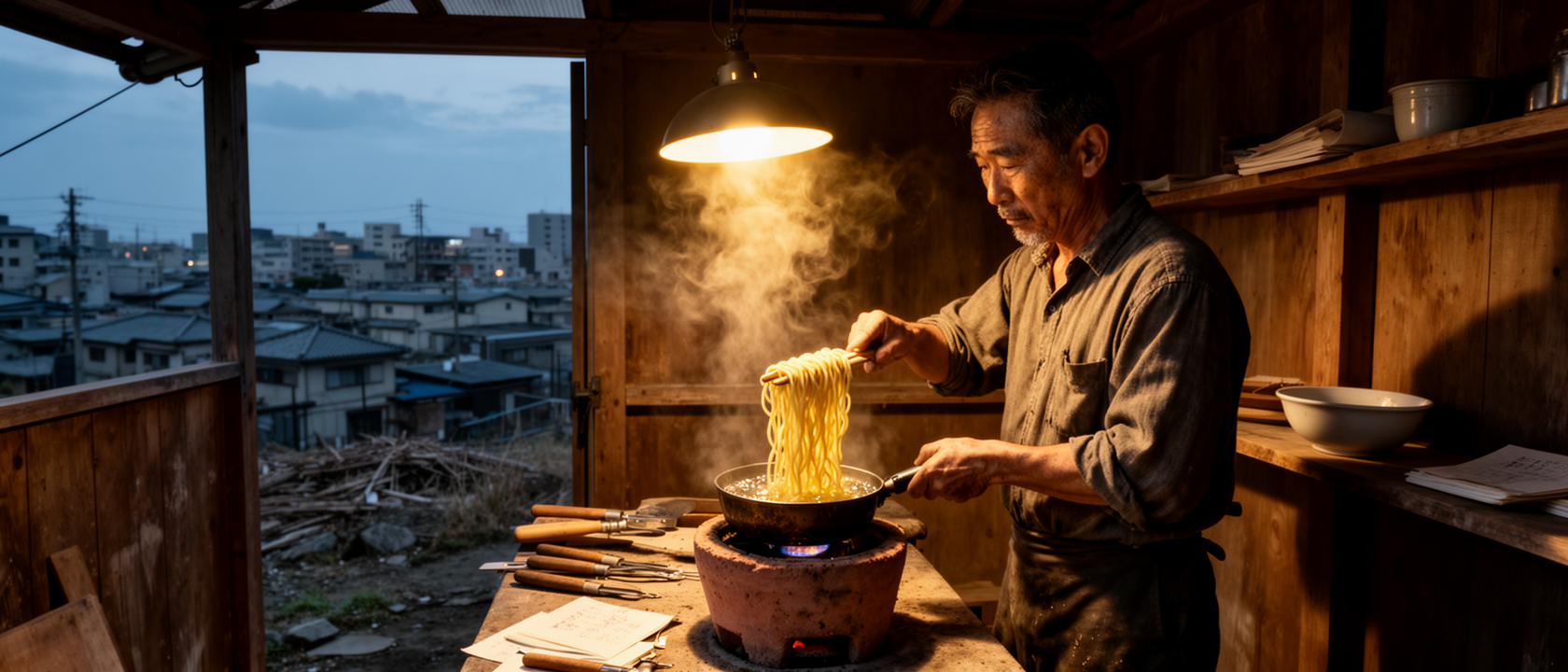
Ando’s stated goal was precise: a noodle that was tasty, shelf-stable, preparable in under three minutes, inexpensive, and safe. He built a small shed in his backyard in Ikeda, Osaka, and spent approximately a year experimenting. He was 48 years old when he finally got it right. The premium launch price was not a contradiction of his mission, the technology was new, and costs were expected to fall as production scaled.
What Flash-Frying Actually Does to a Noodle
The technical breakthrough came from watching his wife, Masako, fry tempura. When fresh noodles are dropped into hot oil, the water inside vaporizes almost immediately, escaping outward and leaving a network of tiny pores. The noodle is now dehydrated and shelf-stable, and riddled with microscopic channels that flood with boiling water and rehydrate the noodle in under three minutes. The frying step does two jobs at once: preserving the noodle and preparing it to absorb water fast.
Ando chose chicken stock as the flavor, reasoning it was familiar enough to feel like a real meal, hence Chikin Ramen, the katakana spelling of “chicken.” Thirteen million packages sold in the first year despite the premium price. By 1968, annual sales had climbed to approximately 3.5 billion servings.
The American Coffee Cup That Changed Everything
On a business trip to the United States in 1966, Ando watched American buyers crumble a noodle brick into a Styrofoam coffee cup, pour in hot water, and eat with a fork. They had no ramen bowls. Ando brought the observation home and built around it. The result, launched in Japan on September 18, 1971, was Cup Noodle: a self-contained vessel with noodles pre-loaded and a foil-peel lid, priced at 100 yen, about four times a regular packet, repeating the same premium-first pattern Chikin Ramen had established.
Sales were slow until an outdoor tasting event in Tokyo’s Ginza district on November 21, 1971, moved more than 20,000 cups in four hours and broke the product open nationally. Nissin opened its first overseas factory in Lancaster, Pennsylvania, in 1973.
One Shed in Osaka, 120 Billion Servings Later
Current data from the World Instant Noodles Association puts global annual consumption at between 120 and 123 billion servings. China accounts for roughly 40 percent; Vietnam leads on a per-person basis at around 81 servings per year. In July 2005, aboard Space Shuttle Discovery, astronaut Soichi Noguchi became the first person to eat instant noodles in space, using Space Ram, a JAXA-developed version with thicker noodles and broth specially thickened to prevent droplets from floating in microgravity. Ando was 95 at the time.
Ando had founded the World Instant Noodles Association in March 1997 to distribute instant noodles in disaster zones and famine-hit regions. When he died in January 2007 at age 96, his funeral was held in a baseball stadium and attended by two former prime ministers. In a poll conducted in 2000, Japanese citizens voted instant ramen the country’s greatest invention of the 20th century, ahead of other celebrated Japanese innovations of the era.