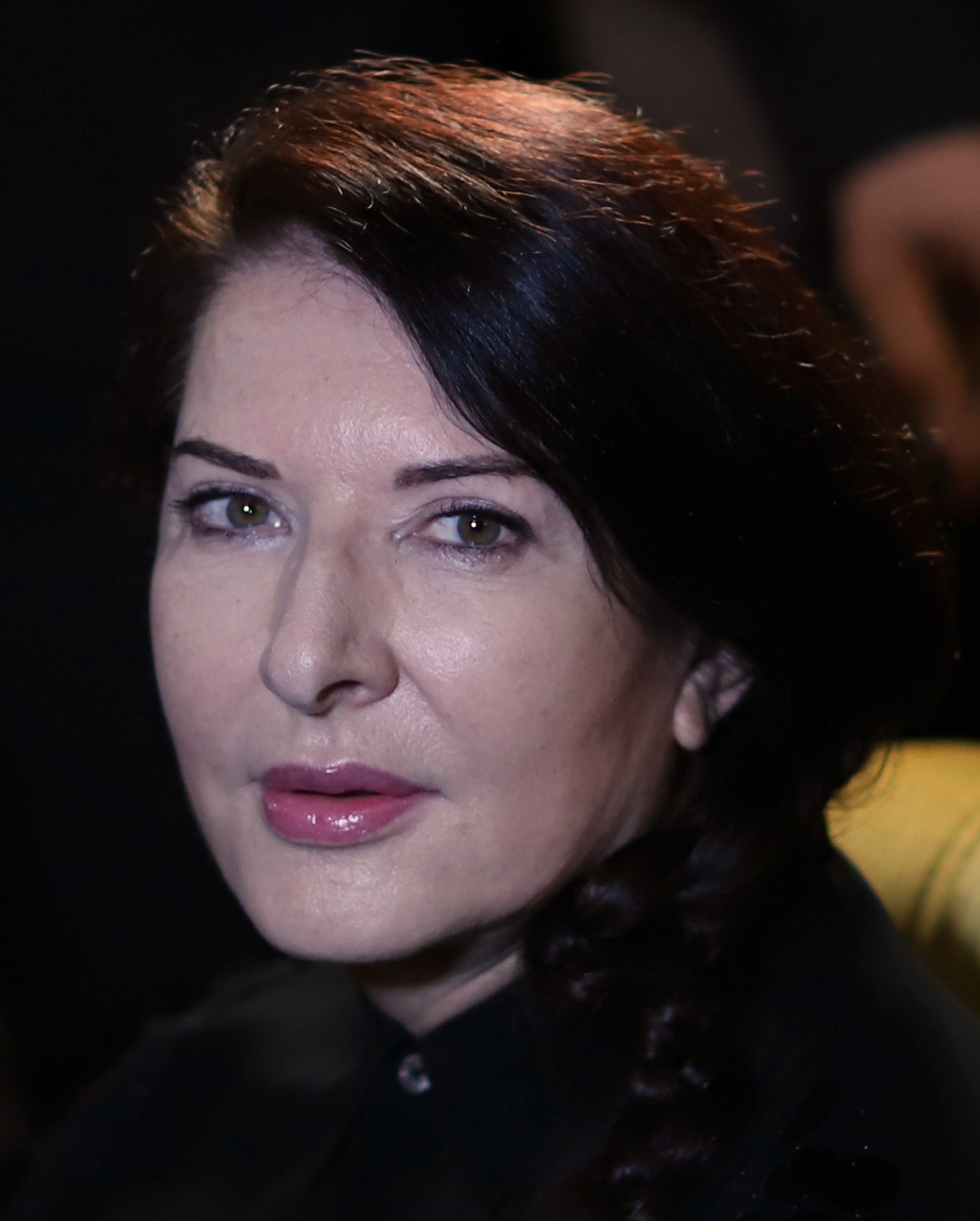
Marina Abramović, born in Belgrade on 30 November 1946, is a Serbian performance artist whose five-decade career has made her one of the most consequential figures in the history of performance, body, and endurance art. She trained at the Academy of Fine Arts in Belgrade and the Academy of Fine Arts at the University of Zagreb, and went on to teach at institutions including the Hochschule für Bildende Kunst in Braunschweig and the Berlin University of the Arts. Her practice places the artist’s own body at the center of the work, often subjecting it to extreme duration, physical risk, and intimate contact with audiences. The fullest single measure of that commitment came at the Museum of Modern Art in New York in 2010, where she sat silently in an atrium for a cumulative 736 hours and 30 minutes.
Key facts
- Born: 30 November 1946
- Birthplace: Belgrade
- Country: Federal People’s Republic of Yugoslavia; Socialist Federal Republic of Yugoslavia; Federal Republic of Yugoslavia; Serbia and Montenegro
- Occupation: performance artist; photographer; video artist; sculptor
- Field: performance art; performance artwork; body art; endurance art
- Employer: Académie des beaux-arts; Berlin University of the Arts; Hochschule für bildende Künste Hamburg; Braunschweig University of Art
- Education: Academy of Fine Arts, Belgrade; Academy of Fine Arts, University of Zagreb
- Awards: Austrian Decoration for Science and Art; Berliner Bär; Princess of Asturias Award for the Arts; Sonning Prize
Origins and family background
Abramović was born into a family shaped by two very different kinds of devotion. Her parents, Vojo Abramović and Danica Abramović, were both Yugoslav Partisans during World War II and were awarded the Order of the People’s Heroes for their service. Despite that revolutionary background, Abramović spent her first six years living with her maternal grandparents, where she absorbed the rhythms of Orthodox religious practice alongside her grandmother’s church rituals.
The religious thread in her ancestry runs deep. Her great-uncle Varnava held the patriarchate of the Serbian Orthodox Church from 1930 to 1937. Separately, her mother Danica was identified as the daughter of Varnava Rosić, Patriarch of the Serbian Orthodox Church. Her parents, however, reportedly rejected that faith in favour of Communist ideology — a tension between Orthodox heritage and secular doctrine that would surface repeatedly in Abramović’s work. After her younger brother Velimir was born in 1952, she moved in with her parents. Her mother imposed a strict 10 p.m. curfew that Abramović observed until she was 29, which meant every early performance she gave in Yugoslavia had to conclude before that hour.
Early performances: the Rhythm series
Abramović’s first major body of work, the Rhythm series, ran from 1973 to 1974 across five performances that probed the limits of the body and consciousness. The series began with Rhythm 10 at the Villa Borghese, Museo d’Arte Contemporanea in Rome in 1973.
The series reached its most unsettling point with Rhythm 0, performed at Studio Morra in Naples in 1974. Over six hours, Abramović stood still and invited the audience to use any of 72 objects on her body. One of those objects was a loaded gun, and she declared herself fully responsible for whatever the audience chose to do. The piece tested how far passive complicity could take strangers, and it established the ethical and physical extremity that would define her approach for decades.
Collaboration with Ulay
For more than a decade, Abramović worked closely with the German artist Ulay, with whom she shared both an artistic partnership and a personal relationship. Their final collaborative performance, The Lovers: The Great Wall Walk, took place in 1988. Each artist walked 2,000 kilometres from opposite ends of the Great Wall of China over 90 days, meeting at Erlang Shan in Shaanxi Province. That meeting marked the end of both their working partnership and their relationship.
The walk had originally been conceived as something else entirely. Abramović and Ulay planned it as a performance ending in marriage, but obtaining permission from the Chinese government took eight years. By the time they set off in April 1988, their relationship had already broken down, and the walk became a farewell rather than a wedding.
Balkan Baroque and the 1997 Venice Biennale
In 1997, Abramović presented Balkan Baroque at the Venice Biennale. The work was originally intended to represent Yugoslavia, but organisers found its anti-nationalistic content sufficiently disturbing that she was required to show it in the basement of the Italian Pavilion rather than in the Yugoslav space. Working in that basement, she still won the Golden Lion for best artist at the Biennale.
Seven Easy Pieces and institutional recognition
In November 2005, Abramović presented Seven Easy Pieces at the Guggenheim Museum in New York. Over seven consecutive nights, she re-enacted five seminal performance works by Bruce Nauman, Vito Acconci, Valie Export, Gina Pane, and Joseph Beuys, along with two of her own works, each lasting seven hours. The performances took place in the Frank Lloyd Wright rotunda, running from 5 PM to midnight each night, and were dedicated to her late friend Susan Sontag.
The US Art Critics Association awarded Seven Easy Pieces its prize for Best Exhibition of Time-Based Art in 2006. Two years later, in 2008, Abramović received the Austrian Decoration of Honor for Science and Art.
The Artist Is Present
From March 14 to May 31, 2010, the Museum of Modern Art in New York presented the first large-scale American museum retrospective of Abramović’s work. At its center was a durational piece of the same name: The Artist Is Present. Abramović sat alone and in silence in the museum’s atrium, across a small table from whichever visitor chose to sit opposite her. Over the full run she accumulated 736 hours and 30 minutes in that chair, the longest single solo piece she had performed to that date.
Among the many visitors who took the seat was Ulay, her former partner. He sat down quietly without prior announcement. When Abramović opened her eyes and recognised him, she reached across the table and took his hands. The moment was widely photographed and became one of the most circulated art images of 2010.
Teaching career
Abramović was appointed Professor for Performance Art at the Hochschule für Bildende Kunst in Braunschweig in 1994 and held the post for seven years. She also taught at the Berlin University of the Arts, the Académie des beaux-arts, and the Hochschule für bildende Künste Hamburg.
The Marina Abramović Institute and later work
In 2012, Abramović founded the Marina Abramović Institute (MAI), a non-profit foundation dedicated to performance art, long durational works, and the practice she calls the Abramović Method. The institute functions as both an archival and a living organisation, oriented toward the continued development of durational art as a discipline.
In 2014, the 512 Hours performance at the Serpentine Gallery in London ran from 11 June to 25 August. Each day the gallery was open, Abramović wandered the empty space and mingled silently with visitors — nothing more. That same year, Time Magazine named her one of its 100 Most Influential People in the world.
In 2016, the memoir Walk Through Walls was published by Crown Archetype in New York. Co-written with James Kaplan, the book runs to 370 pages. Two years later, in 2018, Abramović made her opera-directing debut with a production of Claude Debussy’s Pelléas et Mélisande at the Vlaamse Opera in Belgium.
7 Deaths of Maria Callas
On 1 September 2020, the Bayerische Staatsoper in Munich premiered 7 Deaths of Maria Callas, an opera project conceived and directed by Abramović. The work features new music by Marko Nikodijević and costumes by Riccardo Tisci for Burberry. After its Munich opening, it toured to the Opéra national de Paris, the Greek National Opera in Athens, Deutsche Oper Berlin, and the Teatro San Carlo in Naples.
Awards
Among the honours Abramović has received: the Berliner Bär, the Princess of Asturias Award for the Arts, the Austrian Decoration for Science and Art (2008), the US Art Critics Association Award for Best Exhibition of Time-Based Art (2006, for Seven Easy Pieces), and the Sonning Prize, awarded in 2023.
Did you know
- Abramović has described herself as the “grandmother of performance art” — a nickname she gave herself — while audiences and critics more commonly call her the “mother of performance art.” (baike.baidu.com)
- The Lovers: The Great Wall Walk (1988) was originally conceived by Abramović and Ulay as a performance that would end in their marriage. Obtaining permission from the Chinese government took eight years, and by the time they set off in April 1988, their relationship had ended. The walk became a farewell instead. (theartnewspaper.com)
- Seven Easy Pieces (2005) was dedicated to Abramović’s late friend Susan Sontag. All seven performances took place in the Frank Lloyd Wright rotunda of the Guggenheim Museum, running from 5 PM to midnight on seven consecutive nights. (pastexhibitions.guggenheim.org)
- During The Artist Is Present (2010) at MoMA, Ulay made an unannounced appearance and sat down in the chair opposite his former partner. Abramović opened her eyes, recognised him, and reached across the table to take his hands. The moment was widely photographed and became one of the most circulated art images of that year. (dazeddigital.com)
- In 2014, Time Magazine named Abramović one of its 100 Most Influential People in the world. (menla.org)
- Balkan Baroque was originally intended to represent Yugoslavia at the 1997 Venice Biennale. Organisers found the work’s anti-nationalistic content so troubling that Abramović was made to show it in the basement of the Italian Pavilion. She won the Golden Lion there anyway. (luisasummers.substack.com)
- For 512 Hours at the Serpentine Gallery in London (11 June to 25 August 2014), Abramović’s entire performance consisted of wandering the empty gallery and mingling silently with visitors for the full duration the gallery was open each day. (ebsco.com)
- Abramović’s mother Danica was the daughter of Varnava Rosić, Patriarch of the Serbian Orthodox Church. Both of Abramović’s parents nonetheless rejected that faith and embraced Communist ideology instead. (kunstplaza.de)
Data sources
- Wikidata
- thefamouspeople.com
- domusweb.it
- kids.kiddle.co
- modernamuseet.se
- imma.ie
- hbs.edu
- pastexhibitions.guggenheim.org
- assets.moma.org
- menla.org
- archive.org
- harrisonparrott.com
- ebsco.com
- performancenow.blogs.wesleyan.edu
- kunstplaza.de
Data updated: 2026-10-28