The Vocabulary Lesson From Hell
Picture a slim hardback with a soft watercolor cover and the squat, friendly typeface from a school reading corner. Flip to a page and there’s a tidy word list at the bottom, just like the primers that taught generations of British kids their first sentences. Except these words are “death,” “emptiness,” and “nothingness.”
Nothing announces a joke. The layout is calm, the type cheerful, the illustration style the same gentle line-and-wash look you’d use for a trip to the farm. It just sits there, teaching the wrong lesson in exactly the right voice.
Why Everyone’s Grandparents Owned These
Wills & Hepworth began publishing Ladybird Books in Britain in 1914, and the calm, controlled page layout most people picture took shape in 1940. In 1964, the company launched its Key Words Reading Scheme, deliberately narrowing vocabulary for beginning readers. Its best-known product was the Peter and Jane series, 36 small hardbacks following a steady, cheerful family: Mom running the house, Dad bringing home the pay, kids playing safely in the garden. Sales peaked through the 1960s and 1970s, and the company formally took the name Ladybird Books in 1971. Its Loughborough factory closed in 1999, but the imprint lives on under Penguin Random House. For many British adults, this isn’t “an old book”, it’s the specific object that sat on their childhood shelf.
So Why Would Anyone Do This?
Which raises a real question: why take the gentlest, safest format in British publishing and aim it at the self-serious nihilism often attached to contemporary conceptual art? This isn’t shock for its own sake. Pairing a trusted format with the wrong content is a specific kind of joke, and it only lands if the format never breaks character.
Meet Mommy, Peter, Jane… and the Art World
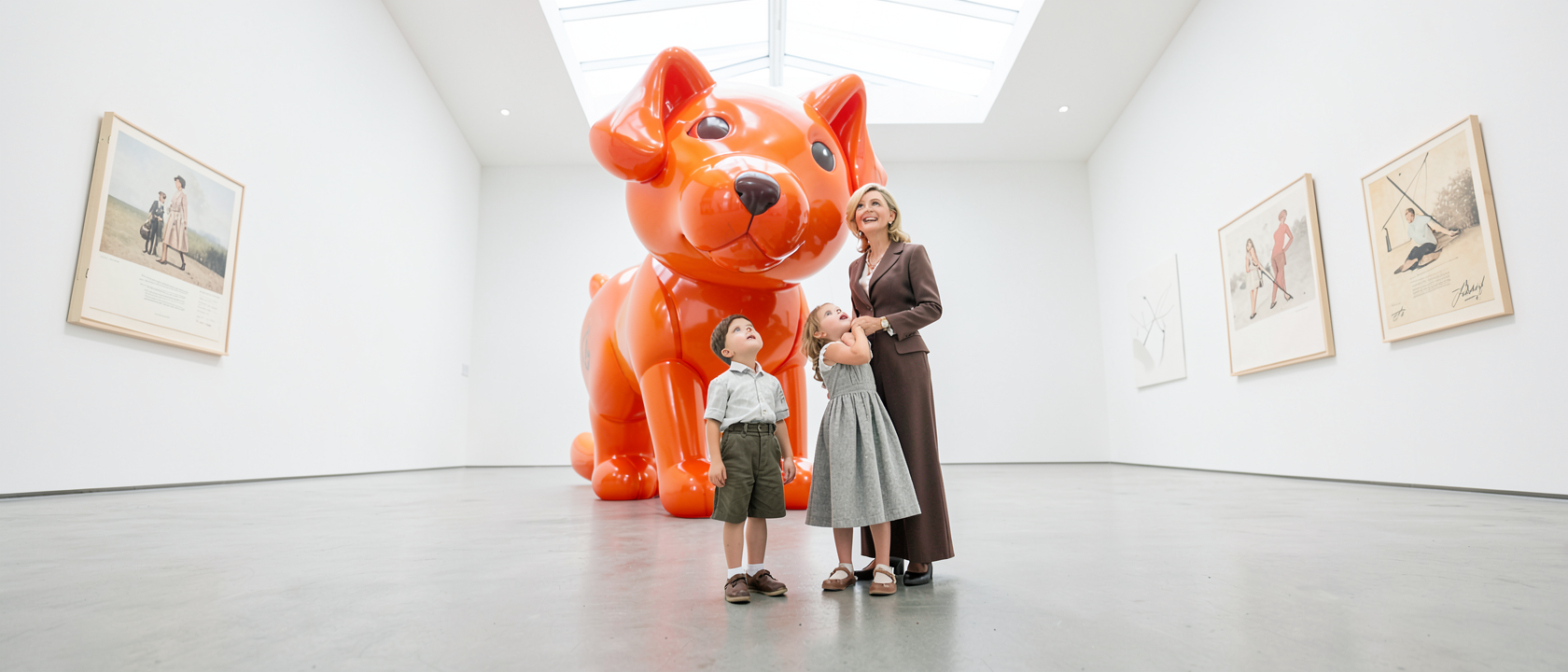
The person behind it is Miriam Elia, a British artist and Sony Award–nominated comedy writer who graduated from the Royal College of Art in 2006. With her brother Ezra Elia, she built “We Go to the Gallery,” a fake Ladybird book in which Mommy takes Peter and Jane (renamed John and Susan in the later commercial edition) through a modern art exhibition. “I thought it would be humorous to see Mommy, Peter and Jane going to a really nihilistic modern art exhibition,” Elia has said.
The gallery spreads lean on real, recognizable work: one pastiches Marina Abramović‘s Imponderabilia, another borrows the shape of Jeff Koons‘s giant Balloon Dog, and the book also nods to pieces in the style of Tracey Emin. The narrator describes each in the same sunny, matter-of-fact tone a Ladybird book would use for a trip to the seaside, except what’s underneath is a naked body blocking a doorway or an inflatable toy priced like a house.
The Engine Room: Why Incongruity Is Funny
Strip away the specific art references and what’s left is a familiar comic engine: incongruity, two things that don’t belong together jammed into the same frame. A childlike voice colliding with adult pretension is well-worn ground. What makes this version sharp is that the narrator never attacks anything, it just describes, plainly, the way it would describe a bus stop, and that plainness does the critical work on its own.
Whose Joke Is It, Really?
Elia has described the themes running through the book as capturing “middle-class self-hatred.” That’s her own reading of her work, not a verified claim about what contemporary art actually is. The mechanism, a trusted format loaded with a flat, uneditorial voice, is right there on the page; what that mismatch “really” says about the art world is interpretation.
The Punchline Was the Packaging All Along
None of this needed to be about death or sex specifically. The sharper trick is structural: borrow a format people already trust, then load it with content it was never built to hold. Elia self-published the first run through a successful Kickstarter campaign, 1,000 copies at £20 each, launched at Cobb Gallery, and sold most of them. Penguin UK, which owns the Ladybird imprint, then sent a cease-and-desist letter citing copyright and objecting to the adult content. A change in UK copyright law protecting parody led Penguin to drop the threat, clearing a commercial edition, a 46-page hardcover published July 28, 2015, under Elia’s own imprint, Dung Beetle Books. Coverage followed in the Independent, the Guardian, and the Times.
Once you’ve spotted the trick, you start noticing it elsewhere: a trusted format hijacked and loaded with the wrong content, whether it’s a government form, a textbook, or an instruction manual. Catching that pattern, rather than just laughing at the page, is the part worth keeping.