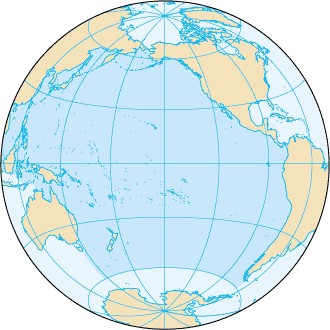
With an average depth of around 4,000 meters and containing nearly twice as much water as the Atlantic Ocean, it is both the largest and the deepest ocean basin on the planet. Its floor is geologically restless, studded with some 25,000 islands and framed by the Ring of Fire, a zone of subduction zones and volcanoes that has produced all five of the largest earthquakes ever instrumentally recorded. At the same time, human activity has left a measurable mark: an estimated 100,000 tonnes of plastic now circulate in a patch between Hawaii and California.
Key facts
- Type: ocean
- Located in: international waters
- Coordinates: 0.0000, -160.0000
- Area: 161,760,000 km²
- Elevation: 0 cm
Size and depth
That disparity in scale shapes everything from global weather systems to the movement of species across open water.
The ocean’s average depth is approximately 4,000 meters (13,000 feet), but its floor is far from uniform. The deepest point on Earth lies within the Pacific: Challenger Deep, at the southern end of the Mariana Trench, sits roughly 10,935 meters (35,876 feet) below sea level. HMS Challenger first surveyed this location in 1875. The Mariana Trench itself runs approximately 2,550 kilometers in length and averages 69 kilometers in width, formed where the Pacific Plate is forced beneath the Mariana Plate through the geological process of subduction.
Geology and the Ring of Fire
The Pacific Ocean sits atop one of the most tectonically active regions on Earth. At its margins, the oceanic plate is continually driven beneath neighboring plates, a process that builds both the deep trenches rimming the ocean and the volcanic arcs above them. All five of the largest recorded earthquakes in history occurred along this Ring of Fire, including the 1960 Valdivia, Chile, earthquake, which reached magnitude 9.5 — the most powerful ever captured by instruments.
Subduction at the margins does more than generate earthquakes. It is also slowly reducing the ocean’s footprint. The Pacific shrinks by approximately 0.5 square kilometers per year, while the Atlantic is expanding. Supercomputer simulations predict that this process, carried far enough forward in time, will cause the Americas to collide with Asia, forming a new supercontinent that researchers call Amasia.
Not all of the Pacific’s volcanic activity is confined to its edges. The Hawaiian hotspot, sitting well within the plate interior, has been active for more than 70 million years. As the Pacific Plate has moved over it, the hotspot has produced the Hawaiian–Emperor seamount chain, a string of volcanic structures in which the rock grows progressively younger toward the southeast. The island of Hawaii at the chain’s southeastern end is composed of rock almost entirely younger than 1 million years old.
Islands and ocean regions
The Pacific holds an estimated 25,000 islands, more than all other oceans combined. These are organized into three broad geographic regions: Melanesia, Micronesia, and Polynesia. The Marianas Trench Marine National Monument, which encompasses some of the waters and submerged lands of this western Pacific area, was established in January 2009 through a presidential proclamation under the Antiquities Act of 1906.
El Niño and climate patterns
The Pacific exerts an outsized influence on global climate through El Niño, a naturally occurring pattern tied to the warming of ocean surface temperatures in the central and eastern tropical Pacific. El Niño occurs on average every two to seven years and typically lasts between nine and twelve months. Its effects ripple outward well beyond the Pacific basin, altering rainfall, drought, and storm patterns across multiple continents.
The Great Pacific Garbage Patch
Between Hawaii and California, in the North Pacific Ocean, an accumulation of plastic debris known as the Great Pacific Garbage Patch has formed through the circular currents of the North Pacific Gyre. Estimates put the total weight at approximately 100,000 tonnes, spread across an estimated 1.8 trillion individual pieces of plastic. The patch is not a visible island of floating rubbish. By count, 94% of those pieces are microplastics smaller than 5 mm, the majority of them too small to see with the naked eye.
Did you know
- If Mount Everest, which stands 8,849 meters tall, were placed at the bottom of Challenger Deep in the Mariana Trench, its summit would still sit more than 2,000 meters below the ocean surface. (geographyworlds.com)
- The Great Pacific Garbage Patch is not a solid island of trash. Of the estimated 1.8 trillion plastic pieces it contains, 94% by count are microplastics smaller than 5 mm, most of them invisible to the naked eye. (theoceancleanup.com)
- The Hawaiian hotspot has been active for more than 70 million years. The Pacific Plate’s movement over it produced the Hawaiian–Emperor seamount chain, where volcanic rock grows progressively younger toward the southeast, culminating with the island of Hawaii itself, composed of rock almost all younger than 1 million years old. (rwu.pressbooks.pub)
- Francis Fletcher, who sailed with Francis Drake during Drake’s circumnavigation of the globe in the 1570s, thought that the name Mare furiosum — Furious Sea — would have been more accurate than Magellan’s Mare pacificum, meaning Peaceful Sea. (commonplace.online)
- Supercomputer simulations predict that as the Pacific Ocean continues to shrink through subduction, the Americas will eventually collide with Asia to form a new supercontinent that scientists call Amasia. (vice.com)
Data sources
- Wikidata
- oceanexplorer.noaa.gov
- worldatlas.com
- earthquaketracker.org
- geographyworlds.com
- noaa.gov
- theoceancleanup.com
- geographyrealm.com
Data updated: 2026-10-28