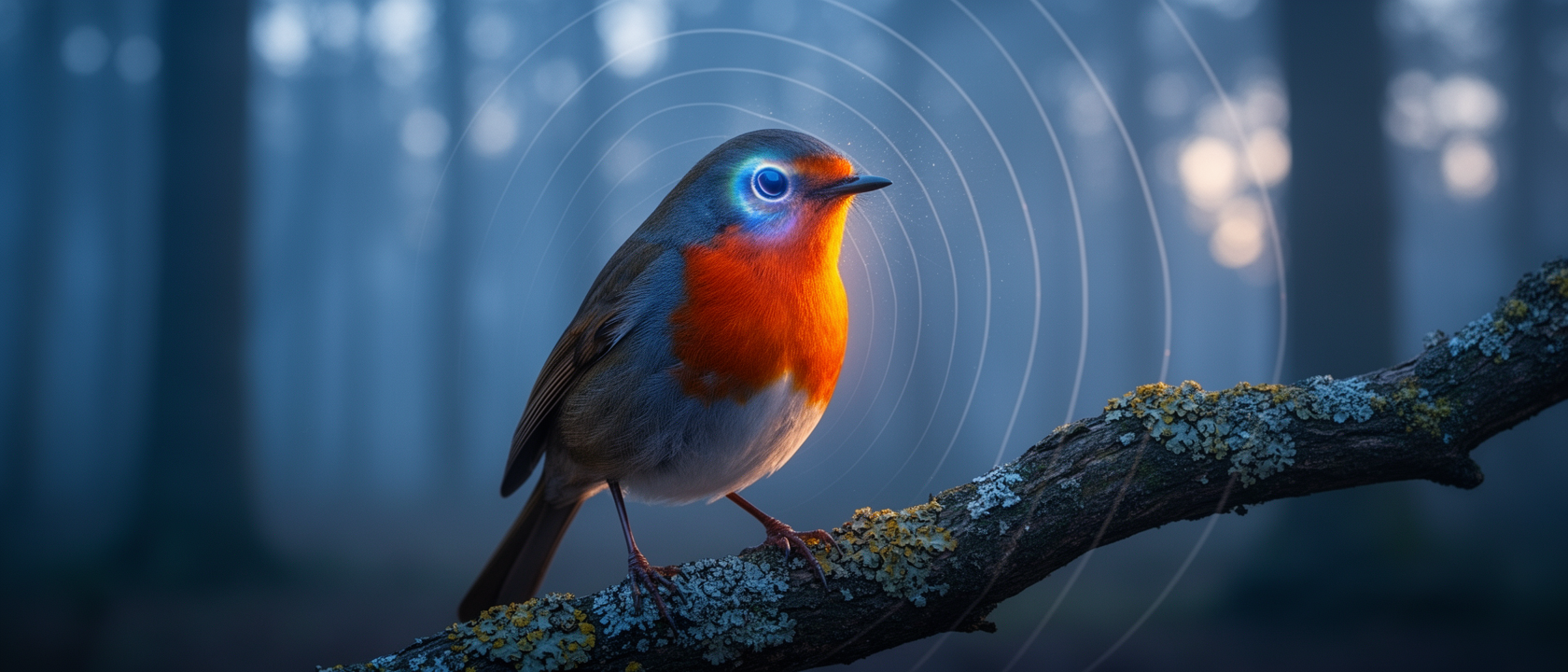
The Bird With a Built-In Visual Compass
Most animals that detect Earth’s magnetic field respond to it something like a compass needle does, they feel a directional pull and adjust accordingly. The European robin (Erithacus rubecula) appears to do something fundamentally different. According to the current leading scientific picture, it actually sees the magnetic field, as patterns of light and shade, possibly with a color component, laid over ordinary vision like a transparent overlay. And in experienced adult birds, that visual compass seems to operate primarily through the right eye. The full story, though, is more layered than that headline suggests.
It Started With Restless Birds in a Darkened Room
The trail begins in autumn 1957, when Hans Fromme at the Frankfurt Zoological Institute noticed something odd about caged European robins during migration season. Sealed in a room with no sky, no sun, no stars, and no landmarks, the birds still clustered in the southwestern corner of their cages, the direction they would naturally fly. Fromme concluded they were picking up Earth’s magnetic field, though his findings were never formally published or independently tested in his lifetime.
Wolfgang Wiltschko at Goethe University Frankfurt picked up where Fromme left off. In 1966, working with Friedrich W. Merkel, he published the first controlled experimental proof: by manipulating the magnetic field around caged robins, he could change which direction they tried to escape. Six years later, in 1972, Wiltschko and his wife Roswitha published a paper in Science pinning down how the compass actually works. It’s an inclination compass, the robin doesn’t read magnetic polarity the way a hiker’s compass does. Instead, it reads the angle at which field lines dip into the Earth relative to gravity. That distinction matters because it works at any latitude, even where field lines run nearly parallel to the ground.
Right Eye Required, With Important Caveats
In 2002, the Wiltschko team published a striking result: cover a robin’s right eye with an opaque patch and its magnetic navigation falls apart entirely; cover the left eye and the bird orients fine. Eight years later, in 2010, Katrin Stapput at Goethe University Frankfurt reinforced the picture using frosted (translucent rather than opaque) goggles, degrading vision through the right eye caused disorientation, while the same goggle on the left eye left navigation intact. The implication was clear: not only does the right eye need to be open, it needs a clean, undistorted image to work with.
Then in 2011, a paper in Nature by Hein and colleagues at the University of Oldenburg complicated the picture considerably. Using double-blind protocols, where the experimenter running the trial didn’t know which eye was covered, they found robins could navigate with either eye. A clean contradiction.
A 2012 study offered a plausible reconciliation: young robins start out with the magnetic sense available in both eyes, but after their first migration it becomes lateralized, settling into right-eye dominance in experienced birds. The Wiltschko group had tested birds in spring, after that first migration, already lateralized. The Hein group had tested birds in autumn, before it. So right-eye dominance in experienced adult robins looks well-supported; the absolute “right eye only, full stop” version is the part that doesn’t hold up.
The Mechanism: A Working Hypothesis
The leading explanation centers on a protein called cryptochrome, specifically a variant known as ErCry4a, found in the robin’s retina. Blue light excites the flavin chromophore inside it, triggering an electron transfer that produces what physicists call a radical pair: two molecules with unpaired electrons whose spin states become entangled. Earth’s magnetic field influences how long that pair takes to return to its baseline state, which in turn subtly modulates the sensitivity of certain retinal cells. The bird perceives this modulation as a pattern overlaid on its ordinary view of the world.
Two details support this picture. First, the magnetic sense is light-dependent in a very specific way: blue or short-wavelength light enables it, while red light disrupts orientation entirely. Second, ErCry4a expression in the retina runs approximately 2.5 times higher during migration seasons than outside them, suggesting this isn’t just a passive structural feature sitting idle year-round, but something the bird actively ramps up when it needs it. That said, the radical pair mechanism remains a leading hypothesis, not a fully proven mechanism.
A Different Solution in Pigeons
Homing pigeons face the same navigation problem but arrived at a completely different answer. In January 1971, William T. Keeton at Cornell University published a study showing that magnets glued to the backs of experienced pigeons disrupted their navigation under total overcast at distances of roughly 17 to 31 miles (27 to 50 km), but not under clear skies, where the birds could use the sun instead. Pigeons rely on magnetite: tiny iron oxide crystals, between 1 and 5 nanometers across, embedded in the upper beak’s subcutis and connected to the brain via the trigeminal nerve.
Where the robin’s compass is visual, light-dependent, and processed in the retina, the pigeon’s is closer to a mineral detector wired directly into its nervous system. Same planet, same magnetic field, two entirely different pieces of equipment.