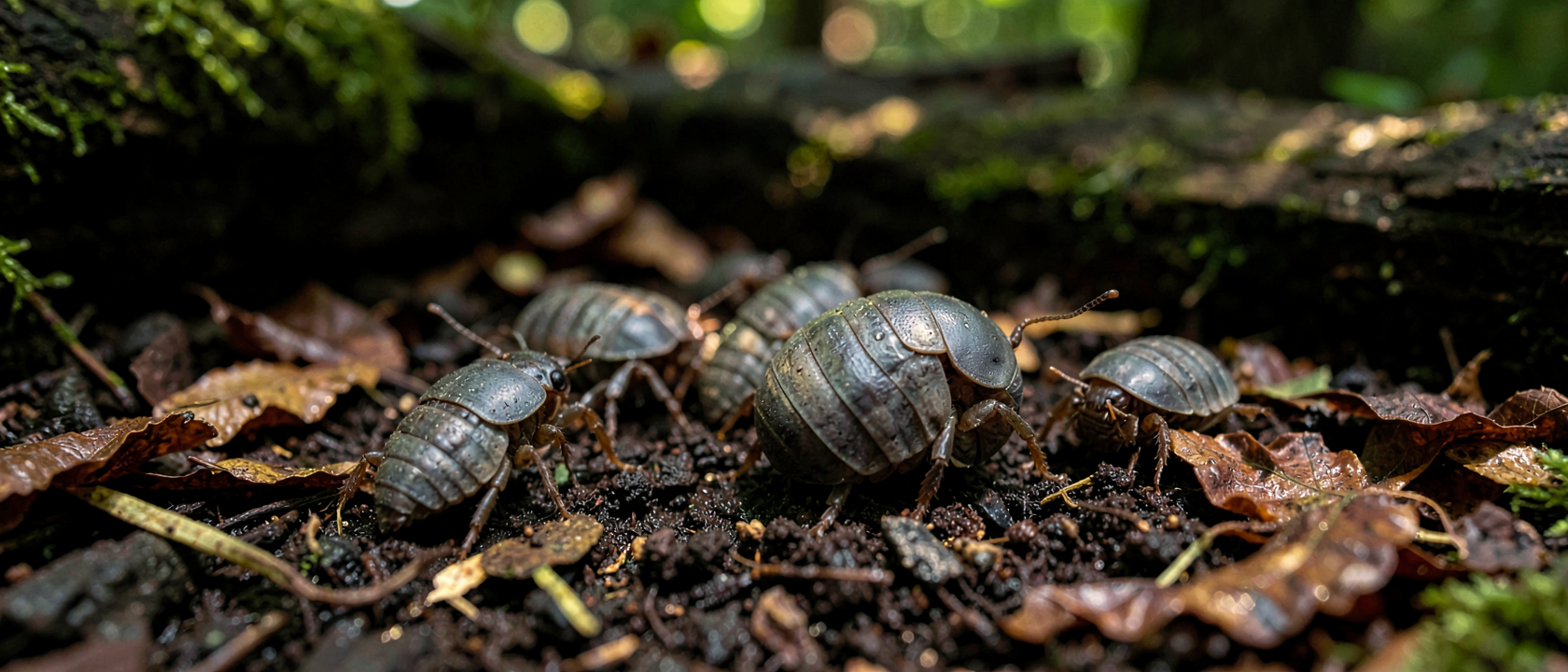
You’ve been calling it the wrong thing your whole life
Pick up a roly poly and you’ve probably filed it mentally under “bug” before you’ve even put it down. Small, many-legged, lives under rocks, that’s a bug, right? Not remotely. The roly poly belongs to Order Isopoda, squarely within the crustaceans: the same broad group as shrimp, crabs, crayfish, and lobsters. Taxonomically, it is closer to what ends up on a seafood platter than to anything fluttering around a lightbulb.
You may know it by other names: pill bug, woodlouse, armadillo bug, potato bug, wood shrimp, doodlebug. They all point to the same animal, Armadillidium vulgare, a grey-brown oval roughly 0.3–0.7 inches (8.5–18 mm) long, with fourteen legs across seven overlapping body plates and a hard chitinous exoskeleton. Nothing about its appearance screams crustacean, but the classification is firm.
One of the very few crustaceans that moved ashore, and stayed
Most crustacean lineages never left the ocean. Moving onto land means solving breathing, desiccation, body support, and reproduction without water, a set of problems most lineages never solved. The roly poly’s ancestors did, making it the only crustacean considered fully adapted to spending its entire life on land. Plenty of crabs venture ashore or climb trees, but they return to water to breed. A. vulgare spread from its native Europe to temperate, subtropical, and subarctic regions across most of the globe, never needing the sea again.
It breathes through gills, on land
Leaving the ocean did not mean leaving ocean biology behind. The roly poly still respires through gill-like structures on its underside, called pleopodal lungs, which only work when damp. This single fact explains nearly everything about its habits: it clusters under logs, flat stones, and leaf litter because it must. It is primarily nocturnal, active when temperatures drop and moisture rises, and favors humidity around 50–60 percent. The animal conquered the land but carried its aquatic respiratory equipment with it.
Its internal biology is genuinely strange
The roly poly’s blood, hemolymph, is blue when oxygenated, owing to hemocyanin, a copper-containing protein that binds oxygen the way iron-based hemoglobin does in vertebrates. Copper matters enough that the animal has built a recycling system around it: it eats its own feces (coprophagy) to recover copper lost during digestion. Instead of liquid urine, it releases nitrogen as ammonia gas through pores in its exoskeleton. It can also absorb moisture through tube-shaped rear appendages called uropods, effectively drinking through its back end. Together, these traits amount to a waste and fluid chemistry almost entirely remade for terrestrial life.
What the colors mean, and why it looks two-toned
A roly poly appearing bright blue or purple is not a rare variant, it is dying. Invertebrate Iridescent Virus 31 (IIV-31) forms a paracrystalline layer of viral particles beneath the exoskeleton that reflects vivid iridescent color. Infection shortens lifespan and dulls normal responses to light and moisture. The virus poses no risk to humans.
A two-toned roly poly, pale at the back, darker at the front, is simply molting in progress. The roly poly sheds its exoskeleton in two stages roughly three days apart, leaving the freshly shed rear end pale while the front still wears the old shell.
Wolbachia bacteria, maternally inherited microbes infecting many arthropods, can convert a genetic male into a functional female. Separately, females can reproduce without males through parthenogenesis, producing female offspring from unfertilized eggs. Male offspring require a male’s genetic contribution, a reproductive system with considerably more flexibility than most animals have ever needed.
It won’t destroy your garden, and rolling up is more interesting than it looks
The roly poly’s reputation as a garden pest is narrower than it seems. Its primary diet is dead and decaying organic matter; it is a detritivore that cycles nutrients back into soil. It can graze on seedlings and ripe fruit touching damp soil, but established plant tissue is simply beyond it. The famous curl-into-a-ball behavior, conglobation, works on two fronts: presenting an armored exterior to predators while sealing off the soft gill structures underneath against desiccation.
A female carries eggs in a ventral brood pouch called a marsupium, produces two to three broods per year, and can store sperm from a single mating for up to a year. Newborns emerge white, tiny, and already shaped like miniature adults. Native to Europe, A. vulgare has followed human movement to every temperate corner of the globe, and almost everything about how it functions is doing something you wouldn’t predict from a casual glance.