The Surprising Journey of a Letter to Santa
Most children picture their letter to Santa sailing north through magical skies. The actual path it takes is far more complicated, and for most of the past two centuries, considerably darker.
First stop: the incinerator
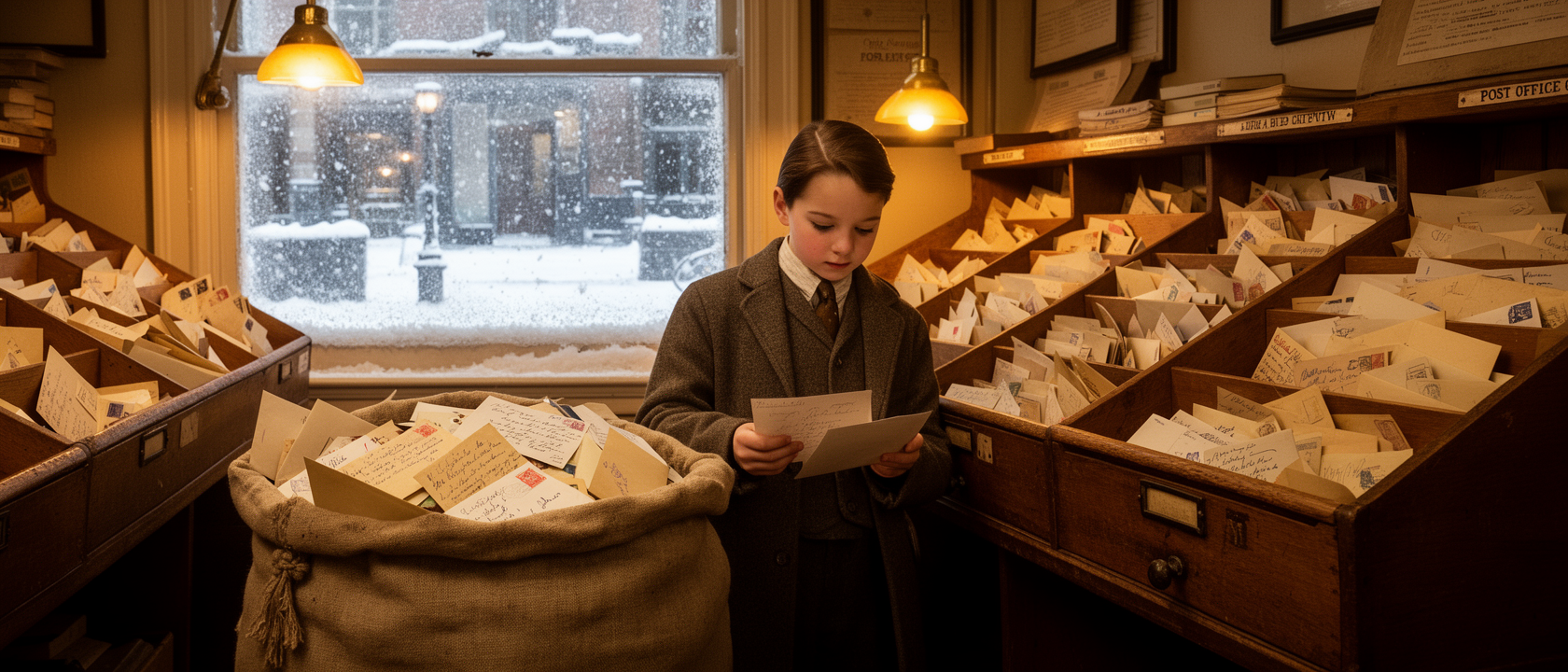
For decades, any envelope addressed to “Santa Claus, North Pole” had the same fate as a letter sent to a fictional address: it landed in what postal workers called the Dead Letter Office, the system’s final resting place for mail that couldn’t be delivered. The standard procedure there was destruction. These letters weren’t lost or forgotten, they were deliberately burned.
That began to change on December 13, 1907, when Postmaster General George von Lengerke Meyer authorized local postmasters to hand Santa letters to charitable institutions instead. The idea was to use the wishes inside to connect needy children with donors. The experiment lasted barely a year before complaints shut it down, some presents were reportedly going to children that critics deemed “undeserving,” which tells you something about the era. Postmaster General Frank H. Hitchcock revived the practice in 1911, and by 1913 it was written permanently into postal regulations.
The man who saw an opportunity
Also in 1913, a customs broker named John Duval Gluck Jr. approached the New York City postmaster with a proposition. He would organize a proper charity, the Santa Claus Association, to intercept letters to Santa and match children’s requests with willing donors. It sounded like exactly what the postal service needed.
What Gluck actually built was a fraud. For fifteen years, the Association collected donations from parents, businesses, and strangers moved by the letters. In 1928, investigators found that Gluck had siphoned hundreds of thousands of dollars from the operation. The postal service cut ties with the Association immediately, and Gluck eventually relocated to Florida.
How the magic actually works now
The modern iteration of this program, called Operation Santa, went digital with a pilot in 2017, starting in New York City, before expanding nationally in 2019. Letters are scanned and uploaded with names, addresses, and ZIP codes removed first, so that vetted volunteers can browse and adopt one to fulfill. It is not a guaranteed gift program; it runs entirely on strangers’ generosity.
Other countries have built their own formal systems. Canada Post has used the postal code H0H 0H0 for the North Pole since 1982. Since the program began, more than 30 million letters have been answered (as of 2020), with replies sent in 39 languages, including Braille. The UK’s Royal Mail routes letters to “Santa’s Grotto, Reindeerland, XM4 5HQ,” a fictional address that has been in operation since 1963. Both Canada Post and Royal Mail share a practical deadline: letters should arrive by approximately December 10 to guarantee a reply reaches the child before the holiday.
Where the North Pole came from
None of this infrastructure would exist without two pieces of American art. The first was a poem published on December 23, 1823, in the Troy Sentinel newspaper. “Account of a Visit from St. Nicholas,” now better known as “The Night Before Christmas,” described a jolly, plump figure arriving by sleigh with eight named reindeer. Clement Clarke Moore is most often credited as the author, though the attribution has been disputed: computer-aided textual analysis in the early 21st century found closer stylistic similarities to the work of Henry Livingston Jr. a poet who died in 1828.
The North Pole itself came from a different source. Political cartoonist Thomas Nast drew 33 Christmas-themed illustrations for Harper’s Weekly between 1863 and 1886. His 1866 image “Santa Claus and His Works” was the first to plant Santa’s address at “Santaclaussville, N.P.”, the North Pole. That label, on an illustration in a mass-circulation magazine, effectively created the geographic fiction that postal services around the world now have to manage.
What the letters reveal
The content of the letters has shifted with the culture. Nineteenth-century children asked for coal, prayer books, and wagons. One adult woman apparently wrote to request a wealthy husband. Early depictions of Santa from around 1810 show him carrying a switch for punishing children, and the letters of that era often read more like moral self-assessments than wish lists. Modern letters trend toward specific consumer items, sometimes with model numbers included, a long way from prayer books, in every sense.