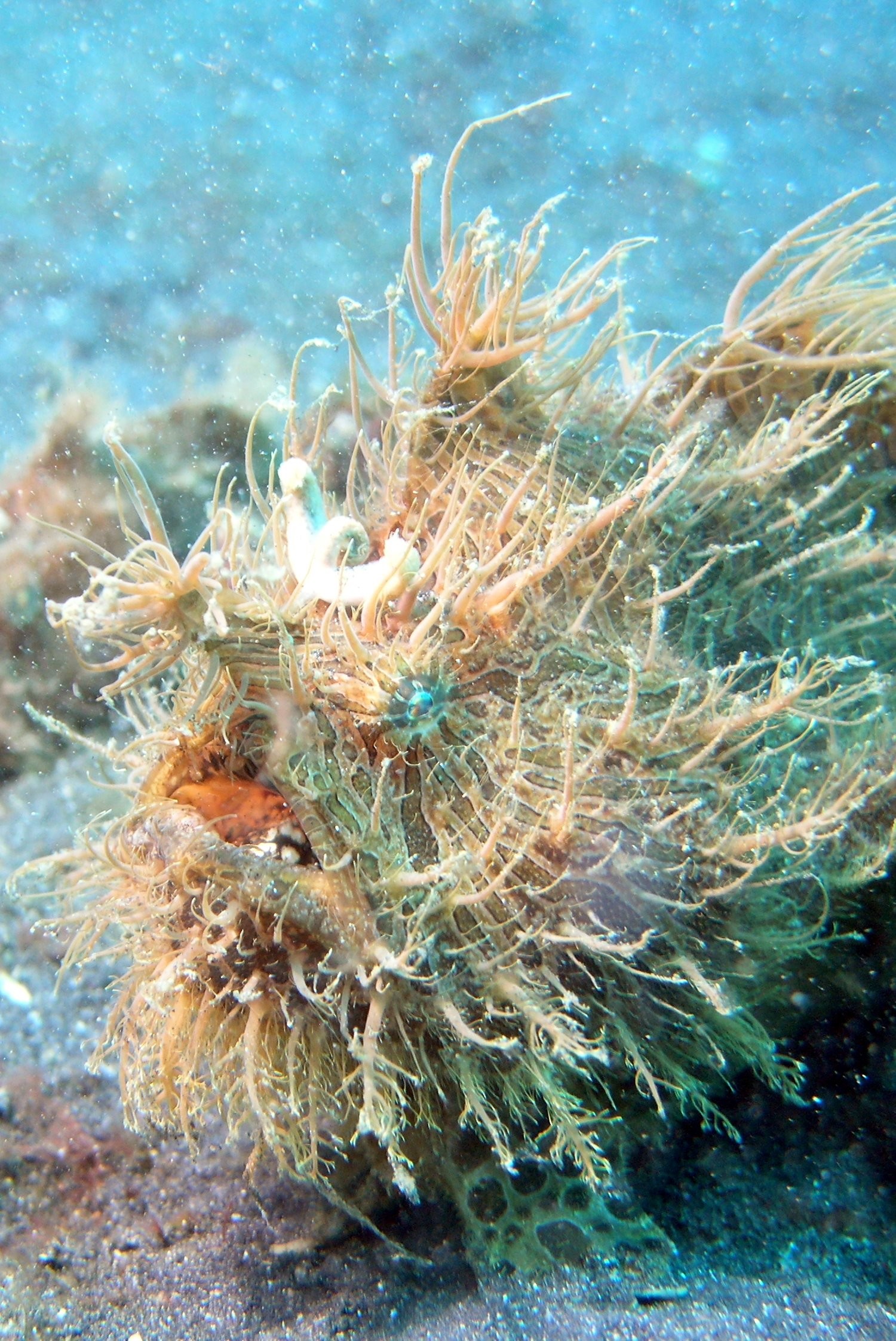
The striated frogfish, Antennarius striatus, is a marine fish belonging to the order Lophiiformes and the family Antennariidae, distributed across tropical and subtropical waters of the Indian, Pacific, and Atlantic Oceans. It is among the most morphologically distinctive reef predators: a globose, soft-bodied animal covered in irregular skin appendages, capable of changing its coloration within a few weeks to match its surroundings. Most individuals measure around 10 cm, though the species can reach 25 cm in total length. Members of the genus Antennarius hold the record for the fastest buccal-cavity expansion of any animal, engulfing prey in under 4 milliseconds.
Key facts
- Scientific name: Antennarius striatus
- Kingdom: Animalia
- Phylum: Chordata
- Order: Lophiiformes
- Family: Antennariidae
- Genus: Antennarius
- Taxonomic rank: species
Taxonomy and naming
The species was first formally described in 1794 by the English biologist George Shaw, who placed it in the genus Lophius under the name Lophius striatus, with the type locality recorded as Tahiti in the Society Islands. It was later moved to Antennarius, the genus name derived from the Latin antenna, a reference to the first dorsal spine modified into a tentacle-like lure on the snout. The specific epithet striatus comes from the Latin stria, meaning ‘line,’ pointing directly to the dark parallel streaks and elongated blotches that mark the body.
Within the family Antennariidae, the striated frogfish is most easily confused with the closely related Antennarius hispidus. The two species are best told apart by their lures: A. striatus carries a slightly shorter illicium rod tipped with two or more worm-like appendages on the esca, while A. hispidus bears a pom-pom-shaped esca.
Physical description
The body is soft and lacks scales, the skin instead bearing irregularly arranged, bifurcate dermal spinules that resemble hairs. Males carry more and longer of these cutaneous appendages than females. Coloration ranges from yellow, orange, brown, green, grey, off-white, and black, overlaid with roughly parallel dark streaks or elongated blotches. The fish can shift both color and pigment pattern within a few weeks, allowing it to blend into sponge beds, rubble fields, or silty substrates with equal facility.
The mouth is large and forwardly extensible, enabling the fish to swallow prey as large as itself. As a defensive measure, the striated frogfish can inflate its body with water, making itself difficult to swallow in the same way pufferfishes do.
Distribution and habitat
The striated frogfish has a circumglobal range in tropical and subtropical seas. In the Atlantic it occurs from the coast of New Jersey south to Brazil, taking in the Gulf of Mexico and the Caribbean. It is present throughout much of the Indian and Pacific Oceans but is absent from the eastern Pacific. Within Australian waters it ranges from south-western Western Australia across the north of the continent and south along the east coast to southern New South Wales.
The species occupies a wide vertical range, from shallow estuaries down to roughly 220 m depth. Most individuals are found in shallow waters on sandy, rocky, or muddy bottoms, with a strong preference for areas where sponges are abundant. Its trophic level, as assigned by FishBase, is 4.2 (±0.7 SE), placing it among the higher-level predators on the reef.
Hunting and locomotion
The striated frogfish is an ambush predator. It holds almost perfectly still and waves its worm-like esca to attract fish and crustaceans within striking range, then engulfs them by expanding the buccal cavity at a speed unmatched in the animal kingdom: under 4 milliseconds. Individuals living in deeper, darker water possess specialized secretory cells in the esca that release an olfactory attractant, supplementing the purely visual lure used by their shallow-water counterparts.
Movement across the seafloor relies on two distinct methods. The fish walks using its arm-like pectoral and pelvic fins in a gait that broadly resembles that of a four-legged animal. When it uses jet propulsion instead, expelling water through the small tubular gill openings situated behind the pectoral fins, it travels at only 2.3 to 2.7 cm per second, equivalent to 0.27 to 0.32 body lengths per second. That modest speed reflects the high drag imposed by the fish’s rounded body shape.
Behavior and reproduction
Outside of the mating period the striated frogfish is solitary and intolerant of its own kind. Individuals come together only to reproduce; once fertilization has occurred, the pair separates, and post-mating partners risk being killed and consumed by their mate if they linger.
Eggs hatch within 2 to 5 days. The larvae drift in the plankton for one to two months before settling onto the reef. Even at larval sizes of 5 to 10 mm, individuals already carry a functional lure, meaning the species begins its predatory career at an extremely early stage of development. The illicium rod can regenerate if lost, so a fish that loses its lure to injury is capable of regrowing it.
Genomics and virology
In 2011, specimens of the striated frogfish caught by trawlers in the East China Sea yielded samples that led to the identification of two entirely new virus genera: Antennavirus, assigned to the family Arenaviridae, and Striavirus, assigned to the family Filoviridae. Both discoveries were reported by Shi et al. in 2018, and the genus name Striavirus directly commemorates the host species.
On June 21, 2024, a chromosome-level genome assembly for Antennarius striatus was published in Scientific Data. The assembly spans 548.56 Mb anchored across 24 chromosomes, with a contig N50 of 21.05 Mb, and annotates 23,945 protein-coding genes. At the time of publication it was the most complete genome assembled for any member of the order Lophiiformes.
Relationship with humans
The striated frogfish is traded commercially in the marine aquarium industry. Captive individuals are almost always wild-caught, as the species has no domestication history. It is also a frequent subject for scuba divers and underwater photographers, drawn by its cryptic appearance and the relative ease with which a motionless individual can be approached once located.
Evolutionary context
A mitogenomic study estimated the basal divergence of the order Lophiiformes at roughly 157 million years ago. All lophiiform lineages, including the frogfishes of family Antennariidae, are thought to have been established by the Eocene, between approximately 40 and 56 million years ago.
Did you know
- The striated frogfish’s buccal-cavity expansion during prey capture takes less than 4 milliseconds, making the genus Antennarius the fastest-feeding animal known. The movement is so rapid that only high-speed cameras can capture the strike. (shinkaiuo-zukan.com)
- The striated frogfish was the source host for the discovery of two entirely new virus genera: Antennavirus (family Arenaviridae) and Striavirus (family Filoviridae). Both were found in East China Sea specimens collected in 2011 and were reported by Shi et al. in 2018. (ictv.global)
- Although widely called the ‘hairy’ frogfish, some individual Antennarius striatus are completely smooth. The ‘hair’ is formed by variably developed dermal spinules, not true filaments, so the amount present differs considerably from one fish to the next. (notroublesjustbubbles.com)
- The lure rod (illicium) of the striated frogfish can regenerate after being lost. A fish whose primary hunting tool is damaged or removed is capable of regrowing it. (floridamuseum.ufl.edu)
- A mitogenomic study estimated the basal split of the order Lophiiformes at approximately 157 million years ago. All lophiiform lineages, including the frogfishes, are thought to have been established by the Eocene, between 40 and 56 million years ago. (pmc.ncbi.nlm.nih.gov)
- The genus name Antennarius refers to the first dorsal spine adapted into a tentacle-like lure on the snout, from the Latin antenna (sensory appendage), while the species name striatus means ‘striped’ in Latin. The two names together describe what are arguably the fish’s two most immediately visible features. (australian.museum)
Data sources
- GBIF
- Wikidata
- fishesofaustralia.net.au
- monaconatureencyclopedia.com
- floridamuseum.ufl.edu
- sta.uwi.edu
- marinespecies.org
- australian.museum
- ncbi.nlm.nih.gov
- nhm.ac.uk
- wcupa.edu
- frogfish.ch
- ictv.global
- nature.com
- a-z-animals.com
- fishbase.se
Data updated: 2026-10-26