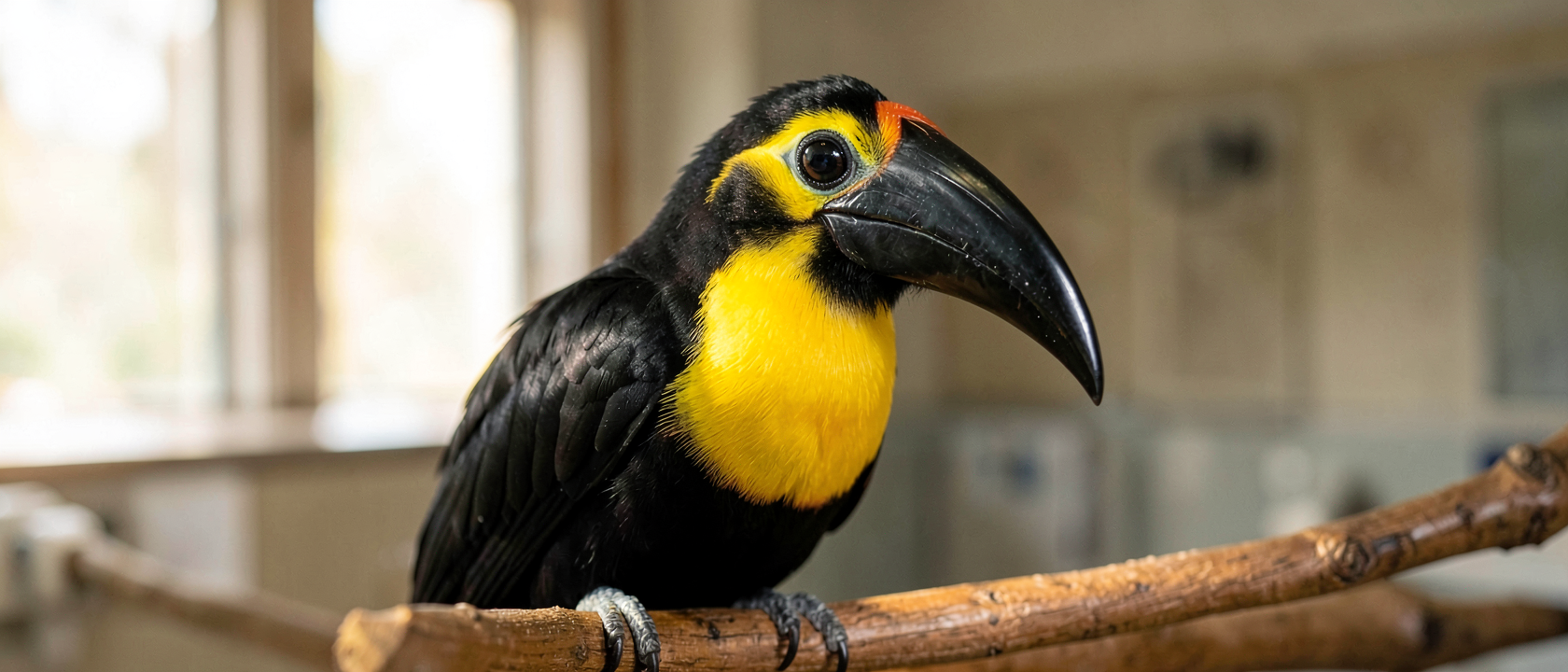
The Rescue That Wasn’t Finished
In March 2015, officers broke up an illegal wildlife fair in Rio de Janeiro and pulled a toucan out of the trade. She was thin, malnourished, and already missing part of her upper beak by the time anyone found her. They named her Tieta. Nobody could say for certain how it happened, accounts conflict between rough handling by smugglers or an attack by a larger bird packed into the same transport cage.
Tieta had survived the raid. What rescuers didn’t yet realize was that her real ordeal was just starting.
Why a Missing Beak Is More Than It Looks
A toucan’s beak looks like a display feature more than a survival tool, so losing half of it seemed like it shouldn’t threaten her life the way losing a wing would. Yet vets treated it as an emergency, not a cosmetic footnote, a sign the beak was doing work that had nothing to do with chewing.
A Beak That Works Like an Air Conditioner
Underneath its bright outer layer, a toucan’s beak holds a dense network of blood vessels close to the surface, working like the fins in a car radiator: blood sheds heat into the air and returns cooled, helping the bird avoid overheating in the humid rainforest. Losing nearly half her upper beak cost Tieta both her feeding tool and her cooling system. Before treatment, she was reduced to tossing bits of food into the air and snapping at them, succeeding only about once every three tries.
Fixing that meant building a replacement precise enough to actually work. A project led by wildlife group Instituto Vida Livre pulled in researchers from UFRJ’s COPPE institute, PUC-Rio, and Universidade Anhanguera, along with Brazil’s environmental agency Ibama. Engineer Roched Seba coordinated the project, Professor Carla Cipolla oversaw the engineering at COPPE, and researcher Gustavo Cleinman built the 3D design. Rio’s Botanical Garden lent a taxidermy toucan specimen so the team could scan a healthy beak at PUC-Rio’s 3D Experimentation Center and use it as a template.
It took four attempts before the fit was right. The final piece was printed in ABS plastic at COPPE’s Pro-PME lab in about two hours. The finished beak weighs just 0.14 ounces (4 grams) and measures 1.6 inches (4 centimeters), built for a bird who herself weighed only about 10.6 ounces (300 grams). It was finished with black nail polish and a coating of castor-oil-based polymer resin developed in Brazil.
Forty Minutes, Three Days, One New Beak
On July 27, 2015, Tieta went into surgery. Attaching the prosthesis, held in place with screws, took about 40 minutes, short but not without risk, as veterinarian Thiago Muniz noted that anesthetizing a wild bird is never routine.
The surgery worked, but Tieta didn’t trust her new beak right away. For three days she ignored the fruit put in front of her, as if the object still felt foreign. Instituto Vida Livre’s director, Roched Seba, said she simply needed time to realize she had it back. Once she did, she skipped the fruit entirely and went for live prey, maggots and cockroaches, catching them the way a toucan in the wild would.
What One Beak Says About the Future of Rescue
A working beak let Tieta reach her preen gland again, the small gland near the tail birds use to waterproof feathers, something she couldn’t manage with half an upper beak. Researchers also raised the unconfirmed possibility that a functioning beak could one day let her feed chicks of her own.
Still, Ibama’s Taciana Sherlock confirmed Tieta could never be released into the wild, partly because of the prosthesis and partly because of a separate, preexisting misalignment between her upper and lower beak that gave her bite a scissor-like shape. She lived out her life in captivity, with good care, until her natural death in 2018.
It was the first procedure of its kind attempted in Brazil, designed around one bird’s exact measurements rather than a one-size-fits-all mold. The story recalls a similar case involving a Costa Rican toucan named Grecia, but that rescue predates Tieta’s and is entirely separate, three universities and a wildlife institute treating a 300-gram bird’s anatomy as a problem worth solving down to the screw.