Terror in the Dark
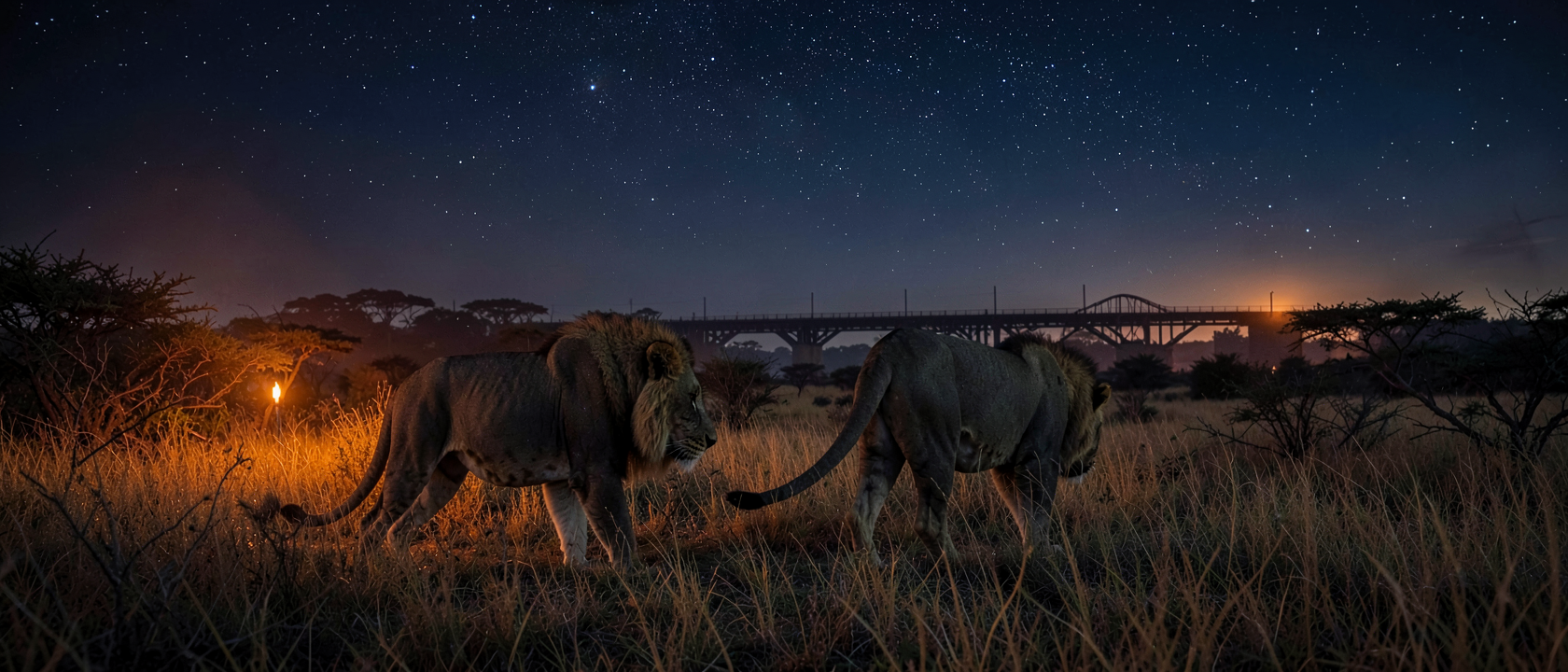
In March 1898, British engineers arrived at the Tsavo River in what is now Kenya to build a railway bridge for the Uganda Railway. Roughly 3,000 workers, mostly Indian laborers along with local Africans, camped along the riverbank. Soon after, two maneless male lions began slipping into camp at night, dragging men from their tents into the bush. The attacks stretched on for nine months, and the story grew bigger than the facts. The number that stuck, 135 dead, appears in books, documentaries, and the 1996 film “The Ghost and the Darkness.” It may not be true.
Why Would Lions Do This?
Lions hunting people at all is strange: we’re slow, we fight back in groups, and lions typically avoid human settlements. Two animals racking up a death toll in the dozens within a year is a genuine puzzle. How could they kill so many without being stopped sooner, and what would push lions to abandon antelope and buffalo for something as risky as a sleeping human? For over a century, nobody seriously tried to answer either question.
An Adaptive, Not Monstrous, Response
Two things were likely happening at once. Drought and a rinderpest outbreak had torn through East Africa’s herds of wildebeest and buffalo, the lions’ normal prey, leaving fewer easy meals. Then there were the lions themselves: examination of their remains showed one had a broken canine, a root-tip abscess, and a damaged jaw. Later research by Bruce Patterson of the Field Museum and Larisa DeSantis of Vanderbilt University, using detailed skull imaging, found tooth-wear patterns resembling those of zoo lions that eat soft food and never crack bone. Chasing a sprinting zebra with a broken jaw is a losing proposition; a sleeping human is not. The man-eating likely wasn’t an outbreak of animal malice, it looks closer to what any hungry, injured creature does: take the easiest option available.
Reading a Lion’s Diet in Hair and Bone
Hair keeps growing throughout an animal’s life, locking in a chemical signature from its diet over roughly the final three months before death. Bone collagen builds up over years, recording a lifetime diet. Researchers at the University of California, Santa Cruz, working with the lions’ preserved hair and bone held at the Field Museum, measured carbon and nitrogen isotopes and compared them against preserved early-20th-century East African human remains and typical Tsavo prey like zebra and wildebeest. The ratios work like a chemical receipt, estimating what percentage of each lion’s diet, by weight, was human flesh.
The Numbers Behind the Myth
The study, led by Justin D. Yeakel with Nathaniel Dominy at UCSC and Bruce Patterson at the Field Museum, published in the Proceedings of the National Academy of Sciences in 2009, estimated the two lions ate about 35 people combined over nine months, roughly 11 by one lion and 24 by the other. With 95 percent statistical confidence, the true number fell between 4 and 72. Not 135.
So where did 135 come from? Lt. Col. John Henry Patterson, the engineer who oversaw the bridge project and eventually shot both lions, popularized that figure in a 1925 pamphlet and his earlier bestselling 1907 book, “The Man-Eaters of Tsavo.” He kept the lions’ skins as floor rugs for 25 years before selling them and the skulls to Chicago’s Field Museum in 1924 for $5,000. The man who told the story may also have been the man who profited from how dramatic he made it.
The Count That Was There All Along
The Uganda Railway company’s own contemporary records logged 28 worker deaths from the lions, all Indian laborers, since African casualties apparently weren’t tracked with the same care. A 2001 scholarly review of Patterson’s original journal, by researchers Kerbis Peterhans and Gnoske, independently arrived at a similar figure, between 28 and 31.
Both figures fit comfortably inside the scientific range of 4 to 72. The quiet, bureaucratic number turns out to have been closer to the truth all along, it just never got a book deal, a pamphlet, or a movie built around it. Which is its own small lesson: the version of a story that travels fastest isn’t always the one that happened. Sometimes it’s just the one somebody had a reason to tell well.