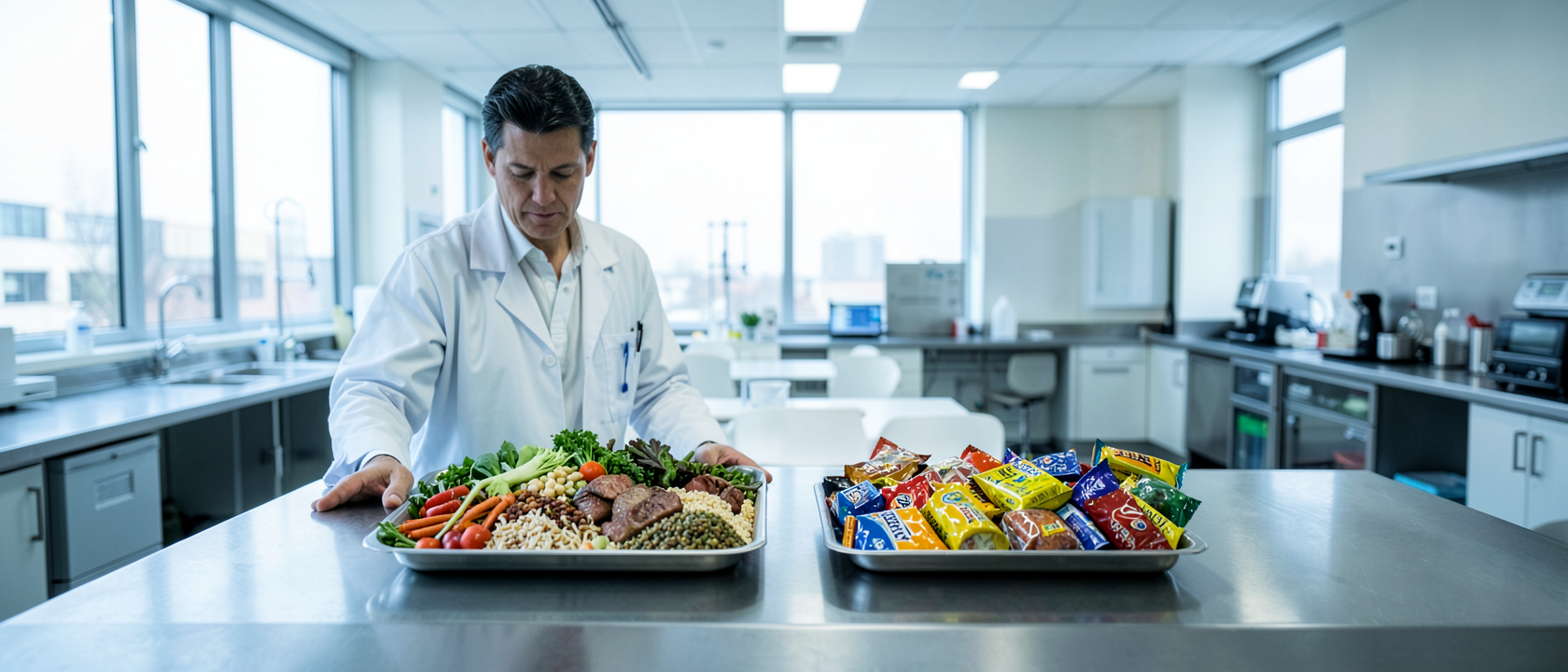
The Two-Week Experiment Nobody Noticed They Were In
In a 2019 clinical trial published in Cell Metabolism, nutrition researcher Kevin Hall ran an experiment at the NIH Clinical Center. Twenty weight-stable adults moved into a metabolic ward and ate however much they wanted, whenever they wanted, across two separate two-week stretches, in random order. One stretch used meals built entirely from ultraprocessed foods: chicken nuggets, frosted snack cakes, and similar packaged items. The other used meals made from largely whole, unprocessed ingredients. No one counted calories or was told to eat more or less; people simply ate until they felt done.
The results were hard to wave off. On the ultraprocessed diet, participants ate an average of 2,979 calories a day, about 509 more than the 2,470 calories a day they ate on the unprocessed diet. Over two weeks, that gap produced average weight gain of about 2 pounds (0.9 kg). On the unprocessed diet, weight barely moved.
Same Nutrition Label, Different Body
On paper, the two diets were identical: matched meal for meal on calories, fat, protein, carbs, sugar, sodium, and fiber. If weight gain came down to macronutrients, both groups should have eaten about the same amount. They didn’t. If every number on the label matched, what actually changed?
It’s Not What’s in the Food, It’s What Happened to It
Hall, a senior investigator at the National Institute of Diabetes and Digestive and Kidney Diseases (NIDDK), part of the NIH, points to processing itself rather than nutrients. Ultraprocessed foods are built from ingredients extracted, refined, and reassembled into something that barely resembles where it started: a chicken nugget instead of a chicken breast, a frosted snack cake instead of one made from flour, eggs, and butter. The nutrition numbers can match exactly; the physical structure doesn’t.
Hall and other scientists hypothesize that this engineered structure changes how fast food is digested and how it interacts with the gut, disrupting the normal gut-brain signaling that says “you’ve had enough.” The fullness message arrives late or weak, so the body keeps asking for food it doesn’t need.
Why This Breaks a Popular Idea
For decades, nutrition advice split into camps: the low-fat era blamed dietary fat, the low-carb era blamed sugar and carbs, both assuming the culprit was an isolatable, countable nutrient. Hall’s trial complicates that story: two diets with identical fat, carbs, sugar, and calories produced completely different outcomes in the same bodies over the same two weeks. The evidence points not to what’s in the food, but to what was done to it before it reached the plate.
A Rigorous First, According to Outside Experts
Barry Popkin, a nutrition professor at the University of North Carolina at Chapel Hill who had no role in the study, called it a well-controlled, high-quality clinical trial. That matters because most earlier evidence linking ultraprocessed food to weight gain came from population studies, which can show two things moving together without proving one causes the other. Popkin said the randomized design pointed to causation, not just correlation, between ultraprocessed food and overeating.
What We Still Don’t Know
The study has real limits the researchers acknowledge. The exact mechanism, what precisely in processing disrupts gut-brain signaling, hasn’t been mapped; it remains a hypothesis. The trial also happened inside a metabolic ward with every meal controlled. Real-world eating is messier: people mix processed and whole foods constantly, and factors like cost and convenience, not measured in this study, likely shape what ends up on a plate. The size of this effect outside a lab remains an open question, and while more scientists take the idea seriously, it isn’t yet the field’s settled view.
Why This Is the Kind of Thing Worth Noticing
The two diets matched on every number that supposedly mattered: same calories, same fat, same sugar. Most people would call that identical and stop looking. The more useful question is what a label can’t show: what happened to the food before it was packaged. Here, the hidden variable wasn’t a nutrient at all, but a process, the industrial step between ingredient and plate that almost nobody thinks to ask about.