A Very One-Sided Fight
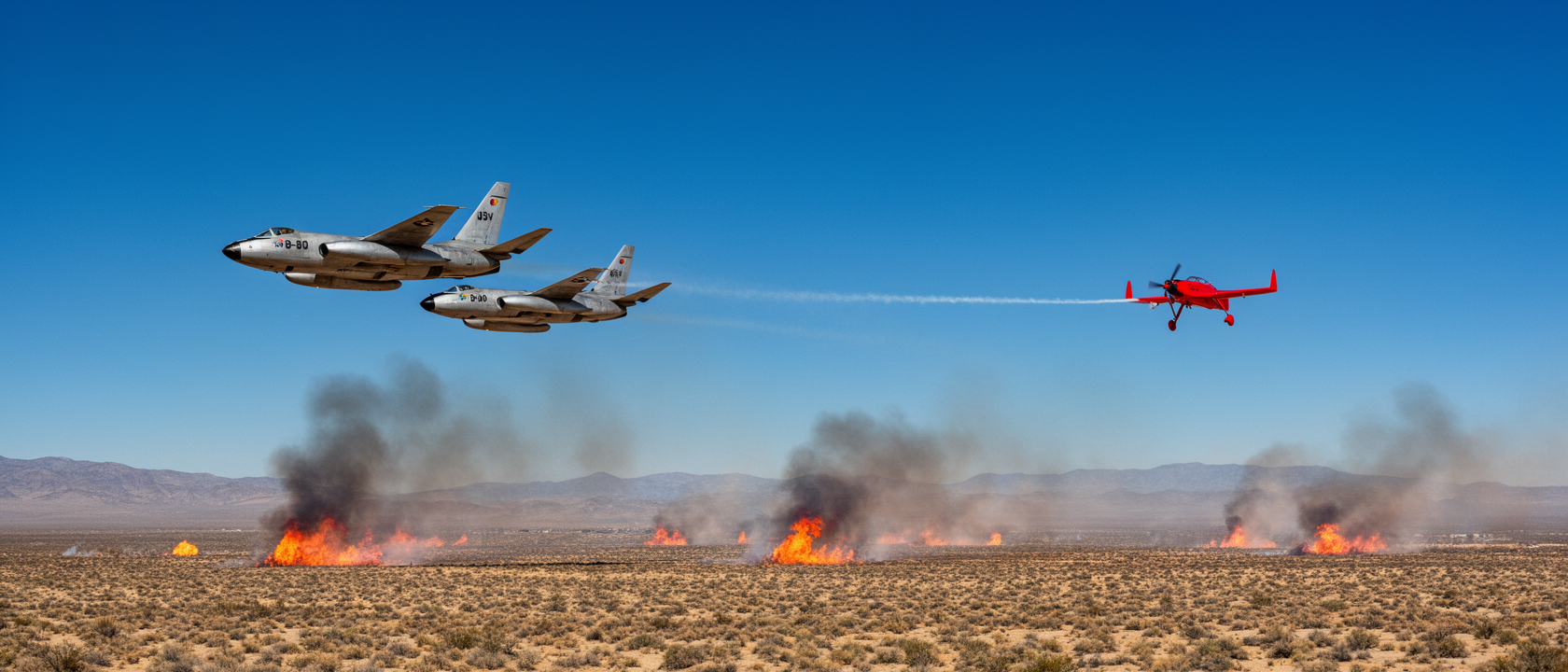
On August 16, 1956, the U.S. Air Force scrambled two of its best interceptors over Southern California. The target: a single unmanned drone, painted bright red, with no weapons and no pilot. By any measure, this should have been easy.
It was not.
The event became known as the “Battle of Palmdale.” The drone was an F6F-5K, a converted Grumman Hellcat repurposed as a radio-controlled target aircraft. It had lifted off from Naval Air Station Point Mugu for a routine missile test over the Pacific when its controllers lost contact, whether the fault lay in the ground transmitter or the aircraft’s receiver was never resolved. The old Hellcat banked southeast and drifted toward Los Angeles.
208 Rockets, Zero Hits
Two F-89D Scorpion jets from the 437th Fighter-Interceptor Squadron at Oxnard Air Force Base went up to intercept it. Each carried 104 Mark 4 “Mighty Mouse” unguided rockets in wingtip pods, 208 rockets between them. By the end of the engagement, all 208 had been launched. Not one struck the drone.
The salvos came in four rounds. The first 42 missed cleanly. A second pass reportedly scraped the drone’s fuselage without detonating. Then 64 more rockets went out near Newhall, followed by a final 30 per aircraft toward Palmdale. The red Hellcat flew on, undamaged.
The Anatomy of a Miss
Two failures stacked to produce this outcome. The F-89D was built around the Hughes E-6 fire control system, which was supposed to handle targeting and trigger salvos automatically. Under these conditions it failed to initiate launches, forcing the pilots to switch to manual fire.
That exposed the second problem: when the E-6 was installed, the aircraft’s optical gunsights had been removed to accommodate it. The pilots were aiming unguided rockets at a maneuvering drone with no targeting aid whatsoever, roughly analogous to handing someone a rifle, removing the sights, and asking them to hit a moving target at altitude. The drone’s erratic path over populated areas further constrained when and from what angles they could fire.
Rain of Steel in the Canyons
Over 200 unguided rockets that miss an aircraft have to land somewhere. Most fell across the Santa Clarita Valley, igniting brush fires in Castaic, Placerita Canyon, and Soledad Canyon. The total area burned exceeded 1,000 acres. Extinguishing the fires took more than 500 firefighters and two full days, with one blaze pushing to within 100 yards of the Bermite Powder Company, an explosives factory.
At ground level, shrapnel tore through the front window of Edna Carlson’s home and came to rest in her kitchen cupboard. Near Palmdale Boulevard, a rocket detonated in front of a car driven by 17-year-old Larry Kempton, shredding a tire and peppering the windshield, he was unhurt. In Placerita Canyon, two workers had stepped away from their truck for lunch when a rocket destroyed it; neither was injured. Of the 208 rockets fired, 15 failed to detonate; the Sheriff’s department later detonated them in place.
The Quiet Ending
The red Hellcat kept flying after the last volley. Its engine ran until the fuel gave out, then it spiraled down and crashed about 8 miles east of Palmdale, severing three Southern California Edison power lines. In July 1997, archaeologists found fragments at the site, still identifiable by part numbers and inspection stamps. The Air Force did not shoot the drone down. It simply ran out of fuel.
The Nuclear Pivot
The Mark 4 “Mighty Mouse” did not survive the embarrassment. The Air Force moved toward a replacement that solved the accuracy problem differently: the AIR-2 Genie, which entered USAF service in 1957, carried no guidance system but flew at Mach 3.3 and delivered a W25 nuclear warhead with a 1.5-kiloton yield. Its lethal blast radius was roughly 1,000 feet. Precision was no longer the point, “close enough” could now be measured in football fields. The 437th Fighter-Interceptor Squadron, the same unit that had fired 208 rockets at one drone to no effect, transitioned to F-89Js armed with the Genie from the spring of 1958.