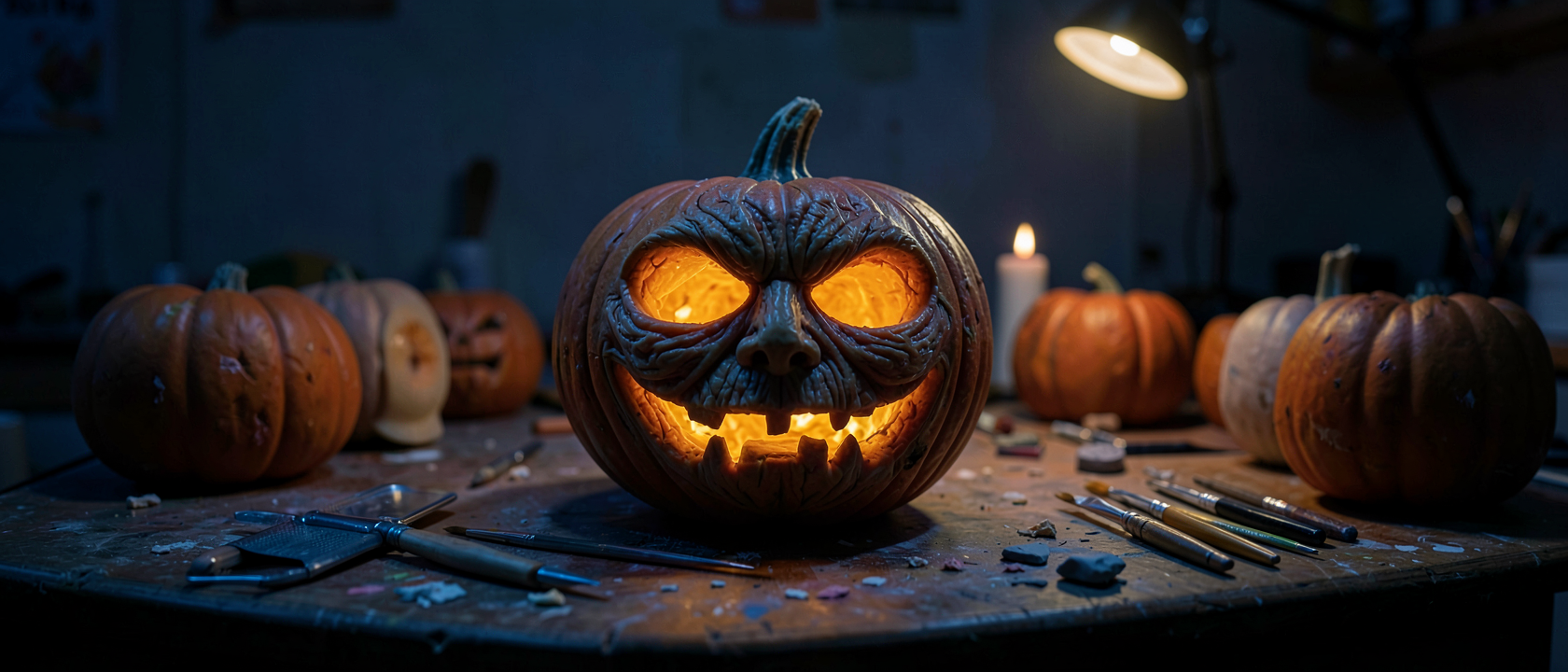
Not Your Doorstep Jack-o’-Lantern
Picture the one on every porch in late October: two triangular eyes, a gap-toothed grin, a tea light guttering inside, a silhouette cut into a vegetable, readable from twenty feet away and not meant to be examined up close.
Jon Neill’s pumpkins are meant to be examined up close. The faces he pulls from them have crow’s feet at the corners of the eyes, individual teeth that cast their own shadows, sagging jowls that catch interior light differently than the brow above. Some figures look world-weary; others have the lurching glee of a carnival barker. What they share is weight and personality, the feeling that the face was already inside the pumpkin and Neill just found it. These are not two points on the same skill curve. They are two different categories of object.
A Medium That Works Against You
A pumpkin’s rind varies in thickness from one patch to the next, so the artist cannot rely on consistency the way a woodcarver relies on grain. Cut too deep and the wall collapses; too shallow and interior light won’t reach the surface. Then there is time: a pumpkin softens the moment the first cut breaks the skin. Neill sources freshly picked pumpkins from farms in Ventura and Moorpark, California, because one that went from soil to studio the same morning holds together noticeably longer than one from a grocery display. Even so, a carving worth several thousand dollars can begin to sag within days, high precision, in a resistant material, against a deadline the artist cannot negotiate.
Relief, Not Removal, The Core Technique
Standard carving works by removal: cut all the way through so light escapes through the hole, producing a glowing silhouette on a dark background. Neill almost never pierces through. He sculpts at varying depths, thin areas glow brighter, thick areas read as shadow. Control the depth and you control the shading; control the shading and the face acquires contour and dimension. It is the same logic a sculptor uses in clay, except the light source is on the inside, finishing the work.
Tools include vegetable peelers, apple corers, and finer implements for detail; he paints with airbrush acrylics and uses plastic domes to give eyes realistic volume. One documented carving, made for a television audition, took more than four hours. He typically carves around 5 to 10 pumpkins per Halloween season, this is not volume work.
A Folk Craft That Grew Up
The jack-o’-lantern is not originally American, and not originally carved from a pumpkin. Irish and Celtic immigrants brought the tradition to North America, where turnips, beets, and potatoes had served the purpose. The word appears in the Oxford English Dictionary as far back as 1660, describing flickering marsh lights, ignited marsh gas. The earliest known image of a carved pumpkin appeared in an 1867 issue of Harper’s Weekly, and the name wasn’t consistently attached to pumpkins until the early 20th century.
Neill started carving as a child, his family growing their own pumpkins. He earned a BFA from the University of Kansas in 1991, moved to Los Angeles, and worked for Stan Winston Studios, whose special-effects work ran across decades of Hollywood productions. That background, professional sculpture, concept illustration, and prop design across more than 50 productions, is what he brings to a vegetable each fall. He won the champion carver title on Season 4 of Food Network’s Halloween Wars and carved Alice Cooper’s portrait on Jimmy Kimmel Live, complete with a working mechanical eyeball.
What “Perishable” Actually Means for Art
The standard objection is lifespan: marble outlasts the civilization that quarried it; a pumpkin is compost within days. But impermanence has a long lineage. Tibetan monks spend weeks on sand mandalas, then sweep them away at a ceremony marking completion. Andy Goldsworthy builds sculptures from ice and leaves that wind or tide takes the same afternoon. The impermanence is not a flaw the work overcomes, it is part of what the work is. For Neill, photography and video become the persistent artifact. The physical carving peaks when first lit and slowly declines from there, leaving behind footage of a face with a moving eyeball carved into a squash for a late-night television audience, which is, genuinely, a strange and specific thing to be very good at.