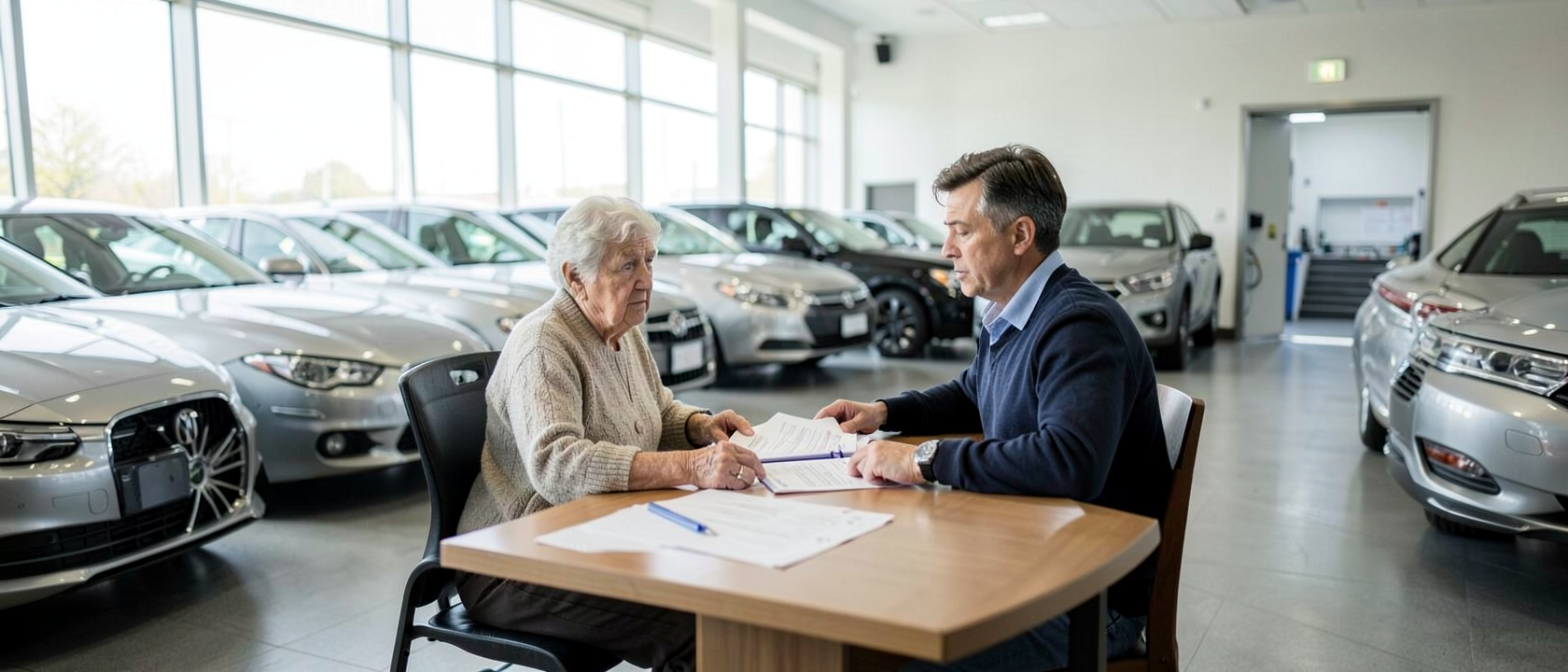
A Routine Oil Change
Audrey McKnight drove her 2006 Hyundai into Holmes Hyundai in Iowa for the kind of appointment that barely registers on a calendar: an oil change. The car had 21,000 miles (33,800 km) on it, she still owed $7,600 on the loan, and her monthly payment was $329. This was supposed to be an errand, not a decision.
Eight hours later, by her account as reported by the Des Moines Register, she walked out having traded that car in for a 2008 Hyundai Azera. Somewhere between the waiting room and the paperwork, a maintenance stop turned into a new loan she says she never planned to take on.
Why a Waiting Room Is a Trap
How does someone end up signing for a car they didn’t intend to buy? The answer has less to do with any one person’s judgment and more to do with the room itself.
A service waiting area is built around dead time. There’s no clock to watch, no obvious exit since your actual car is somewhere in a bay, and you’ve already handed over your keys, a small act of trust in the people around you. Add a few hours of nothing to do, and you get a customer whose guard drops simply because there’s nowhere else to be.
None of this means McKnight was careless. It means the setting was already doing half the work before anyone mentioned a new car.
How the Pitch Escalated
By McKnight’s account, the pressure built in stages, and each stage made the next one easier to accept.
The first move was a low-pressure invitation. A saleswoman allegedly urged her to test-drive the 2008 Hyundai Azera, framed as a no-risk trial she could return the next day if she didn’t like it. It sounded harmless enough. But paperwork changes the math the moment you sign it; walking away suddenly takes more effort than just keeping the car.
While she waited on her own vehicle, a sales manager reportedly pulled her credit without asking permission first. A credit check can look like a formality, barely worth mentioning. Once a number exists showing what she could qualify for, though, something shifts. Backing out no longer feels neutral; it starts to feel like giving up a number she’s already been shown.
Then came the reframe. Staff allegedly suggested she could cover the new payment by dropping her Medicare supplemental insurance. Notice what that move actually does. It takes an expense with nothing to do with financing, her health coverage, and repurposes it as the solution to a problem the dealership had just created minutes earlier.
The Math Behind the Deal
Set the numbers side by side and the jump is plain to see. On the old car: $7,600 owed, $329 a month. On the new one: a reported $26,000 total, with payments climbing past $400 a month.
That’s roughly 3.4 times the debt, taken on for a car only two model years newer. An oil change that should have cost a fluid top-up and an hour of a Saturday reportedly ended as an $18,400 jump in what she owed the bank.
What We Actually Know
This story rests on one source: McKnight’s own account, reported by the Des Moines Register in a piece published December 1, 2009. Holmes Hyundai isn’t on record with a response in that reporting, and no outcome is confirmed, no formal complaint, no investigation, no lawsuit. It’s also not stated whether she kept the Azera or found a way to unwind the deal afterward.
That doesn’t make the account worthless. It makes it a documented consumer complaint rather than a settled fact, worth learning from without treating it as the final word on that dealership specifically.
What This Says About You
The pattern shows up anywhere “free” gets attached to a service: free inspection, free consultation, free trial. That word often marks the entry point of a sales process, not the edge of a favor.
Spotting that isn’t cynicism. It’s a skill. The next time a wait turns into a pitch, you’ll already have the checklist: a trial that requires a signature isn’t risk-free, a credit check run without a clear yes is a lever rather than a formality, and any suggestion to cut an unrelated expense to “afford” something new deserves the question McKnight might wish she’d asked sooner: afford it, or just been talked into it.