The Slice That Cheats You, or Doesn’t
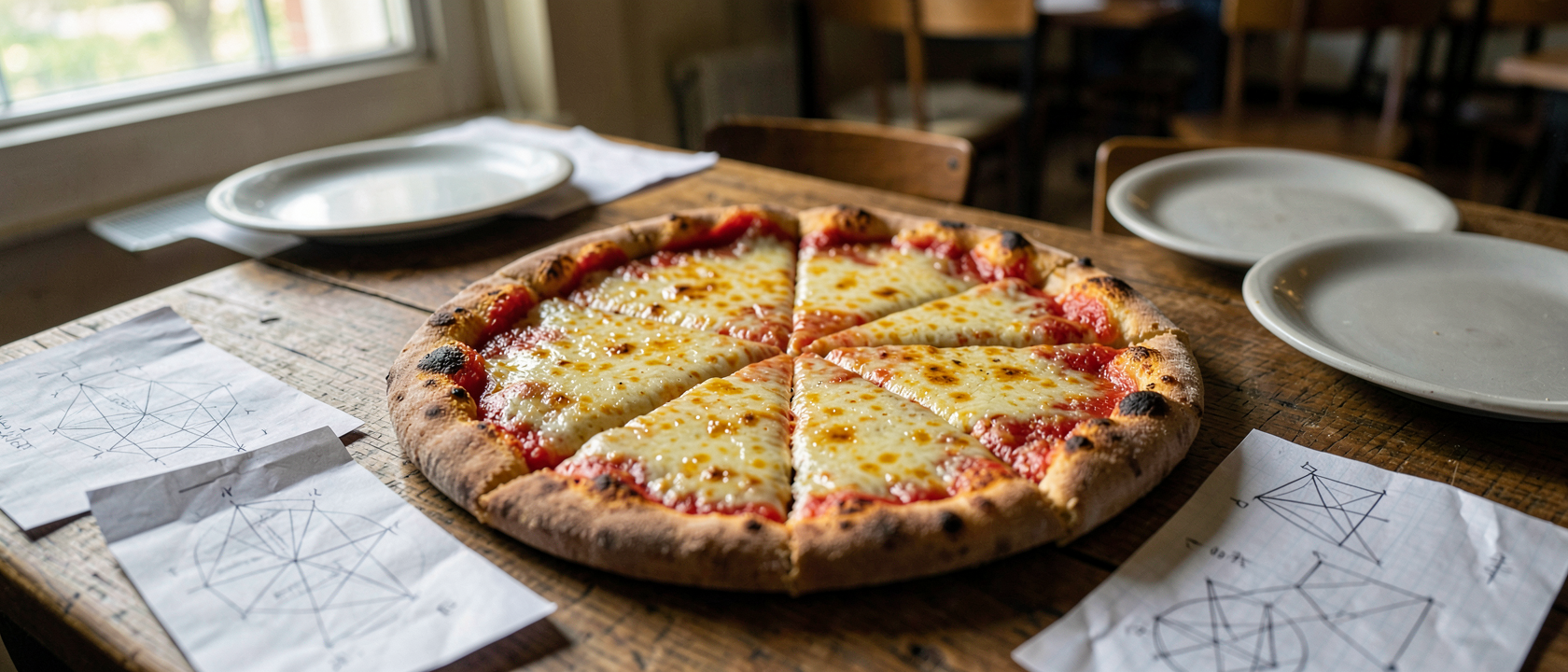
Picture a pizza that wasn’t cut through its true center. Someone makes three straight cuts through a single point set off to one side, spaced evenly, turning the pie into six wedges. Two people split it by taking alternating wedges, three apiece. Whoever ends up with the wedge that contains the pizza’s actual center gets more pizza overall, even though nobody rigged the cuts to help them.
Cut the same lopsided pizza again, this time with five cuts through that same off-center point, and you get ten thinner wedges, five to a person. Now the center-slice eater comes away with less pizza than their friend. Nothing about the pizza changed between the two setups. Only the number of cuts did.
A Problem Nobody Could Finish
This isn’t a lucky dinner-table coincidence. It’s a genuine math puzzle called the pizza theorem, and its hardest version appeared as Problem 1457 in Mathematics Magazine, posed by Larry Carter and Stan Wagon in 1994 (volume 67, issue 4, page 304). Readers were asked to prove two specific claims: that six slices favor whoever gets the center, and that ten slices favor the other person instead.
Mathematicians confirmed the six-slice case fairly quickly, using techniques that were already well known. The ten-slice case was another matter entirely. Everyone suspected the reversal was real, but suspecting a pattern in math and actually proving it are two very different things, and the gap between them held for years.
Years On, One Extra Case
Rick Mabry of Louisiana State University in Shreveport and Paul Deiermann of Southeast Missouri State University kept returning to the ten-slice problem, working it off and on. By some accounts, they first got tangled up in the question over lunch, arguing about the geometry while their own pizza went cold on the table. In 2006, they finally nailed down the proof. It reached print in 2009, in a paper titled “Of Cheese and Crust: A Proof of the Pizza Conjecture and Other Tasty Results,” in The American Mathematical Monthly.
The explanation comes down to a small piece of arithmetic. Divide the number of slices by 8 and look at what’s left over. A remainder of 6 favors the center, which is exactly what happens with six slices. A remainder of 2 favors the other side, which is exactly what happens with ten slices. Those are two separate results about two separate pizzas, not one setup that flips as you add cuts. Slice counts divisible by 4, like 8 or 12, dodge both remainders and split the pizza evenly, with no advantage to either side.
Fairness Isn’t Always Where You Think It Is
The real lesson has nothing to do with pizza. It’s about how a rule that looks solid in one case can turn out to have an exact opposite waiting nearby, once you change how many pieces are on the table. Same off-center point, same style of cut, but six slices and ten slices land on opposite sides of the ledger. Mabry and Deiermann’s proof turned up a related twist too: when a pizza splits unevenly, whoever gets more of the pizza area actually ends up with less of the crust. More filling, less rim, every time the two sides aren’t equal.
That kind of trap shows up wherever a simple rule gets scaled up: dividing land, splitting time, allocating any resource cut into more and more pieces. Something that holds cleanly at one scale can quietly reverse at another, and most people never think to check. Noticing that kind of hidden flip, in pizza or anywhere else, is exactly the sort of thing that separates people who just see the surface from people who see the mechanism underneath.
Enter the Calzone
Once the pizza case was settled, Mabry and Deiermann turned their attention to pizza’s folded cousin, the calzone. Fold a flat disk in half and the geometry changes: every portion’s relationship to the center point shifts with the fold, so the old proof doesn’t simply carry over. The question stayed open for a few years, until mathematician Greg Frederickson worked out a formal “calzone theorem” in 2012, covering a three-dimensional ball sliced by one horizontal cut plus a set of vertical cuts that all meet at a single point: the folded version of the same idea that started with a cooling pizza at a lunch table in Shreveport.