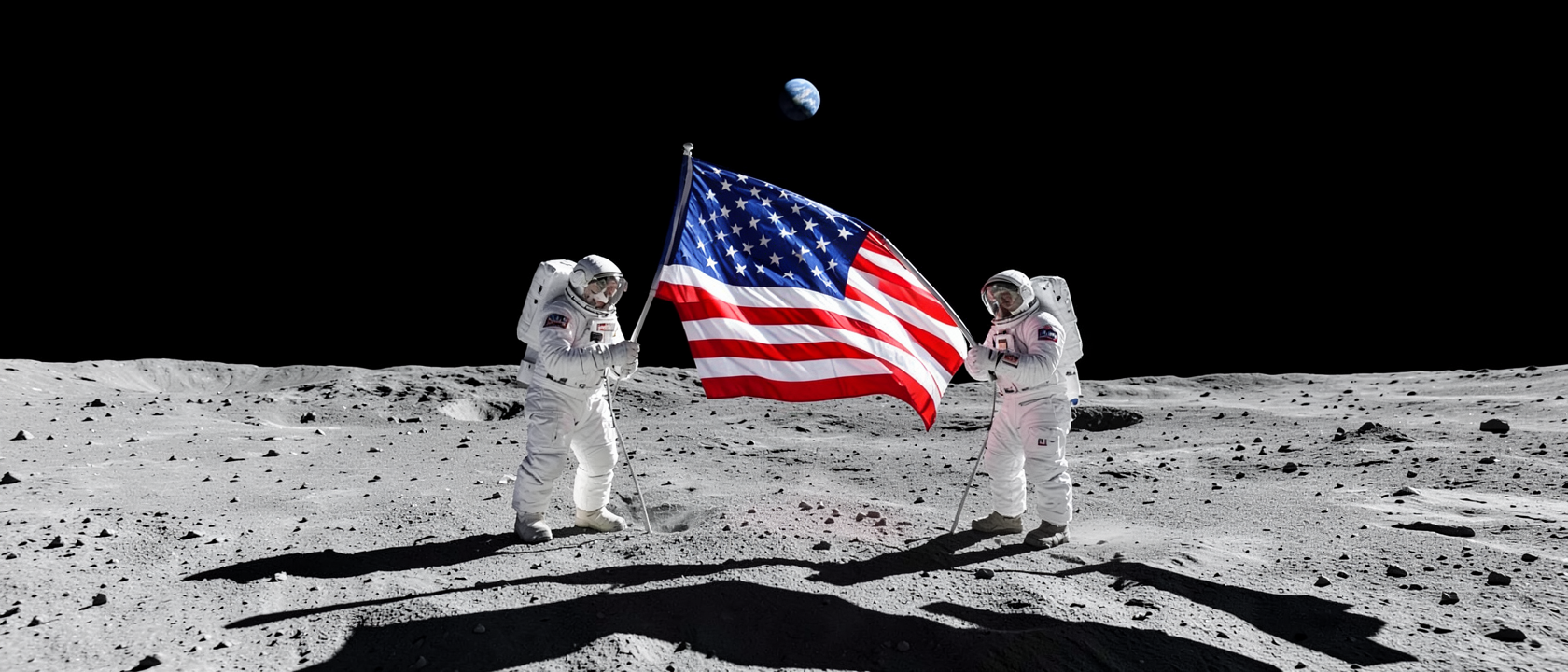
A Symbol With No Script
Everyone knows the photograph: Neil Armstrong and Buzz Aldrin on the Moon on July 20, 1969, standing next to an American flag caught mid-wave. It looks like the most carefully planned image in the history of photography, storyboarded years in advance.
It wasn’t, or at least not the way it looks. Charles Fishman’s book One Giant Leap: The Impossible Mission That Flew Us to the Moon describes the flag as close to being the one item the astronauts almost forgot to bring at all. So what actually happened behind that perfectly composed shot?
How Does This Get Missed?
By early 1969, NASA engineers were still deep in problems of orbital mechanics, life support, and guidance systems, the kind of work where one mistake could kill someone. A flag couldn’t.
That’s the real logic behind the gap. When engineering hours are finite and the stakes are literally life and death, symbolism waits its turn, until someone forces it onto the list.
A Committee Nobody Expected
On February 25, 1969, NASA Administrator Thomas O. Paine created the Committee on Symbolic Activities for the First Lunar Landing, chaired by Associate Deputy Administrator Willis H. Shapley, to decide what gesture would mark the first steps on another world.
The committee consulted outside groups ranging from the Smithsonian Institution to congressional committees. The most common suggestion was straightforward: carry an American flag and plant it on the Moon. That recommendation reached Paine less than five months before Armstrong and Aldrin actually stood on the surface.
Solving a Problem That Shouldn’t Exist on the Moon
Recommending a flag was easy. Making one behave on the Moon was not. A flag “flies” because moving air pushes against the fabric, and the Moon has no atmosphere at all, so a planted flag should simply hang straight down.
Robert Gilruth, director of the Manned Spacecraft Center and a member of the committee, handed the problem to Jack Kinzler, the center’s chief of technical services, nicknamed “Mr. Fix It.” Kinzler remembered his mother hanging curtains when he was a boy, and proposed running a horizontal rod through a hemmed pocket along the flag’s top edge, hinged to a vertical pole driven into the ground. Slide the flag out along that rod, and it holds its shape with no wind at all. He worked out the details over several days with the center’s deputy division chief, Dave McCraw.
Startling Speed
Kinzler sketched the design and brought it to the committee. Actual construction of the flag assembly didn’t begin until roughly three months before the mission. Every ounce sent to the Moon costs fuel, so the finished unit had to stay light: it weighed just 9 pounds (4.1 kg) and packed into an insulated case bolted to the lunar module’s ladder, shielded from engine exhaust that could reach 2,000°F (1,093°C) during landing. A team from Marshall Space Flight Center, led by Kinzler himself, attached the flag and its plaque to the lunar module Eagle the night before launch.
Just an Ordinary Flag
It’s tempting to assume something this historic was custom-built for the trip, woven from some special material to survive a vacuum. It wasn’t. The flag Armstrong and Aldrin planted was a standard nylon flag pulled from warehouse stock, 3 feet by 5 feet (0.91 by 1.52 m), the kind ordered from a government supply catalog. The last flag ever planted on the Moon was slightly bigger, 6 feet (1.8 m) wide, and had spent most of the Apollo program simply hanging in Houston’s Mission Operations Control Room.
What “Perfect” Moments Really Look Like
Apollo 11 is remembered as a triumph of total control. The flag tells a different story: a committee formed five months out, an engineer solving a vacuum problem with a memory of curtain rods, and hardware finished in months rather than years, bolted on the night before launch.
It didn’t even survive the moment cleanly. Aldrin later said he caught a glimpse of it knocked flat by their own ascent engine’s exhaust as they left the surface. Three later flags, from Apollo 12, 16, and 17, appear to still be standing, based on photos from the Lunar Reconnaissance Orbiter. The picture everyone remembers may be the one flag that didn’t make it.