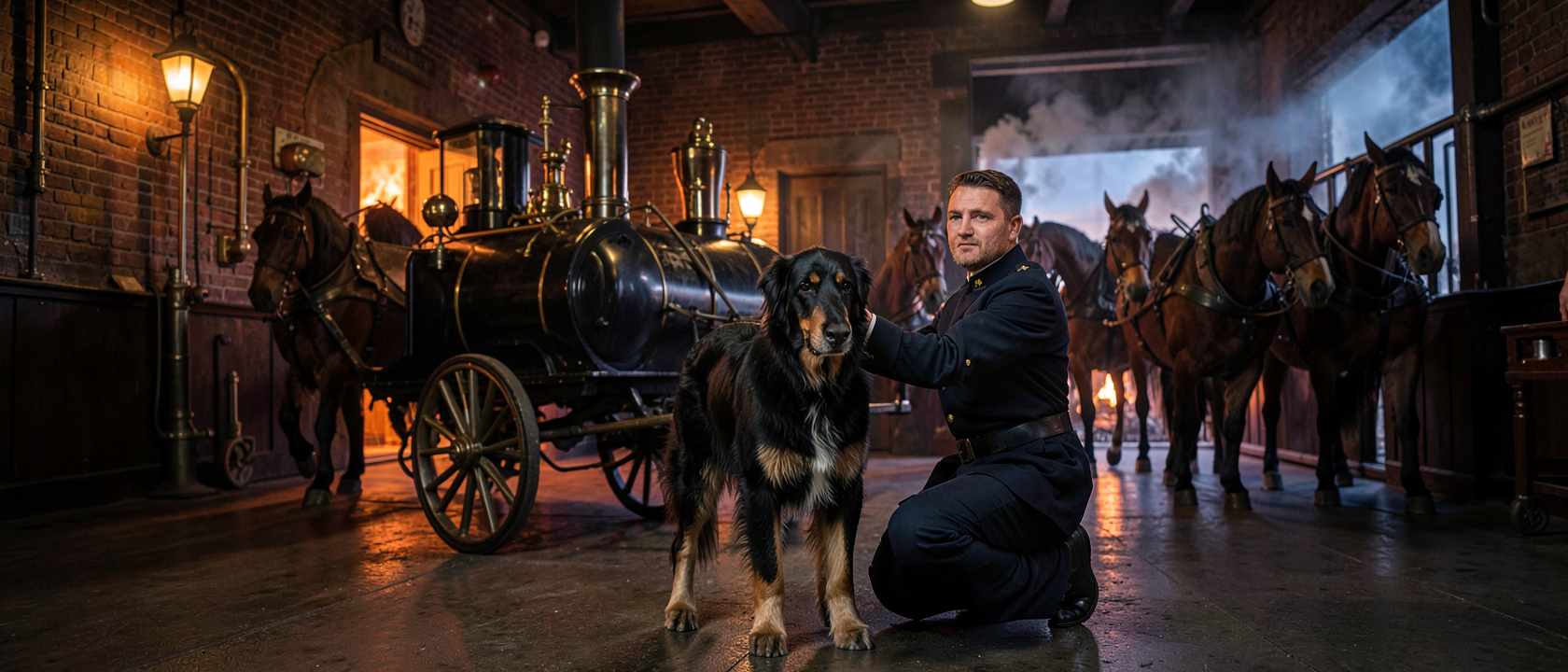
The New Recruit
Picture a New York City firehouse in 1893: brass fittings polished to a shine, horses stamping in their stalls, men waiting for the alarm bell to break the quiet. Into this world walked James MacMurray, a former herdsman from a large New Jersey stock farm who had just joined the New York Fire Department (FDNY). He brought a companion nobody expected: a two-year-old black-and-tan collie named Robert Bruce, trained from puppyhood to herd sheep.
Firehouses of the era often kept a mascot, usually a stray that had simply wandered in and stayed. Robert Bruce was different, he arrived with a job already wired into him, just not one that seemed to have anything to do with fire.
Wrong Animal for the Job?
A sheepdog’s whole skill set is built around one task: watch a flock, notice the instant one animal strays or falters, and react before it becomes a real problem. That means constant scanning, an instinct tuned to catch the one thing out of place in a group of moving bodies.
None of that seemed to apply inside a firehouse, with no pastures or flocks, just horses, smoke, and the racket of a city fire company on the move. Was Robert Bruce just a good-luck charm with four legs, or was there a piece of his training nobody had thought to use yet?
The Wallpaper Factory Fire
In October 1893, fire broke out at the Nevius & Haviland wallpaper factory and spread to the neighboring William Campbell paper factory. By the time the first fire companies arrived, both buildings already had flames bursting through their windows.
Smoke was everywhere. Firefighters, including Pete Tinkum, poured everything they had into the fight while horses tethered nearby endured climbing heat. Somewhere in that noise and confusion, one of the horses near the flames began to collapse from the heat. No fireman driving the engine noticed. No fireman fighting the blaze noticed. The one set of eyes that caught it belonged to the dog.
How a Herding Instinct Becomes a Warning System
Robert Bruce’s assigned spot during a fire was near the engines and horses, out of the tangle of hoses and ladders. That position let him see what the people around him missed, he wasn’t buried in smoke or focused on a hose line, just watching, the way he’d always watched.
When he spotted the horse going down, he raised the alarm the only way he knew how: by jumping up on the nearest firefighters. One after another, they were too locked into the fire to notice a dog pawing at their legs, until he reached Pete Tinkum directly. Tinkum turned, understood, and got the remaining horses clear just before the heat and smoke would have taken them too.
A herding dog is built to keep a constant eye on a group and escalate, again and again, until somebody responds to a member in trouble, exactly the instinct a shepherd counts on with sheep. Robert Bruce hadn’t learned a new trick. He had simply pointed an old one at a different kind of animal.
Not a One-Time Fluke
The wallpaper factory fire wasn’t isolated. Robert Bruce is credited with helping save lives on other occasions during his time with the department, including at least one incident where his sheep-herding instincts were reportedly the deciding factor. Full details of that event weren’t recorded in surviving sources, but the wallpaper factory rescue clearly fit a pattern rather than standing alone, the same watchfulness kept surfacing, fire after fire, in a setting nothing like the pastures it was built for.
The Skill Was Never the Problem
Robert Bruce didn’t have to learn how to be a firehouse hero. He just needed a new flock. Horses tethered near a burning building required the same vigilance a shepherd’s dog gives a herd in a field, and his training mapped onto the new situation almost perfectly.
It’s a useful reminder that a skill often looks useless only because we’re judging it by the one setting we first learned it in. An instinct that seems out of place outside its original job can turn out to be exactly what’s needed somewhere nobody thought to look. Spotting that hidden fit, the moment an old skill quietly solves a new problem, is its own kind of noticing, one most people walk right past.