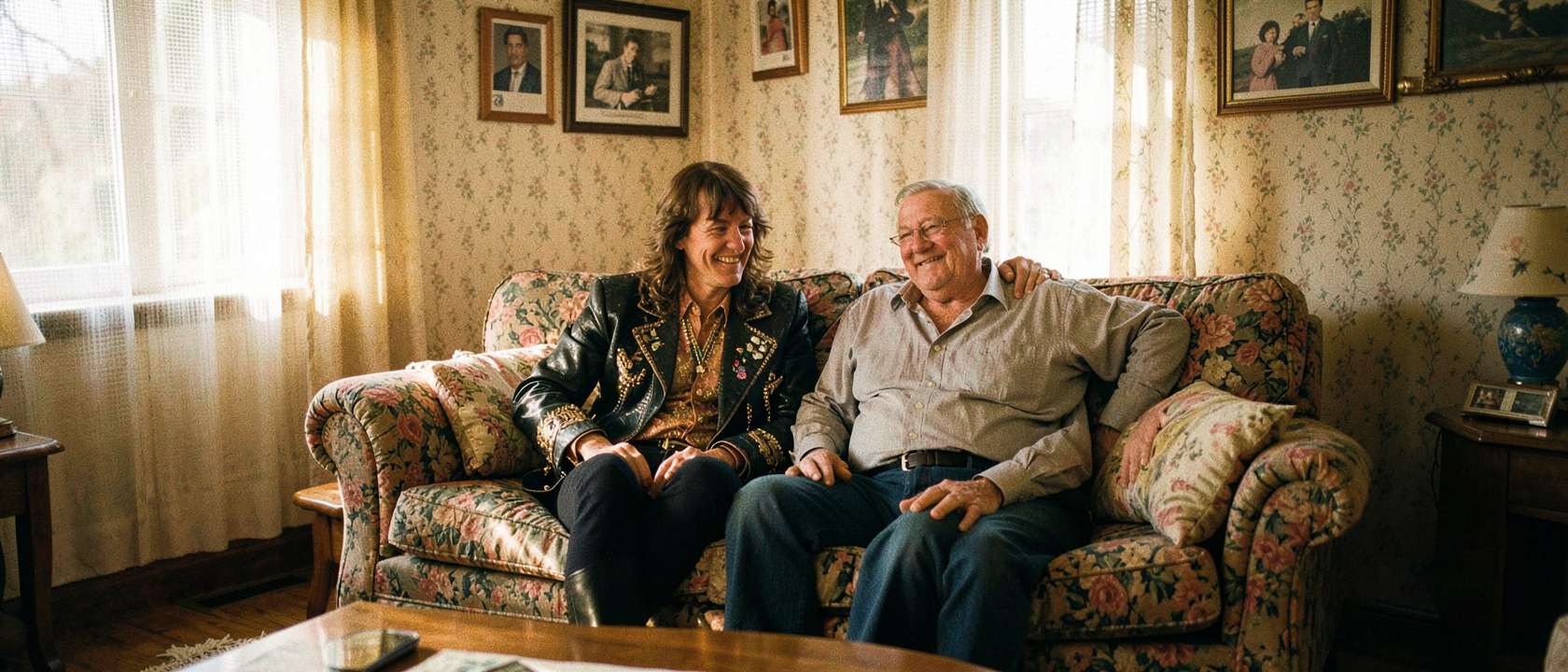
The Wild Men, at Home
Open LIFE Magazine’s September 24, 1971 issue and you’d expect smoke, sweat, and stage lights. Instead, photographer John Olson gives you living rooms. Frank Zappa sits under a lamp in his family’s Los Angeles home, flanked by his mother Rosemarie, his father Francis, and the family cat. Eric Clapton poses beside his grandmother, Rose Clapp, in Surrey, England (Rose had actually raised him, which is why she stands in for a parent). David Crosby sits with his father Floyd, a cinematographer whose credits stretch from the silent film “Tabu” to “High Noon” and the early Vincent Price horror pictures.
None of these men look like the figures on their album covers. They look like sons.
Why Would Anyone Want This Photo?
Olson wasn’t a stranger to chaos. He’d joined LIFE at 21, the youngest staff photographer in the magazine’s history, and by 1968 had already won the Robert Capa Gold Medal for his combat photography in Vietnam, including his coverage of the Battle of Hue. This was someone who knew how to get close to real danger.
So why hand that photographer an assignment to shoot beige sofas and doily-covered end tables? LIFE could have sent him after concerts, tour buses, and hotel-room mayhem, the version of rock stardom readers expected. Instead, the magazine wanted parents’ houses. The obvious question: what does a story gain by taking the wildness out of its own subjects?
The Joke Was the Point
Olson later explained that the contrast wasn’t a misstep. It was the entire concept. The project ran for 15 months and took him from the suburbs of London to Brooklyn to California’s Bay Area. As he put it, “the story on rock stars with their parents was a natural,” and, tellingly, “a number of the same stars I’d found very distasteful and uncooperative were very cooperative around their parents.” Even Zappa, whom Olson had been warned might be difficult, turned out to be “very professional” once his mother and father were in the frame.
You can see why. Sit a countercultural icon on his mom’s floral couch, next to the people who remember him in diapers, and the outlaw pose has nowhere to go. Nobody needs to say the rebellion was partly theater. The room says it for them.
Three Men, Three Reactions
Look at the three most-shared portraits together and you get three small, different stories, though these are readings of a photograph, not quotes from the men themselves.
Zappa looks stiff, almost bracing, in a room sometimes described online as his parents’ “purple den,” a detail that isn’t part of Olson’s documented account, just one that follows the photo around. Still, it’s easy to imagine him uneasy about the decor getting national exposure.
Clapton, next to the grandmother who raised him, looks like a man counting the minutes. One detail from Olson fits the mood: Rose Clapp kept a parrot that had picked up a profanity from the touring duo Bonnie and Delaney, something Rose apparently refused to admit.
Crosby, by contrast, looks unbothered, settled into his father’s house like it never occurred to him to be anywhere else. Maybe it’s two creative people comfortable in the same line of work; maybe he just liked the couch. Either way, he’s the one who looks least like he’s posing.
The Mystery That’s Still a Mystery
Here’s what keeps the story interesting rather than tidy: it’s bigger, and stranger, than the three portraits everyone shares. The same 15-month project also produced Elton John laughing with his mother and stepfather in London, Grace Slick posing very pregnant beside her own mother in Palo Alto, and the Jackson 5, still literally living with their parents, in a shoot controlled enough to land that September 24, 1971 cover.
What’s never explained is how the Zappa, Clapton, and Crosby trio keeps resurfacing online credited, without further explanation, to “Pee-wee Herman.” Nobody clarifies whether that means the comedian, a blog using the name, or something else entirely. One online commenter has also claimed the circulating Zappa photo was digitally altered, an unverified claim with no credible backing. Some stories earn their staying power exactly because nobody has fully closed the file, and noticing that gap is half the fun of finding a photo like this in the first place.